Ordinary Meeting
Meeting Date: Tuesday,
16 December, 2025
Location: Council
Chambers, City Administrative Building, Bridge Road, Nowra
Time: 5.30pm
Membership
(Quorum – 7)
Clr
Patricia White – Mayor
Ward 1 Ward
2 Ward
3
Clr Matthew Norris Clr
Ben Krikstolaitis Clr
Denise Kemp
Clr Peter Wilkins -
Deputy Mayor Clr
Bob Proudfoot Clr
Gillian Boyd
Clr Selena Clancy -
Assist. Deputy Mayor Clr Jemma Tribe Clr
Karlee Dunn
Clr
Brett Steele Clr
Luciano Casmiri Clr
Debbie Killian
Please note: The proceedings of this meeting (including presentations,
deputations and debate) will be webcast, recorded and made available on
Council’s website, under the provisions of the Code of Meeting
Practice. Your attendance at this meeting is taken as consent to the
possibility that your image and/or voice may be recorded and broadcast to the
public.
Shoalhaven City Council live
streams its Ordinary Council Meetings and Extra Ordinary Meetings. These
can be viewed at the following link
https://www.shoalhaven.nsw.gov.au/Council/Meetings/Stream-a-Council-Meeting.
Statement
of Ethical Obligations
The Mayor and Councillors are
reminded that they remain bound by the Oath/Affirmation of Office made at the
start of the council term to undertake their civic duties in the best interests
of the people of Shoalhaven City and to faithfully and impartially carry out
the functions, powers, authorities and discretions vested in them under the
Local Government Act or any other Act, to the best of their skill and
judgement.
The Mayor and Councillors are also reminded of the
requirement for disclosure of conflicts of interest in relation to items listed
for consideration on the Agenda or which are considered at this meeting in
accordance with the Code of Conduct and Code of Meeting Practice.
Agenda
1. Acknowledgement
of Country
Walawaani (welcome),
Shoalhaven City Council recognises the First Peoples
of the Shoalhaven and their ongoing connection to culture and country. We
acknowledge Aboriginal people as the Traditional Owners, Custodians and Lore
Keepers of the world’s oldest living culture and pay respects to their
Elders past, present and emerging.
Walawaani njindiwan (safe journey to you all)
Disclaimer: Shoalhaven City Council acknowledges and
understands there are many diverse languages spoken within the Shoalhaven and
many different opinions.
2. Moment of
Silence and Reflection
3. Australian
National Anthem
4. Apologies /
Leave of Absence
5. Confirmation
of Audio-Visual Attendance
6. Confirmation
of Minutes
· Ordinary
Meeting - 9 December 2025
7. Declaration
of Interests
8. Presentation of Petitions
9. Mayoral Minute
10. Deputations and Presentations
11. Notices of Motion / Questions on Notice
Notices of Motion / Questions on Notice
CL25.417..... Question on Notice - Banksia Street Road Reserve...................................... 1
12. Call Over of the
Business Paper
13. A Committee of the
Whole (if necessary)
14. Committee Reports
Nil
15. Reports
CEO
CL25.418..... Proposal to Reform Community Consultative Bodies
(CCB) Model of Engagement........................................................................................................................ 3
City Performance
CL25.419..... Outcomes of Public Exhibition - Draft Code of
Meeting Practice and Draft Public Forum Policy................................................................................................... 9
CL25.420..... Determination of Date and Time of Ordinary
Council Meetings.................. 16
CL25.421..... Ongoing Register for Pecuniary Interest Returns -
November 2025........... 21
CL25.422..... Investment Report - November 2025........................................................... 23
CL25.423..... Investment Policy......................................................................................... 29
CL25.424..... Tender Exemption - Proposed Investment in Payment
Platform - Paybles 40
City Services
CL25.425..... Review of Comerong Island Ferry Fees and Charges................................ 42
CL25.426..... Policy Review - Occupation of Council Owned or
Managed Land (POL25/49) 52
CL25.427..... Shoalhaven Coastal Management Programs
Implementation and Resourcing 67
City Development
CL25.413..... Development Application DA2024/1589 - 737
Woollamia Road WOOLLAMIA - Lot 12 DP 9289........................................................................................................ 70
Shoalhaven Water
CL25.428..... Tenders - Culburra STP Upgrades.............................................................. 86
CL25.429..... Connection to Town Sewerage System - 99B Garrads
Lane Milton........... 89
CL25.430..... Review of Waste Services Policies.............................................................. 93
16. Confidential Reports
Reports
CCL25.31.... Tender Exemption - Proposed investment in Payment
Platform - Paybles
Local Government Act - Section 10A(2)(d)(i) - Commercial
information of a confidential nature that would, if disclosed prejudice the
commercial position of the person who supplied it.
There is a public interest
consideration against disclosure of information as disclosure of the
information could reasonably be expected to reveal commercial-in-confidence
provisions of a contract, diminish the competitive commercial value of any
information to any person and/or prejudice any person’s legitimate
business, commercial, professional or financial interests.
CCL25.32.... Tenders - Culburra STP Upgrades
Local Government Act - Section 10A(2)(d)(i) - Commercial
information of a confidential nature that would, if disclosed prejudice the
commercial position of the person who supplied it.
There is a public interest
consideration against disclosure of information as disclosure of the
information could reasonably be expected to reveal commercial-in-confidence
provisions of a contract, diminish the competitive commercial value of any
information to any person and/or prejudice any person’s legitimate
business, commercial, professional or financial interests.
|
|
Ordinary Meeting – Tuesday
16 December 2025
Page
0
|
CL25.417 Question
on Notice - Banksia Street Road Reserve
HPERM Ref: D25/571548
Submitted
by: Clr Jemma Tribe
Question
Information has been recovered
through a GIPA release process regarding the Banksia Street Road reserve.
Emails obtained reveal that several internal staff were recommending that the
proposed closure NOT go ahead for reasons that were outlined in detail through
multiple pieces of correspondence. Those concerns relate to the current
reliance on this parcel of land for drainage of water (a drainage easement at
the southern boundary of the block with a new stormwater outlet through the
dunes onto Collingwood beach was not considered an appropriate solution by the
author of the email who was concerned about the erosion issues this may cause).
Concerns raised by other staff members include the relocation of the pole
mounted transformer, the cost of relocating underground utilities
(investigation, design and action), as well as the unknown of where these
services could be relocated to that would also have the necessary easements and
the list goes on. Could Councillors please find out how the final recommendation
came about, (which was to instead support the sale of this block) and provide
reasons as to why.
Response
Information obtained through a GIPA release indicates that
internal staff raised concerns regarding the proposed closure and sale of the
Banksia Street Road Reserve.
The correspondence received was part of Council’s
standard internal referral process for land dealings, where specialist staff
across departments are invited to provide comments. The purpose of this
consultation is to identify potential issues so they can be addressed through
engineered solutions or other measures.
In the case of the Banksia Street Road closure, the feedback
received was practical and informative, enabling the Property team to develop
solutions or seek further information. Concerns raised included drainage and
erosion risks, relocation of electrical infrastructure, and costs associated
with underground utility relocation. All these matters were considered and
addressed as part of a due diligence approach during the assessment and
preparation process.
In summary the recommendation to support the sale of the block
was made following a comprehensive assessment of all relevant factors,
including, those raised via internal referrals:
1. Stormwater
Drainage
o The parcel was identified as surplus
to Council’s operational requirements and not required for future road
purposes.
o Alternative drainage solutions were
considered and a feasible design developed consistent with engineering
standards, and subject to appropriate design and environmental controls.
o The Stormwater solution includes
construction of a new underground stormwater connection to the western of
Elizabeth Drive to integrate with existing stormwater infrastructure.
o While concerns were raised about
erosion risks associated with a stormwater outlet through the dune’s,
further engineering design has eliminated this risk.
2. Infrastructure and
Utility Relocation
o The unformed road reserve proposed
for closure contains overhead powerlines and a pole-mounted substation.
o To protect this infrastructure,
Endeavour Energy has requested the creation of a 9-metre-wide easement to
contain the established overhead power infrastructure.
o It is proposed to establish a
9-meter-wide easement to satisfy this requirement.
o Relocation of the pole-mounted
transformer and relocating power underground is not required by Endeavour
Energy and therefore no associated costs will be incurred.
3. Consultation and
Decision-Making Process
o Internal feedback was considered
during the assessment process and whilst the initial feedback identified
matters needing resolution, cost effective solutions have been identified.
o The final recommendation reflects a
balance between operational concerns, strategic land management objectives, and
financial considerations.
Summary
The decision to support the sale was based on strategic
alignment with Council’s land management objectives, feasibility of
addressing drainage and infrastructure concerns, and the opportunity to deliver
financial and operational benefits to the community. The processes noted are
standard internal practices.
|
|
Ordinary Meeting – Tuesday
16 December 2025
Page
0
|
CL25.418 Proposal
to Reform Community Consultative Bodies (CCB) Model of Engagement
HPERM Ref: D25/569158
Department: Communication
& Community Engagement
Approver: Andrew
Constance, Chief Executive Officer
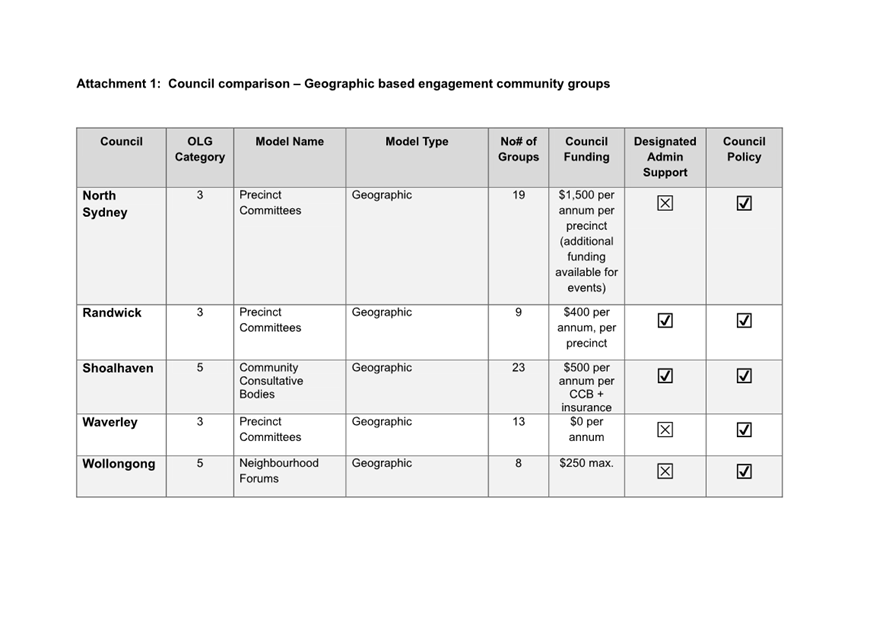
Attachments: 1. Place
Based Councils Comparison Table ⇩
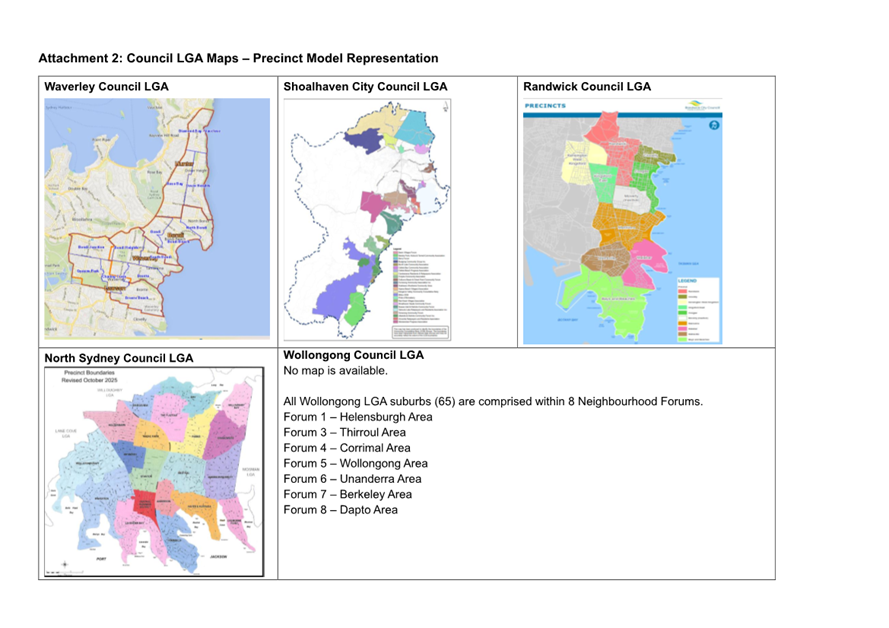
2. Comparison Councils Precinct
Models Map ⇩
Purpose:
The purpose of this report is to seek Council’s
endorsement to reform the Community Consultative Bodies (CCB) model of
engagement.
|
Recommendation
That
Council:
1. Formally discontinue the Community
Consultative Bodies model of engagement in its current form, from 1 July
2026.
2. Thank all current Community
Consultative Bodies for their contributions to community dialogue and
undertake community consultation in February-March 2026 to discuss options to
become independently incorporated bodies.
3. Provide administrative and financial
support to assist any Community Consultative Bodies to become an incorporated
community group before 1 July 2026, and enable them as independent bodies, be
it Ratepayers Associations, Community Forums, Progress Associations, to:
a. consult properly with all tiers of
government,
b. apply for grants for potentially up
to 100%,
c. no
longer be beholden to Council rules.
|
Background
The Community Consultative
Bodies (CCB) model was established in 1991 to provide a structured mechanism
for community groups to engage with Council on local issues. For many years,
these resident groups provided an important conduit between community and
Council.
Currently, there are 23 resident
groups that are endorsed by Council as a CCB and perform engagement functions
as the representative group for residents and ratepayers within a defined
geographical area. As a CCB, they are required to disperse information, promote
and facilitate discussion and communicate shared and collective views of the
community to Council.
Under the CCB model, each
community group independently develops and manages its own terms of reference,
constitution, and membership. Variations in structure and representation can
limit the effectiveness of the CCB engagement model, as they may not always
fully reflect the diversity of the communities they are intended to represent.
While the model has served its
purpose in the past, reviews and recent community feedback have highlighted
significant limitations in its effectiveness, inclusivity and alignment with
best-practice engagement methods and principles, as those outlined by the
International Association of Public Participation (IAP2) and the NSW Office of
Local Government.
While all community groups are a
valuable way to share information with communities, the ongoing evolution of
communication tools and techniques has enabled Council to directly reach and
engage with residents of all ages, abilities and interests.
Safe Work considerations
Council currently has two NSW Safe Work orders requiring that
it make changes to improve the safety of its elected officials. The existing
model does not fully support Council’s obligations under NSW Safe Work
psychosocial safety requirements, particularly in circumstances where elected
officials and staff may experience challenging or unsafe interactions.
Current engagement methods
The Shoalhaven City Council
Community Engagement Strategy and Framework 2025-29 details a contemporary
engagement model that applies principles to facilitate authentic, transparent
and inclusive consultation.
Council’s engagement
framework is based on the International Association of Public Participation
(IAP2) model to determine the level and method of engagement.
To be effective, engagement with
stakeholders needs to occur at the most opportune time in the planning process
to influence decisions of Council. This occurs with the community through the
development of the Council’s highest order of planning document, the
Community Strategic Plan, the annual Delivery Program and Operational Plan as
well as through specific consultation opportunities for projects and
initiatives that are held throughout each year. This year alone, Council
conducted 21 community engagement projects,
including for the development of the Community Infrastructure Strategic Plan,
the Disability Inclusion and Access Plan and many small-scale projects such as
parks and playgrounds.
To promote engagement and reach
target audiences for consultation, Council distributes information to a range
of community contact networks, including those endorsed as CCBs.
Alternative Engagement Models
To achieve the highest level of
engagement (Collaborate or Empower), community reference groups of
stakeholders, such as steering groups, advisory committees and citizen panels
are some of the most impactful ways people can partner with Council to influence
decision making and help shape their lifestyles.
Benchmarking
A desktop review conducted on
128 councils in NSW found that four councils (North Sydney, Randwick, Waverly
and Wollongong) recognised community facilitated groups as formal engagement
committees. Each council provides varying levels of financial, governance and
administrative support to a different number of groups under their respective
models (Attachment 1).
By comparison, Shoalhaven
endorses the highest number of community organisations representing
significantly less of the towns, suburbs and geographical area of the LGA than
others (Attachment 2).
To examine possible alternatives
to the CCB model, community engagement protocols of 11 councils have been
reviewed including OLG Category 5 councils (Coffs Harbour, Maitland, Mid-Coast,
Port Macquarie-Hastings, Port Stephens, Shellharbour, Tweed and Wollongong),
and neighbouring councils (Kiama, Bega and Eurobodalla).
Two main structural approaches emerged that are designed to
achieve the highest levels of engagement:
· Project-specific
groups: Established for the duration of a project or initiative. These can
be established as community reference groups or working groups for major
infrastructure or social planning projects. A recent example of this includes
the Nowra Riverfront Precinct Working Group for the development of the
riverfront master plan, as well as the longstanding inter-government agency
Nowra Riverfront Action Taskforce.
· Thematic
advisory committees: Long term established to focus on specific policy
areas of social, environmental and/or infrastructure. Current examples of this
at includes the Floodplain Risk Management Committees, Aboriginal Advisory
Committee, Youth Advisory Committee and the Inclusion and Access Committee.
Currently, Council
maintains 13 committees that address a range of projects and initiatives
including affordable housing, transport, finances, land use planning and
development.
Next steps
In February and March 2026,
Council staff will consult with the CCBs about the reform and determine the
most appropriate methods to continue to engage with each as individual
community groups.
Information will be provided
about the process to becoming an incorporated group that would facilitate
independence and access to external funding opportunities for projects and
initiatives. Staff will provide support to assist with transitioning to an incorporated
body before 1 July 2026.
Risk Implications
The reform of the CCB engagement
model presents minimal risks to people, the environment, Council’s
finances, or systems.
Internal Consultations
Organisational staff have been
consulted, with no negative feedback provided.
External Consultations
Other Councils have been contacted for information.
Community Consultations
The CEO announced that we would
undertake a process to reform the CCB model at the CCB Executive meeting on 1
December 2025 and no comments were received at that time. Further engagement
with the CCBs would be conducted in February – March 2026.
Policy and Statutory Implications
There are no policy
implications.
Financial Implications
Council currently provides each
CCB with $500 per year for administrative purposes. In the 2025–26
financial year, this totalled $11,500. Additionally, insurance costs for
2025–26 was $14,825.45, and is projected to increase to between $16,500
and $17,000 in 2026–27.
Application fees (up to $500)
for any CCB wanting to become an incorporated body by 1 July 2026 would be paid
for by Council from the existing 2025-26 budget.
In 2026-27, it is anticipated a total savings of
approximately $28,000 to $28,500, which would be ongoing.
|
|
Ordinary Meeting – Tuesday
16 December 2025
Page
0
|
|
|
Ordinary Meeting – Tuesday
16 December 2025
Page
0
|
|
|
Ordinary Meeting – Tuesday
16 December 2025
Page
0
|
CL25.419 Outcomes
of Public Exhibition - Draft Code of Meeting Practice and Draft Public Forum
Policy
HPERM Ref: D25/569630
Department: Business
Assurance & Risk
Approver: Katie
Buckman, Director - City Performance
Attachments: 1. Draft
Code of Meeting Practice (under separate cover) ⇨
2. Draft Public Forum Policy
(under separate cover) ⇨
Purpose:
To report on the outcomes of the
public exhibition of the Draft Code of Meeting Practice and Draft Public Forum
Policy, summarise submissions received and outline recommended changes.
|
Recommendation
That
Council:
1. Adopt the Draft Code of Meeting
Practice (Attachment 1) as exhibited, noting that no changes are
recommended following public exhibition.
2. Adopt the Draft Public Forum Policy
(Attachment 2) subject to the following amendments proposed following
consideration of public submissions outlined in this report:
a. Amend clause 4.2(g) to provide as follows:
1.
“Applications to speak at the
Public forum must be received by 9.30am on the day of the Public
Forum.”
b. Insert additional sentence in clause
4.2(h):
2.
“Applicants requesting to make an
oral submission must provide a written summary (max. one page) of their
intended address when lodging their application. This summary will be
distributed to all Councillors prior to the related Council meeting.”
c. Insert additional sentence in clause
4.2(j)
“The
Chief Executive Officer or their delegate must give reasons in writing for a
decision to refuse an application.”
d. Include an additional clause under section
4.2 – Implementation
3.
“Approved speakers who require
assistance due to disability or additional needs may nominate a support
person to assist or continue their presentation if necessary. The total
speaking time must not exceed the five (5) minutes allocated for submission.”
3. That the Council’s newly
adopted Code of Meeting Practice and Public Forum Policy become effective on
1 January 2026 to align with the requirements of the Model Code.
4. Publish the adopted Code of Meeting
Practice and Public Forum Policy on Council’s website, together with
information explaining the new processes and application forms relating to
Public Forums.
|
Background
Following the release of the
Model Code of Meeting Practice by the Office of Local Government, in August
this year, a report was provided to the Ordinary Meeting of Council on 28
October 2025. The Council resolved to place the Draft Code of Meeting
Practice and Draft Public Forum Policy on public exhibition in accordance with
section 361 of the Local Government Act 1993.
The exhibition period ran from
31 October to 12 December 2025, providing the community with an opportunity to
review and comment on the proposed documents.
As previously outlined to
Councillors in briefings and reports, the exhibited Draft Code incorporates all
mandatory provisions of the Model Code, including rules for councillor
attendance, order of business, voting, and conduct during meetings. These
provisions are legally required and cannot be altered by Council.
The Draft Public Forum Policy
outlines a structured process for oral and written submissions prior to Council
meetings, aiming to enhance transparency and community engagement while
maintaining orderly and lawful decision-making.
Public Forums are intended to be
separate from formal Council meetings, consistent with the Model Code and
Office of Local Government guidance. This separation ensures that forums
provide an opportunity for community input without forming part of the decision-making
process. The draft policy also includes measures to manage time, maintain
equity among speakers, and uphold respectful conduct in a forum structure,
The agenda for the Council
meeting is scheduled for publication on 11 December 2025 to allow sufficient
time for Councillors and the public to review. As the exhibition period closes
on 12 December, this report contains all submissions received by Council up to
5 December and it is intended that an addendum report will be prepared and
published on 15 December 2025 to address any submissions that may be received
after the agenda is approved and before the close of exhibition. If no
further submissions are received during this period, an addendum report will
not be provided to supplement this report.
Summary of Submissions
Council has received eight (8)
individual submissions during the exhibition period. Key issues raised
included requests for greater accessibility, independent facilitation, expanded
speaking rights, and changes to procedural timeframes. Each submission was
assessed against legislative requirements, operational feasibility, and
Council’s commitment to transparency and inclusivity. Where concerns
related to mandatory provisions of the Model Code (e.g., councillor attendance
via audio-visual link), Council is legally unable to make changes. Recommended
amendments to the Draft Public Forum Policy following consideration of the
submissions include:
· Extending the
application deadline to 9:30 am on the day of the Public Forum.
· Requiring
oral submission applicants to provide a written summary of their intended oral
address.
· Allowing a
nominated support person for speakers with disability or additional needs.
· Requiring
written reasons for any refusal of an application.
These changes aim to balance
accessibility and fairness with operational efficiency and compliance with
statutory requirements.
Summary
Table
|
Document
|
Key Issues Raised
|
Staff Consideration
|
|
Draft Public Forum Policy
|
1. Require
written reasons for all discretionary decisions by the CEO, circulated to
councillors and made public.
2. Record
refusals and speaker limitations in Council minutes.
3. Introduce
a right of review for refused applications.
4. Expand
speaker limits and improve accessibility.
5. Use
independent facilitation for public forums.
|
1. Council
currently provides written reasons for refusal of an application.
Recommendation: Amend clause 4.2(j) of the Draft Public Forum Policy to reflect
this practice.
2. The Public
Forum is conducted prior to a Council meeting and is not minuted as part of
the formal meeting proceedings. The Office of Local Government has confirmed
the intent is that the forum remains distinct from the decision-making
process of the Council meeting.
No action recommended.
3. Refusals
are based on procedural grounds only (e.g., breach of policy conditions,
exceeding speaker limits), not on political or personal views. Applicants who
cannot speak may submit a written submission instead.
Introducing a review process would also create
operational delays and administrative complexity given the application
deadline and scheduling of Public Forums.
No action recommended.
4. The Draft
Public Forum Policy provides for speakers to be granted an extension of time
at the discretion of the Chairperson.
Clause 4.2(g) of the Draft Public Forum Policy
proposes that applications to speak must be received by 3pm on the day prior
to the Public Forum.
Recommendation: Improve accessibility by amending clause 4.2(g) of
the Draft Public Forum Policy to provide that applications to speak at the
Public Forum must be received by 9.30am on the day of the
Public Forum.
5. The Model Code gives councils
discretion to set rules for public forums. The draft policy proposes that
Public Forums be chaired by the Mayor or a nominated Councillor to ensure
consistency with the Model Code of Meeting Practice, accountability to
the elected Council. Independent facilitation would add cost and complexity
without improving transparency, which is already supported through
livestreaming.
No
action recommended.
|
|
Draft Code of Meeting
Practice
|
Support for the draft Code – fostering a
respectful and lawful decision-making environment in council meetings.
|
Comment
noted – reinforces objectives of the Model and draft Code.
No action recommended.
|
|
Draft Public Forum
Policy
|
Concerned that public
forums may create pressure for decisions to reflect popular opinion expressed
by vocal groups rather than strategic planning and statutory obligations.
|
Public forums are for requests to address agenda items only and do not
replace representative decision-making.
Written submissions remain available as an alternative as provided in
the Draft Public Forum Policy.
No action recommended.
|
|
Draft Code of Meeting
Practice/Draft Public Forum Policy
|
1. Emphasised
the need for respectful conduct during Council meetings and public forums,
ensuring community members feel safe and valued when making address to the
forum.
2. Suggested
providing questions in advance so as not to ‘blindside’ speakers.
|
1. Comment
noted – reinforces objectives of the Model and draft Code.
No action recommended.
2. Operationally,
very difficult to implement. The turnaround time between receiving requests
to address, distributing them to councillors, and then getting questions back
to speakers before the meeting is extremely tight (and in many cases
impossible), especially when applications close quite close to the meeting
date. It should also be noted that there is nothing to prevent
Councillors asking questions of the speaker on the floor of council as they
arise.
In addition, to achieve
this the submitter would be required to provide all the information they wish
to address in advance of the meeting for Councillors to consider.
No action recommended.
|
|
Draft Code of Meeting
Practice
|
Three submissions were received in regard to:
Objection to
restrictions on councillor attendance via audio-visual link, believing
councillors should be able to join meeting online without needing a reason or
Council approval, and further, this could potentially disenfranchise remote
and disadvantaged populations in particular.
|
Clauses 5.18 –
5.27 reflect mandatory provisions of the Model Code in regard to councillor
attendance via audio-visual link. Council is required to comply with
all mandatory provisions and cannot alter these clauses.
No action recommended
|
|
Draft Code of Meeting
Practice
|
Clause 17.10
(non-mandatory)
Contention that only
allowing notices of motion to alter or rescind a resolution relating to a
development application to be lodged within one (1) day of the meeting is too
restrictive and suggests extending it to three (3) business days to allow
adequate time to gather facts and prepare a case.
|
Council reports and
submissions are intended to provide Councillors with relevant facts for
decision making. Councillors may seek deferral of decision making if they are
unsure or seek other information before deciding. Extending the timeframe to
three (3) business days may complicate processes from a statutory aspect and
create lack of community understanding about when a decision is considered
finial.
For Council’s
consideration.
|
|
Draft Public Forum
Policy
|
Concern that the
proposed quorum of one Councillor and separation of Public forums from
Ordinary/Extraordinary meetings reduces opportunities for all Councillors to
hear from the public and ask questions, placing greater reliance on staff
reports and increasing time demands on Councillors.
|
Public Forums will
remain separate from Council meetings in accordance with the Model Code of
Meeting Practice, they also will be webcast and therefore available to be
viewed by any Councillor who is unable to join the forum at the advertised
time. Requiring a quorum of greater than one Councillor (to chair) may result
in cancelled forums where speakers have lost the opportunity to put
information before the Council as there would be no provision for the
rescheduling of Ordinary Meetings on the basis that a forum did not proceed.
A written summary of
verbal address at the forum, as well as written submissions, ensure that all
Councillors are informed of community views when considering agenda items.
To support information
being available to Councillors, the draft policy could be amended to require
applicants making oral submissions to provide a written summary of their
intended address when lodging their application. This ensures all Councillors
have access to key points prior to the related Council meeting, even if they
cannot attend the Public Forum.
Recommendation: Amend clause 4.2(h) of the Draft Public Forum Policy
to add the following:
Applicants requesting
to make an oral submission must provide a written summary (max. one page) of
their intended address when lodging their application. This summary
will be distributed to all Councillors prior to the related Council meeting.
|
|
Draft Public Forum
Policy
|
Submission suggests
revising clause 4.2(b), which limits speakers to one ‘for’ and
one ‘against’ each item, to allow flexibility for speakers who
may require assistance due to disability or additional needs. The submitter
proposes an option for a backup speaker to ‘tap in’ mid-speech to
support inclusivity.
|
Allowing a nominated
support person has been Council practice for some time. It promotes
accessibility and participation for people with additional needs without
compromising the draft Policy’s intent to manage time and maintain
equity among speakers. Council may wish to consider implementing an
additional clause under 4.2 – Implementation to cement this practice.
Recommendation:
“Approved
speakers who require assistance due to disability or additional needs may
nominate a support person to assist or continue their presentation if
necessary. The total speaking time must not exceed the five (5) minutes
allocated for submission.”
The Council practice has
traditionally been to hear one deputation for and against each item.
Council’s engagement policy allows and facilitates community
consultation on complex issues or matters of significant impact on the
Shoalhaven before a Council Report is provided for decision. The community is
encouraged to participate at earlier stages of consultation where available.
However, Council may consider amending the number of speakers in a forum
setting.
For Council’s
consideration.
|
Classification of provisions
contained in the draft Code of Meeting Practice
The classification has been
retained from the previous report to Council on 28 October 2025, where the
draft Code of Meeting Practice [Attachment 1] was attached prior to public
exhibition.
|
Colour
|
Meaning
|
|
Black
|
Mandatory provisions from the Model Code (including
council set parameters such as timeframes, marked in “bold”
font)
|
|
Red
|
Non-mandatory provisions from the Model Code
|
|
Blue
|
Council’s current non-mandatory provisions that it
wishes to retain (including any proposed amendments marked in “bold”
font)
|
|
Green
|
New non-mandatory provisions proposed to be introduced by
Council to support the implementation of mandatory provisions in the Model
Code
|
Risk Implications
Reputational risk: Failure to
provide clear and transparent processes for public participation could
undermine community trust and confidence in Council’s
decision-making. Recommended amendments such as requiring written
summaries of oral submissions and allowing support persons for speakers with
additional needs can mitigate this risk by improving accessibility and
transparency.
Corporate Governance risk:
Non-compliance with mandatory provisions of the Model Code of Meeting Practice
or the Local Government Act 1993 could expose Council to legal
challenge. The Draft Code incorporates all mandatory provisions, and
recommended changes to the Draft Public Forum Policy remain consistent with
legislative requirements.
Corporate Governance risk:
Public Forums involve interaction between community members, Councillors, and
staff. Clear behavioural standards, livestreaming, and informed
safety/risk assessments reduce the risk of inappropriate conduct and ensure a safe
environment for participants.
Internal Consultations
Internal consultation with the
Executive Leadership Team and at Councillor briefing, both which occurred prior
to the previous report to Council on 28 October 2025. The Governance team
has now reviewed the submissions lodged during the exhibition period, and a
summary and recommendations are provided in this report.
External Consultations
The OLG released the 2025 Model Code of Meeting Practice via
Circular No 25-20 on 29 August 2025, following extensive sector-wide
consultation. Council staff participated in engagement sessions held by
the Office of Local Government.
Community Consultations
In accordance with Section 361 of the Local Government Act
1993, Council publicly exhibited the Draft Code, inviting community
submissions prior to adoption.
Policy and Statutory Implications
The recommendations comply with Sections 360 and 361 of the Local
Government Act 1993, ensuring the Draft Code of Meeting Practice
incorporates all mandatory provisions and was publicly exhibited.
Proposed amendments to the Draft
Public Forum Policy are lawful, align with the Office of Local Government
guidance, and do not conflict with existing policies. Adoption of these
documents strengthens Council’s commitment to transparency, accessibility,
and good governance.
Financial Implications
Adoption of the Draft Code of
Meeting Practice and Draft Public Forum Policy will have negligible financial
impact. Minor administrative costs that may be associated with
implementing recommended changes, such as processing written summaries, supporting
speakers with additional needs, could be absorbed within existing
budgets. No additional funding is required.
|
|
Ordinary Meeting – Tuesday
16 December 2025
Page
0
|
CL25.420 Determination
of Date and Time of Ordinary Council Meetings
HPERM Ref: D25/569980
Department: Business
Assurance & Risk
Approver: Katie
Buckman, Director - City Performance
Attachments: 1. Proposed
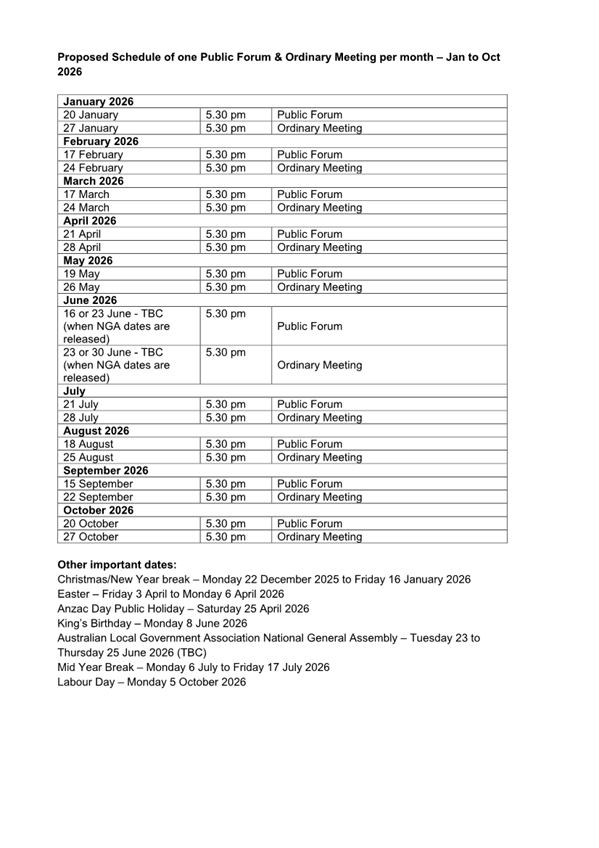
Meeting Dates (one Ordinary Meeting per month) ⇩
Purpose:
To set the date and time of
Ordinary Council Meetings from January 2026 aligning with the commencement of
the new Model Code of Meeting Practice. The report also proposes times for
associated Public Forums with respect to business on Council Ordinary Meeting
agendas.
|
Recommendation
That
Council:
1. Adopt a
schedule of one (1) Ordinary Council meeting per month held on the fourth
Tuesday, commencing in January 2026 until the end of October 2026 as outlined
in Attachment 1 to the report.
2. Determine,
that Ordinary and Committee meetings are not to be held on public holidays or
during the following periods, unless required for reasons of urgency or
unusual circumstances requiring Council immediate deliberation:
a. Christmas/New Year Break - 20 December
2025 to 11 January 2026.
b. Easter Break – 03 April 2026 –
06 April 2026.
3. Determine
that Ordinary meetings will generally commence at 5.30pm.
4. Conduct
a live-streamed Public Forum, in accordance with the adopted Code of Meeting
Practice and Public Forum Policy, generally on the third Tuesday of each
month commencing at 5.00pm (i.e. One (1) week to the Ordinary Meeting).
|
Background
All Ordinary Council meetings
must be held in accordance with requirements in the Local Government Act
1993, the Local Government (General) Regulation 2021 (Regulation) and the
Council’s Code of Meeting Practice. A separate report to the Council on
those matters is provided on the agenda of this meeting.
With the adoption of a New Code
of Meeting Practice, and/or the commencement of the mandatory aspects of the
Model Code of Meeting Practice on 1 January 2026, Council is required to
establish a schedule of meetings for 2026.
Under the Code, Councillors are
required to be given at least three days’ notice of meetings, except for
extraordinary meetings called in an emergency.
In February 2022 (re-adopted
September 2022 & 2023) Council established a starting time for Ordinary
meetings at 5.30pm, with two (2) Ordinary Meetings held per month. These
meetings have included addresses from the public in accordance with the Code of
Meeting Practice.
The
recommendation to adopt one (1) Ordinary Council Meeting per month, supported
by a Public Forum held a week prior, is based on the following considerations:
1. Compliance with
Legislative and Policy Requirements
The proposed schedule
aligns with the Local Government Act 1993, Local Government (General)
Regulation 2021, and Council’s adopted Code of Meeting Practice. It
ensures statutory notice periods for Councillors and the community while
maintaining transparency and accountability.
2. Improved Governance
and Operational Efficiency
Reducing the number of
Ordinary Meetings from two per month to one consolidated meeting streamlines
agenda preparation and administrative processes. This approach allows staff to
focus on delivering comprehensive, high-quality reports and supports informed
decision-making without compromising governance standards. These matters have
been discussed in detail with the Executive Leadership Team and elected
Councillors in briefings and previous reporting on the new Code requirements.
3. Enhanced Community
Engagement
A dedicated Public Forum
held one week prior to the Ordinary Meeting provides a structured opportunity
for community members to address Councillors on agenda items. This separation
which is recommended by the Office of Local Government ensures Councillors have
adequate time to consider information included in the agenda in advance of
hearing directly from community members, and, if required, seek further
information and advice (which will be published) before deliberation. This will
foster responsiveness and trust.
4. Resource and Cost
Management
Fewer meetings reduce
operational costs, including staff time, venue setup, and live streaming
requirements. It also consolidates the scheduling and time dedicated to report
writing, approval, publication, printing and related processed which will
result in efficiencies. This approach aligns with Council’s
commitment to financial sustainability and efficient service delivery.
5. Predictability and
Accessibility
A consistent monthly
cycle, Public Forum on the third Tuesday and Ordinary Meeting on the fourth
Tuesday, offers predictability for Councillors, staff, and the public. This
regularity simplifies scheduling and supports better planning for governance
and community participation.
Proposed Monthly Generic
Calendar
|
Week
|
Mon
|
Tues
|
Wed
|
Thu
|
Fri
|
|
1
|
|
|
|
|
Staff Reports due to CEO for next meeting
|
|
2
|
|
5.30pm Deadline for Councillors to submit Notices of Motion for
the next meeting
|
|
Agenda published to website
|
|
|
3
|
|
9.30am: Deadline for oral and written submissions from community
for Public Forum
5.00pm: Public Forum – Registered Community participation
on Council Agenda items.
|
|
|
|
|
4
|
|
Ordinary Meeting from 5.30pm
|
|
|
Minutes published on Website
|
Risk Implications
Corporate Governance and
Reputational risks: Council Meetings and their arrangements are required to
reflect legislative requirements and provide opportunity for the public to see
and hear the decision-making processes of the elected body. They also need to
be suitably timed and scheduled for elected members. There are legal and
reputational risks for the Council should the framework of meetings not meet
these requirements. The impact of the proposed schedule and arrangement will be
monitored, with a view to providing advice to Councillors for consideration of
any identified adjustments required.
Internal Consultations
Council’s Executive
Leadership Team have been consulted on options for change, noting the new
arrangements that will be required under the Model Code. Councillors
informal feedback to staff on meeting arrangements have also been considered.
External Consultations
Council has previously surveyed
the NSW Councils and determined that most Councils meet once per month and hold
a separate public forum in place of deputations.
There are no requirements to
consult with external parties or organisations prior to the adoption of
scheduling or related arrangements for Council meetings. Information provided
by the Office of Local Government with respect to the related Model Code of
Meeting Practice has been considered in the drafting of the proposed schedule.
Community Consultations
Council is required to make
publicly available a list of endorsed meeting times and dates.
The proposed Public Forum
arrangements will continue the Council’s practice of allowing
constituents to be heard on matters listed on the agenda of the Council.
Formal community consultation
has been undertaken in regard to the Draft Code of Meeting Practice and Draft
Public Forum Policy during the public exhibition period. The proposed schedule
has previously been included for consideration and information in Council
reports leading up to the adoption of the Draft Model Code of Meeting Practice.
Policy and Statutory Implications
Arrangements proposed in this
report do not impact on policy documentation of the Council but will prepare
the Council for operation under a new Code of Meeting Practice.
The Council may adjust the
timing of proposed meetings and related aspects of the schedule by resolution
at any time.
Financial Implications
The frequency and time dedicated
to Ordinary Meetings has a direct correlation with the administrative costs and
resources for those meetings. The proposal (including forums) is expected to
reduce administrative and resourcing costs related to Ordinary meetings by
approximately 30%.
|
|
Ordinary Meeting – Tuesday
16 December 2025
Page
0
|
|
|
Ordinary Meeting – Tuesday
16 December 2025
Page
0
|
CL25.421 Ongoing
Register for Pecuniary Interest Returns - November 2025
HPERM Ref: D25/545491
Department: Business
Assurance & Risk
Approver: Katie
Buckman, Director - City Performance
Purpose:
To provide Council with the
Register of Pecuniary Interest Returns from newly designated persons lodged
with the Chief Executive Officer for the period of 1 November 2025 to 30
November 2025 as required under Section 440AAB of the Local Government Act 1993
and Part 4.26 of Council’s adopted Code of Conduct (implemented in
accordance with the Model Code of Conduct released by the Office of Local
Government).
|
Recommendation
That the report of the Chief
Executive Officer regarding the Ongoing Register of Pecuniary Interest
Returns lodged for the period of 1 November
2025 to 30 November 2025 be received for
information.
|
Background
Under Section 440AAB of the Local
Government Act 1993 and Part 4.26 of Council’s adopted Code of
Conduct (the Code), newly designated persons are required to complete an
Initial Pecuniary Interest Return within 3 months of becoming a designated
person.
Section 440AAB (2) of The
Local Government Act 1993 states:
“Returns required to be lodged with the general
manager must be tabled at a meeting of the council, being the first meeting
held after the last day specified by the code for lodgement, or if the code
does not specify a day, as soon as practicable after the return is
lodged.”
Part 4.21 of the Code states:
“A Councillor or designated person must make and
lodge with the Chief Executive Officer a return in the form set out in schedule
2 to this Code, disclosing the Councillor’s or designated person’s
interests as specified in schedule 1 to this Code within 3 months after:
a) becoming
a Councillor or designated person, and
b) 30
June of each year, and
c) the
Councillor or designated person becoming aware of an interest they are required
to disclose under schedule 1 that has not been previously disclosed in a return
lodged under paragraphs (a) or (b).”
In regard to this, Part 4.26 of
the Code states:
“Returns required to be lodged with the general
manager under clause 4.21(c) must be tabled at the next council meeting after
the return is lodged.”
This report is one of a series
of reports of this nature which will be provided throughout the year to align
with the legislative requirements and, in this instance, is lodged under Part
4.21(a) of the Code.
Those persons who have submitted
a return within the period in accordance with their obligation to lodge an
initial pecuniary interest return are listed below:
|
Directorate
|
Name
|
Designated Position
Start Date
|
Returned
|
|
Councillor
|
Debbie Killian
|
16 September 2025
|
16 September 2025 *
|
|
City Development
|
Jesica Hughes
|
27 October 2025
|
4 November 2025
|
|
City Development
|
Samantha Turner
|
27 October 2025
|
11 November 2025
|
*Due
to an administrative error this form was omitted from previous reports to
Council.
Electronic versions of the
disclosure documents (with relevant redactions) are available on the Council
website, in accordance with requirements under the Government Information
(Public Access) Act, 2009.
Risk Implications
A failure of meeting the
obligations with respect to the Pecuniary Interest Returns by a designated
officer leaves Council at risk of non-compliance with legislative requirements,
conflict of interests and limited transparency.
Allegations of failure of a
designated officer or Councillor to complete a return within the required
timeframe or include relevant information in a return may amount to a breach of
Part 4 of the Code of Conduct. Such allegations are to be referred to the
Office of Local Government for investigation in accordance with the Procedures
for the Code of Conduct.
Internal Consultations
Internal consultation is not
required as the process for Initial Pecuniary Interest forms is governed by the
Local Government Act 1993, the Model Code of Conduct and the Government
Information (Public Access) Act, 2009.
External Consultations
External consultation is not
required as the process for Initial Pecuniary Interest forms is governed by the
Local Government Act 1993, the Model Code of Conduct, Council’s
adopted Code of Conduct, and the Government Information (Public Access) Act,
2009.
Community Consultations
Community consultation is not
required as the process for Initial Pecuniary Interest forms is governed by the
Local Government Act 1993, the Model Code of Conduct, Council’s
adopted Code of Conduct, and the Government Information (Public Access) Act,
2009.
Policy and Statutory Implications
The obligations with respect to
the Pecuniary Interest Returns by designated officers are in accordance with
the Code and the Government Information (Public Access) Act, 2009.
Financial Implications
There are no financial
implications for this report.
|
|
Ordinary Meeting – Tuesday
16 December 2025
Page
0
|
CL25.422 Investment
Report - November 2025
HPERM Ref: D25/565998
Department: Finance
Approver: Katie
Buckman, Director - City Performance
Attachments: 1. Monthly
Investment Review - November 2025 (under separate cover) ⇨
2. Statement of Investments -
November 2025 (under separate cover) ⇨
Purpose:
The reason for this report is to inform the Councillors and
the community on Council’s investment returns. The report also ensures
compliance with Section 625 of the Local Government Act 1993 and Clause 212 of
the Local Government (General) Regulation 2021, that requires a written report
is provided to Council setting out the details of all funds it has invested.
Summary and Key Points for
Consideration:
Council’s total Investment
Portfolio returned 4.63% per annum for the month of November 2025,
outperforming the benchmark Aus Bond Bank Bill Index (3.66%p.a.) by 97 basis
points (0.97%).
|
Recommendation
That Council receive the
Record of Investments for the period to 30 November 2025.
|
Background
Investment Portfolio
Council’s investment
balance as of 30 November 2025 was $270 million and consisted of the following
types of investments:
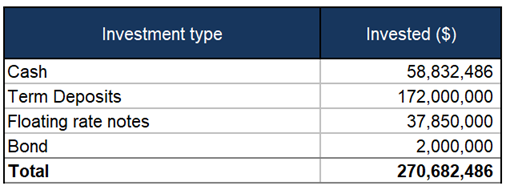
The details of each investment held
by Council on 30 November 2025 is included in the Statement of Investments at Attachment
2.
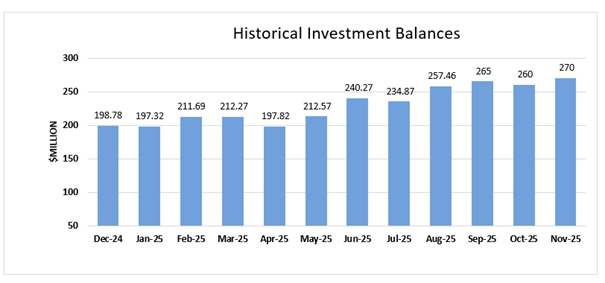
The graph below illustrates
Council’s investments balance on a rolling 12-month basis. The
timing of expenditures and receipt of grant funds fluctuates throughout the
year, leading to monthly variations in the overall balance.
The $10M boost in the
Council’s portfolio is primarily attributed to:
1. Grant
Income: the Council received approximately $6 million from various grants.
2. Rates
Revenue: the second rates instalment was due on 30 November 2025 and had begun
being receipted by month end.
Portfolio Return
For the month of November, the total investment returns were a
positive 4.63% p.a. outperforming Aus Bond Bank Bill Index (3.66%) by 97 basis
points.
Investments
Graph 1 below, shows the performance of Council’s
Investment Portfolio against the benchmark on a rolling 12-month basis.
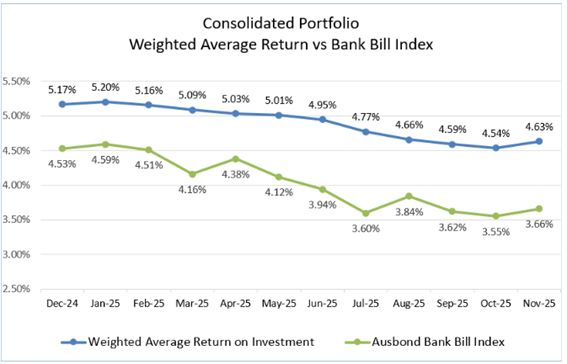
Investment Interest Earned – November 2025
Much of Council’s cash is
restricted in its use to specific purposes by external bodies (e.g. specific
purpose unspent grants), legislation (e.g. developer contributions, domestic
waste management, water and sewer funds) and Council resolutions (i.e.
internally restricted reserves). Interest earned on externally restricted
cash must be allocated to those external restrictions in accordance with
legislation. The two tables below show the allocation of interest to each
applicable Fund.
Table 1 below, shows the interest earned for the
month of November 2025.
Table
1 - Interest Earned for the Month of November 2025
|
Fund
|
Monthly Budget
$
|
Actual Earned
$
|
Difference
$
|
|
General
|
440,045
|
535,668
|
95,623
|
|
Water
|
169,398
|
196,412
|
27,014
|
|
Sewer
|
110,024
|
160,701
|
50,677
|
|
Total
|
719,467
|
892,781
|
173,314
|
The interest earned for the month of November 2025, was $892,781
compared to the monthly budget of $719,467.
Investment Interest Earned -
Year to Date
Table 2
below, demonstrates how the actual amount of interest earned year to date has
performed against the 2025/26 budget.
Table 2 - Amount of interest earned year to date,
against the total budget
|
Fund
|
Total Annual Budget
$
|
Actual
YTD
$
|
%
Achieved
|
|
General
|
5,353,884
|
2,746,721
|
51%
|
|
Water
|
2,061,012
|
1,023,908
|
50%
|
|
Sewer
|
1,338,624
|
763,091
|
57%
|
|
Total
|
8,753,520
|
4,533,720
|
52%
|
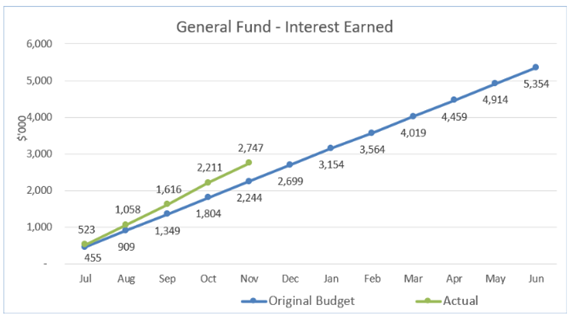
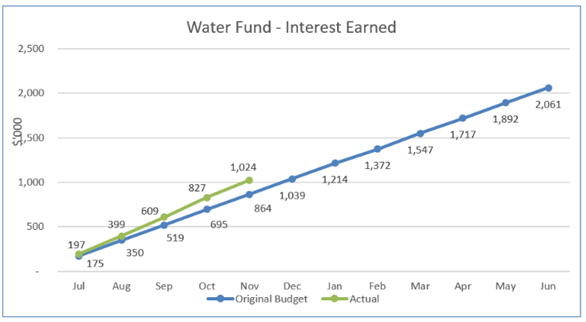
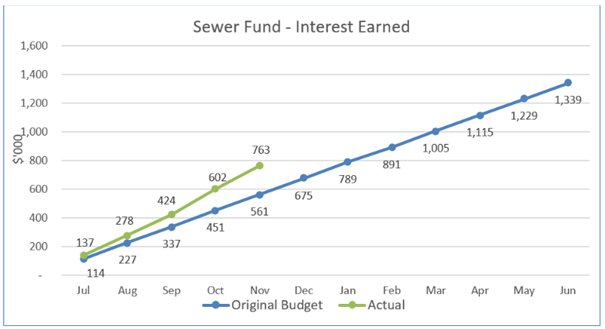
The cumulative interest earned for the
year (July to November) was $4,533,720 which is 52% of the current full year
total annual budget.
The interest earned in the general fund of
$2,746,721 includes interest earned on unspent s7.11 developer contributions
and Domestic Waste Management reserves, which is required to be restricted by
legislation. Interest earned on unspent s7.11 developer contributions is
$673,761 and Domestic Waste Management reserves is $410,398 to the end of
November. This leaves $1,662,561 which is unrestricted.
All investment returns on externally
restricted funds are allocated to those funds in accordance with legislation.
All investment returns on unrestricted
funds are included in Council’s budget as general revenue and are
utilised to help fund core services.
Graph 2 (3 separate graphs) below,
illustrates the cumulative interest earned for the year for each fund (General,
Water and Sewer) against budget:
Graph 2 - Cumulative interest earned for the year for
each fund against budget.
Risk Implications
All investments are placed with
preservation of capital being the key consideration to prevent any loss of
principal invested.
Internal Consultations
Not applicable.
External Consultations
Council’s investment
advisor, Arlo Advisory Pty Ltd.
Community Consultations
Not applicable.
Policy Implications
All investments have been placed
in accordance with Council’s Investment Policy.
Financial Implications
Financial markets declined this
month as global central banks, including Australia, moved away from an easing
bias, with some now forecasting a rate increase next year if inflation
persists.
Statement by Responsible
Accounting Officer
I hereby certify that the investments listed in the attached
report have been made in accordance with Section 625 of the Local Government
Act 1993, Clause 212 of the Local Government (General) Regulations 2021 and
Council’s Investments Policy POL23/2.
Mathew Badcock Date:
4 December 2025
|
|
Ordinary Meeting – Tuesday
16 December 2025
Page
0
|
CL25.423 Investment
Policy
HPERM Ref: D25/555183
Department: Finance
Approver: Katie
Buckman, Director - City Performance
Attachments: 1. Investment
Policy with tracked changes December 2025 ⇩
Purpose:
The purpose of this report is to
submit the updated Investment Policy, which has been endorsed by the Audit,
Risk and Improvement Committee (ARIC), for consideration.
|
Recommendation
That Council adopt the updated Investment Policy as per
Attachment 1.
|
Background
Legislation requires Council to
maintain an Investment Policy that complies with the Local Government Act
1993, Local Government (General) Regulation 2021, Ministerial Investment
Order of 12 January 2021 and the Investment Policy Guidelines issued by the
then Division of Local Government in May 2010, and to review the Investments
Policy at least annually.
Council adopted the current Investment
Policy (the Policy) at its meeting on 28 October 2024. The Policy has been
reviewed by Finance staff with consultation from our investment advisor, Arlo
Advisory. Minor changes to the content are proposed.
The updated Policy was included
on the agenda of the Audit, Risk and Improvement Committee (ARIC) meeting held
on 12 November 2025, and it was resolved “that ARIC endorse the
Investment Policy, noting the minor changes outlined in the report”.
Proposed changes
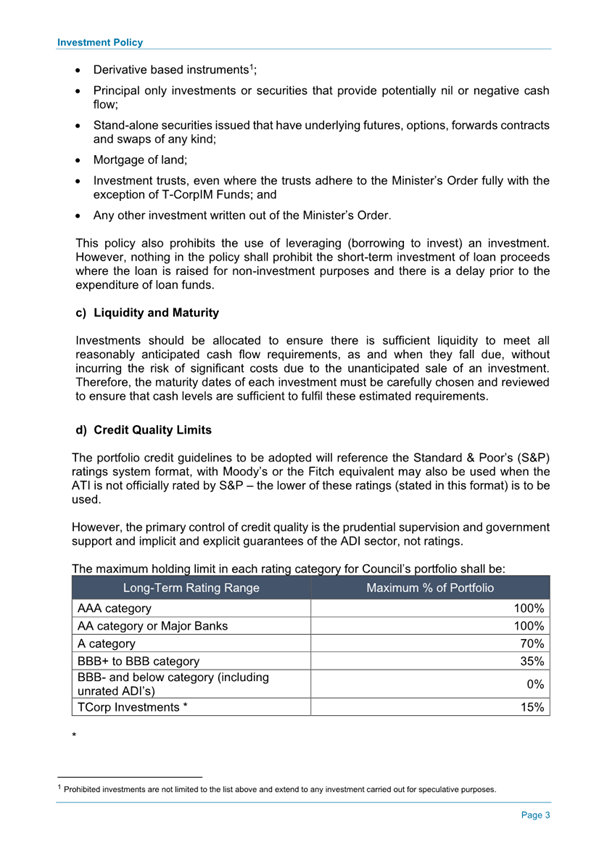
There are no proposed changes to the overall content, structure
or objectives of the Policy. The main changes proposed are under the following
headings of the Policy:
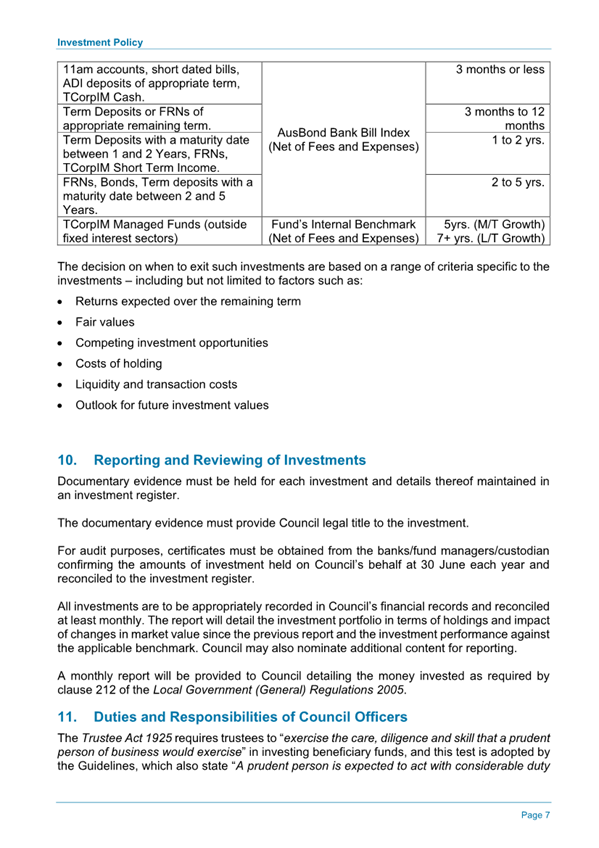
4. Risk Management
a) Authorised investments
· Remove the last
dot point because Council does not have any grandfathered investments.
d) Credit Quality
Limits
· Include the
Fitch equivalent credit ratings for those approved deposit taking institutions
who are not officially rated by Standards & Poor’s.
· Consolidate the table
to have each rating category on its own line.
· Increase
the maximum percentage of portfolio in the A category from 40% to 70%.
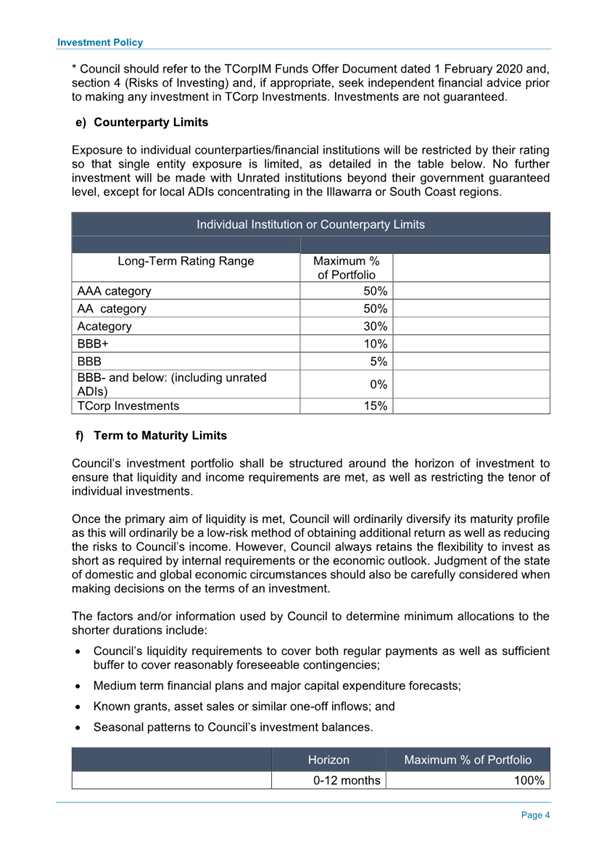
e) Counterparty Limits
· Consolidate the
table have the A category on a single line.
· Reduce
the AAA category from 100% to 50%.
· Reduce
the AA category from 100% to 50%.
· Reduce
the A category from 100% to 30%.
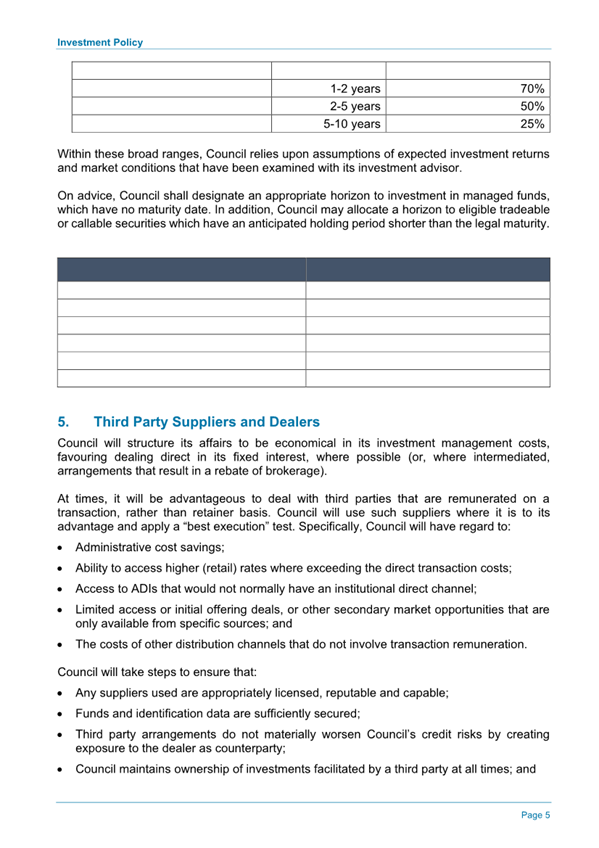
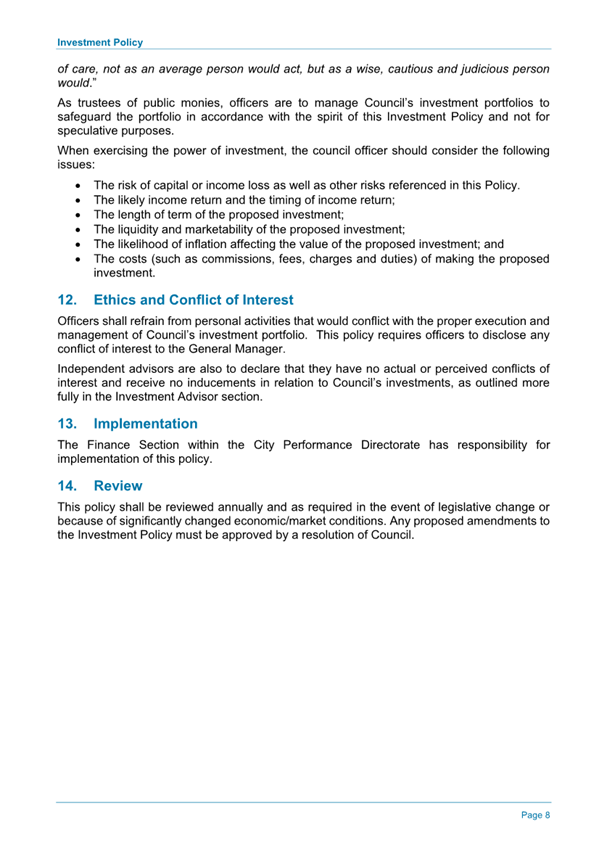
f) Term to Maturity Limits
· Remove
the 0 – 3 months investment horizon.
· Remove
the left most column as these descriptors are not used in any reporting.
· Remove
the second table on tenor limitations.
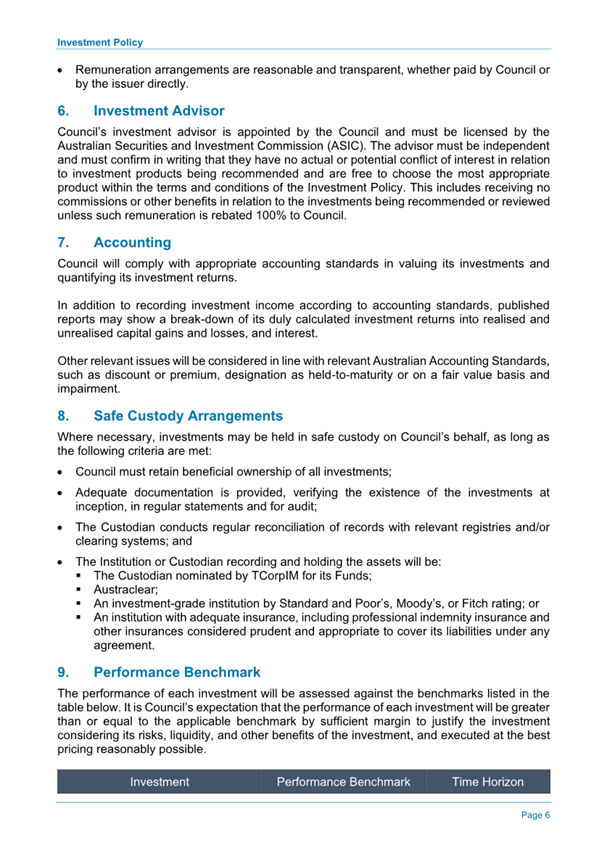
Some further wording
and grammatical changes are also proposed to update the Policy to improve the
overall presentation of the Policy.
Risk Implications
The proposed changes are aimed
at reducing Council’s risk exposure in the current economic climate
Internal Consultations
Governance
External Consultations
Office of Local Government
Council’s investment
advisor, Arlo Advisory Pty Ltd
Community Consultations
Not applicable
Policy and Statutory Implications
The Policy has been reviewed by
Council’s investment advisor and the ARIC, with some minor changes
recommended.
Financial Implications
Not applicable
|
|
Ordinary Meeting – Tuesday
16 December 2025
Page
0
|
|
|
Ordinary Meeting – Tuesday
16 December 2025
Page
0
|
CL25.424 Tender
Exemption - Proposed Investment in Payment Platform - Paybles
HPERM Ref: D25/566645
Department: Finance
Approver: Katie
Buckman, Director - City Performance
Purpose:
To allow council to consider a
tendering exemption, and enter direct negotiations with a vendor to implement a
direct to customer payment platform for water and council rates.
In accordance with Section
10A(2)(d)(i) of the Local Government Act 1993, some information should remain
confidential as it would, if disclosed, prejudice the commercial position of
the person who supplied it. It is not in the public interest to disclose this
information as it may reveal commercial-in-confidence provisions of a contract,
diminish the competitive commercial value of any information to any person
and/or prejudice any person’s legitimate business, commercial,
professional or financial interests. This information will be considered under
a separate confidential report.
|
Recommendation
That Council consider a
separate confidential report in accordance with Section 10A(2)(d)(i) of the
Local Government Act 1993.
|
Background
Payble
Pro is an online platform that via a ratepayer login allows ratepayers to
access real time data on their water and general rates outstanding balances. It
also permits ratepayers to create flexible payment plans via automatic direct
debit which is a cheaper payment method (from Council’s perspective) than
other methods used.
The intention is to enter a
contract with Payble to implement the service which will allow ratepayer bill
smoothing at the ratepayers discretion and reduce printing costs for rates
notices as well as staff time relating to debt enquiries.
Shoalhaven Water staff and
General Fund Rates (Finance Department) staff have reviewed the current
experience of our customers and considered options to use proven products to
achieve the following outcomes:
- Improve the
ability for customer to self-service and improve customer experience (objective
of ICT strategy)
- Improve
cashflow and reduce debt levels (recommendation of the Finance Review Panel)
- Reduce manual
tasks required to support customer payments and direct debits, and customer
balance inquiries
- Invest
savings made, through the reduction of manual tasks, into proactive debt
management and auditing of customer categories.
The solution offered by vendor
Payble is in place across the local government sector (currently 45 councils
have contracts with Payble). Our staff have reviewed the product to validate
the benefits that can be realised from their solution.
A tender exemption is sought as
Payble Pro is a unique proprietary software developed by Payble Pty Ltd
specifically designed for the needs of councils. It is the only solution that
integrates with TechnologyOne infrastructure and CBA payment processing and is
the only system that can successfully meet council's PCI-DSS Compliance
requirements for secure credit/debit card data storage.
Specific features of Payble that
are unique to the market include:
· PCI-DSS
compliant credit/debit card storage, enabling customers to initiate "set
and forget" card payments
· End-to-end
facilitation of bill-smoothing payments, including customer prompts, enrolment,
schedule calculation, and customer notifications
· Self-serve
payment arrangements compliant with council policies and the Local Government
Act
· Pro-active
repairs - automatic follow-up of missed or dishonoured payments
· Works across rates
and water while enabling separate compliance processes and
configuration for each
Details relating to the proposal are contained in the
confidential report.
Risk Implications
Details relating to the proposal
are contained in the confidential report
Internal Consultations
The Finance department (Rates)
and Shoalhaven Water have been involved in the initial consultations, and will
be involved in the implementation of this platform.
Council’s IT team have
also reviewed the product offered and completed a base line Cyber Security
assessment – the team were satisfied the product meets our requirements
in this regard.
External Consultations
Technology One, the Commonwealth
Bank, and other Councils who have implemented the platform will be consulted in
relation to the implementation.
Community Consultations
Shoalhaven City Council
ratepayers will need to be consulted and encouraged to engage with the
platform. This will be undertaken using existing communication channels
including, but not limited to, information sent out with quarterly rates
notices.
Policy Implications
This report and proposed
recommendation is in accordance with Council’s adopted Procurement
Procedures and applicable Legislation.
Financial Implications:
Financial details relating to the proposal are contained in
the confidential report
|
|
Ordinary Meeting – Tuesday
16 December 2025
Page
0
|
CL25.425 Review
of Comerong Island Ferry Fees and Charges
HPERM Ref: D25/520630
Department: Works
& Services
Approver: Andrew
Constance, Chief Executive Officer
Attachments: 1. Comerong
Island Ferry Services - Discussion Paper ⇩
Purpose:
The
purpose of this report is to recommend that the Comerong Island Ferry fees be reinstated
to the rates applied in the 2024/2025 financial year, due to the lack of
targeted consultation with significantly impacted residents prior to the
adoption of the 2025/2026 fees and charges.
Due
to the scheduled refurbishment of the ferry and subsequent technical issues
from September to early December 2025, the 2025/2026 charges have not been
applied to date.
Any
future proposals to amend the Comerong Island Ferry fees will be subject to a
formal report to Council, which will include consultation with residents and
primary land users of Comerong Island.
|
Recommendation
That the fees for the
Comerong Island Ferry revert to those adopted for the 2024/2025 financial
year, due to the lack of targeted community consultation undertaken prior to
the adoption of the 2025/2026 fees and charges.
|
Background and Supplementary information
The Comerong Island Ferry
provides essential access to Comerong Island and forms part of the local road
network. There are no alternative road connections to the island; therefore,
residents and other users rely entirely on the ferry for access. This includes
14 residential dwellings, adjacent farmland, and areas managed by National
Parks.
Historically, residents of
Comerong Island were not charged for ferry use with fees only being applied to
non-residential users. However, new fees were introduced in the 2025–26
financial year following Shoalhaven City Council’s annual review of Fees
and Charges. This includes, among other things, a fee structure that applied to
residents.
Each year, Council reviews its
Fees and Charges as part of developing and adopting the Delivery Program
Operational Plan (DPOP). This process outlines the proposed and adopted works,
budget allocations, and fees required to achieve the goals set out in Shoalhaven
2035 Community Strategic Plan.
For the 2025–26 financial
year, the DPOP was placed on public exhibition for 28 days (MIN25.196)
and subsequently adopted on 19 June 2025 (MIN25.324).
The adopted fees are detailed in Fees
and Charges – Part 2 (2025/26), page 60.
Key Changes
Compared
to the 2024–25 structure (Table 1), the 2025–26 fee structure
(Table 2) introduced significant changes, including a new fee for Comerong
Island residents to use the ferry and several additional charges.
Table 1 – 2024-25 Fees and Charges
|
Fee Description
|
Purpose
|
Pricing Policy
|
Recovery
|
GST incl.
|
2024/2025 Amount
|
|
Comerong
Island Ferry Toll
|
As
stated, return trip per vehicle, including bicycles and motorbikes
|
Partial
cost recovery
|
7.40%
|
Y
|
$20.00
return trip per vehicle including bicycles
|
Table 2 – 2025-26 Fees and Charges
|
Fee Description
|
Purpose
|
Pricing Policy
|
Recovery
|
GST incl.
|
2025/2026 Amount
|
|
Comerong
Island Ferry Toll - Agricultural Tractor - Annual
|
As
stated
|
Partial
cost recovery
|
10%
|
Y
|
$400.00
|
|
Comerong
Island Ferry Toll - Agricultural Tractor - Return Trip
|
As
stated
|
Partial
cost recovery
|
10%
|
Y
|
$30.00
|
|
Comerong
Island Ferry Toll - Bicycle / MotorCycle - Annual
|
As
stated
|
Partial
cost recovery
|
10%
|
Y
|
$200.00
|
|
Comerong
Island Ferry Toll - Bicycle / MotorCycle - Return Trip
|
As
stated
|
Partial
cost recovery
|
10%
|
Y
|
$10.00
|
|
Comerong
Island Ferry Toll - Bicycle / MotorCycle - Weekly
|
As
stated
|
Partial
cost recovery
|
10%
|
Y
|
$35.00
|
|
Comerong
Island Ferry Toll - Car / Vehicle under 3 tonne capacity - Annual Pass (limit
of two per residence)
|
As
stated
|
Partial
cost recovery
|
10%
|
Y
|
$400.00
|
|
Comerong
Island Ferry Toll - Car / Vehicle under 3 tonne capacity - Return Trip
|
As
stated
|
Partial
cost recovery
|
10%
|
Y
|
$20.00
per service
|
|
Comerong
Island Ferry Toll - Car / Vehicle under 3 tonne capacity - Weekly
|
As
stated
|
Partial
cost recovery
|
10%
|
Y
|
$70.00
|
|
Comerong
Island Ferry Toll - Caravan, Box or boat trailer (additional charge excluding
vehicle) - Return trip
|
As
stated
|
Partial
cost recovery
|
10%
|
Y
|
$20.00
|
|
Comerong
Island Ferry Toll - Vehicle over 3 tonne capacity - Annual
|
As
stated
|
Partial
cost recovery
|
10%
|
Y
|
$800.00
|
|
Comerong
Island Ferry Toll - Vehicle over 3 tonne capacity - Return Trip
|
As
stated
|
Partial
cost recovery
|
10%
|
Y
|
$40.00
|
Although these changes were
publicly exhibited as required by MIN25.196, no targeted consultation occurred
with the ferry’s impacted users. After adoption, residents received a
letter dated 20 August 2025 outlining the new fees and a permit system for
residents. This prompted the community to submit a Discussion Paper to Council
expressing concerns, including:
“Council included an unprecedented fee schedule
into the Draft Delivery Program Operational Plan & Budget 2025/26 without
any community engagement or consultation. The first time any Comerong Island
property owners were aware of this change was in a letter dated 20 August 2025,
which included a permit system for residents with the following
restrictions…”
This lack of consultation and
the resulting fee structure prompted a site meeting between residents and the
Director of City Services on 31 October 2025. During preparations for, and at
the meeting itself, it was confirmed that no consultation had occurred beyond
the general public exhibition, and the changes were not specifically
communicated to ferry users.
Given the financial impact on
residents who rely on the ferry for access to their homes, the lack of targeted
consultation is considered insufficient. Accordingly, this report recommends:
- Reverting to
the 2024–25 adopted Fees and Charges for the Comerong Island Ferry.
- Ensuring
that any future fee adjustments include targeted consultation with impacted
ferry users so that implications are fully considered before adoption.
Risk Implications
Failure to revert to the 2024/2025 fee structure presents a
significant reputational risk to Council. It may be perceived that Council did
not undertake adequate, targeted community consultation prior to adopting the
2025/2026 Comerong Island Ferry fees, particularly given the substantial
financial impact these fees impose on Comerong Island residents.
From a financial perspective,
the risk is minimal. The anticipated increase in revenue under the current fee
structure remains relatively insignificant when compared to the overall cost of
operating the ferry.
Internal Consultations
Minimal internal consultation
has been undertaken regarding the proposed revision of fees, as the internal
impact is assessed to be low.
External Consultations
No external consultation has
been undertaken in the preparation of this report, as the impacts are limited
to the affected community members.
Community Consultations
Comerong Island residents and several associated land users
were consulted on the proposal outlined in this report during a site meeting
held on 31 October 2025. Additionally, consideration has been given to the
contents of the joint Comerong Island Community Statement, which was submitted
to Council on 27 October 2025 (Attachment 1).
Policy and Statutory Implications
No policy or statutory
implications have been identified in the preparation of this report.
Financial Implications
Reverting to the 2024/2025 fee
structure will reduce Council’s capacity to generate revenue to support
the ongoing operation of the ferry. However, even under the 2025/2026 fee
structure, the projected revenue represents only a small fraction of the
ferry’s operational costs. Consequently, the associated reduction in
revenue is not considered significant.
Due to the scheduled
refurbishment of the ferry and subsequent technical issues occurring from
September to early December 2025, the associated charges have not been applied to
date. This delay in implementation has resulted in no revenue being generated
from the newly introduced fees during this period.
|
|
Ordinary Meeting – Tuesday
16 December 2025
Page
0
|
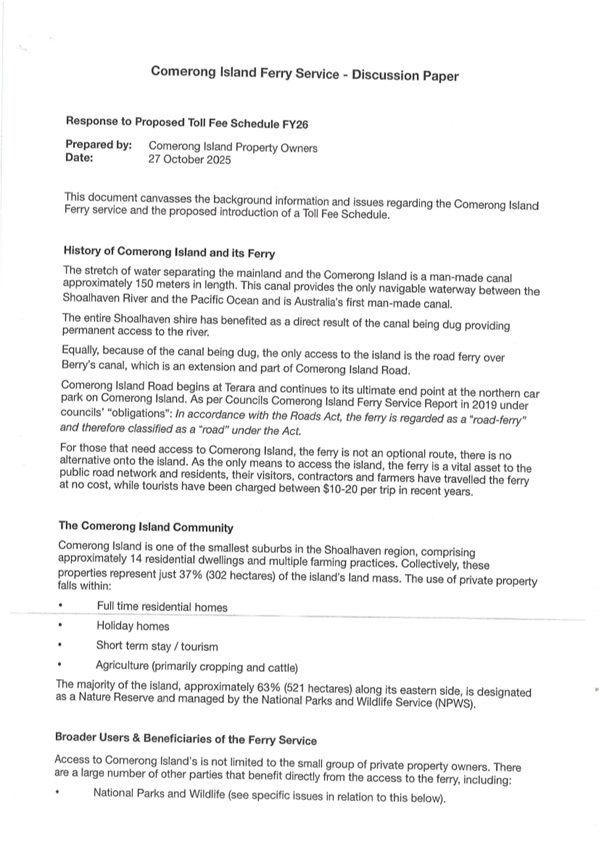
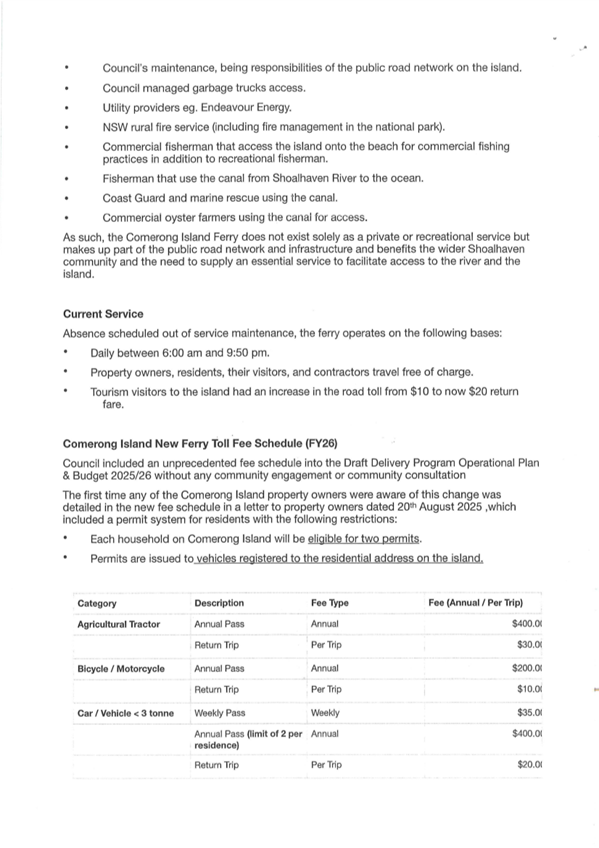
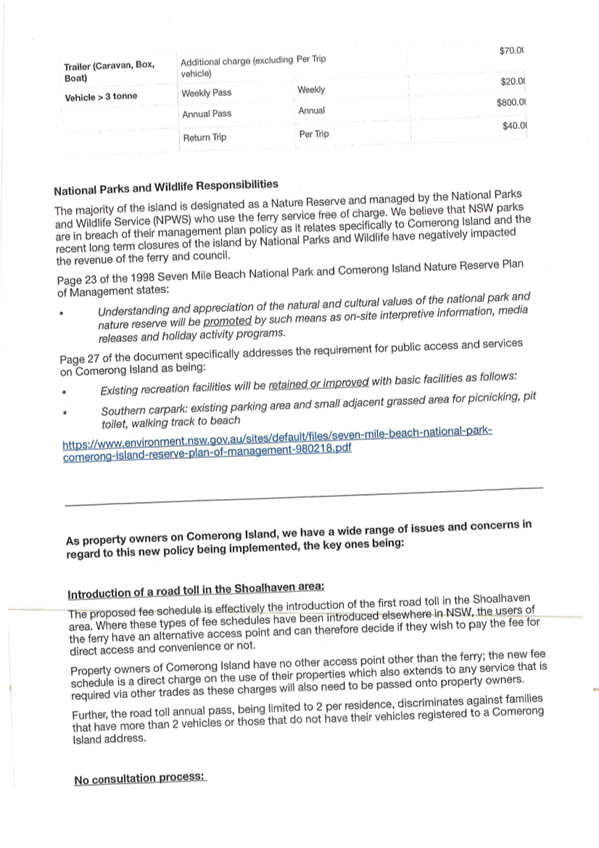
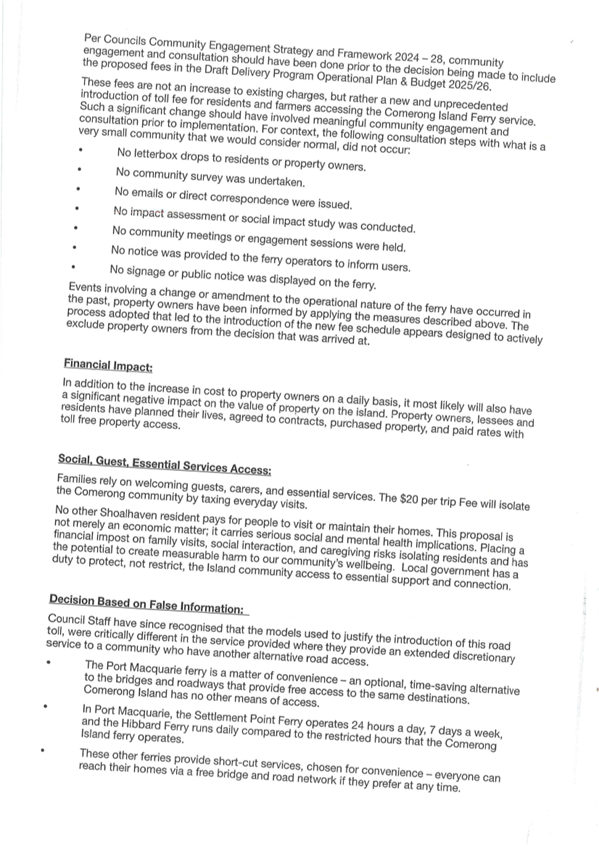
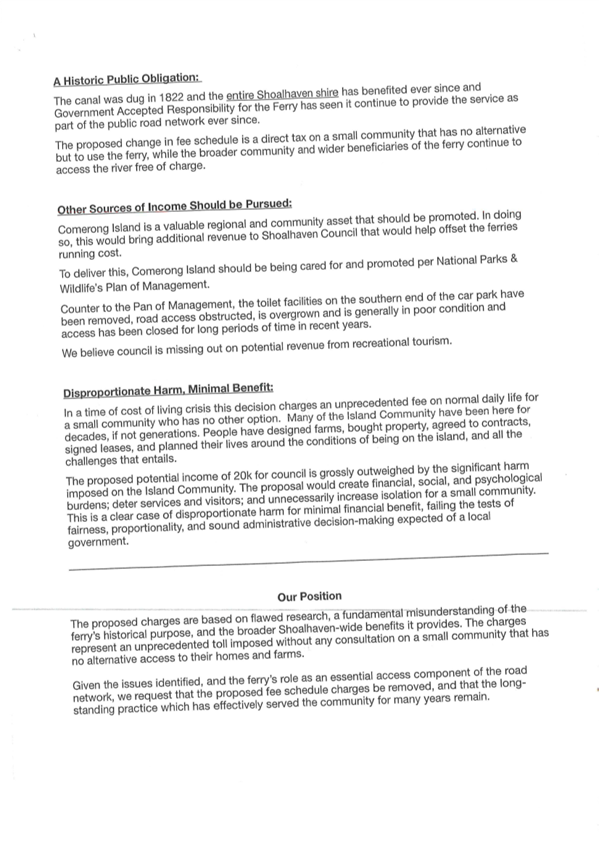
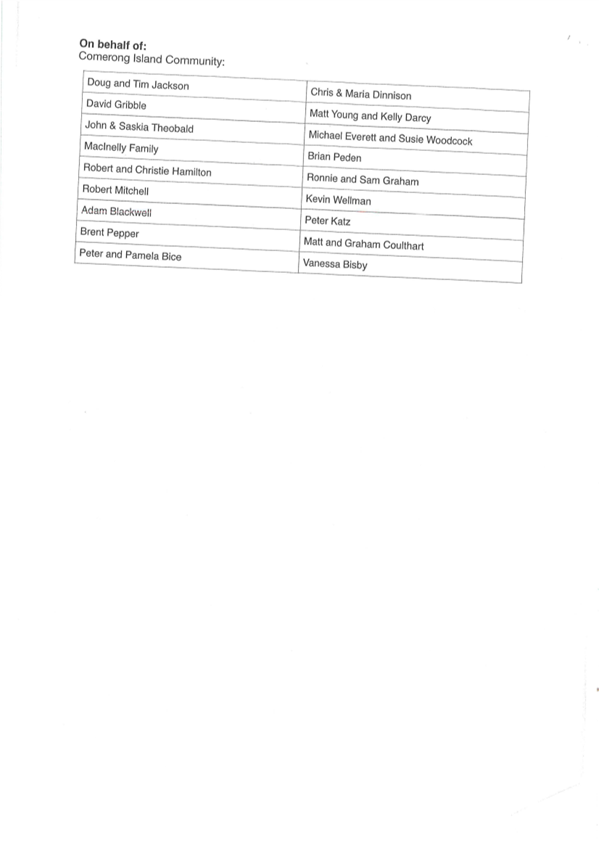
|
|
Ordinary Meeting – Tuesday
16 December 2025
Page
0
|
CL25.426 Policy
Review - Occupation of Council Owned or Managed Land (POL25/49)
HPERM Ref: D25/447148
Department: Buildings
& Property Services
Approver: Kevin
Norwood, Director - City Services
Attachments: 1. POL25/49
- Occupation of Council Owned or Managed Land ⇩
Purpose:
Current Council Policy
(POL22/98) – Occupation of Council Owned or Managed Land is now due for
review. The Policy has been reviewed, and changes have been made to the
prevailing policy. The draft revised policy is now identified as POL22/49.
The revised policy is reported
to Council for adoption.
|
Recommendation
That
Council adopt revised POL25/49 – Occupation of Council Owned or Managed
Land as shown as an attachment to this report.
|
Background and Supplementary information
Shoalhaven City Council’s
Policy (POL22/98) Occupation of Council Owned or Managed Land was adopted 21
December 2009, with amendments in 2013, 2015, 2016, 2020 and 2022. In line with
the requirement for policy reviews to occur within each Council term, the
policy review has been completed.
The policy has been revised in
response to feedback from key internal stakeholders, who indicated that the
previous version did not deliver effective outcomes or align with best
practice. Since the policy’s adoption 12 years ago, no significant changes
had been undertaken, and it is necessary to ensure Council’s policies
remain contemporary. Headline changes to the policy include:
1. Policy
Purpose and Statement
Wording updated to reflect strategic alignment with Council’s
responsibilities for lease and licence considerations under the principal
related legislation: the Local Government Act 1993 and Crown Land
Management Act 2016.
2. Policy
Provisions
Expanded content to include:
· Leases and
licences occupying Council-managed Crown Land
· Statutory
requirements for lease advertising
· Lease terms,
rental calculation, and cost recovery
3. Expression
of Interest & Tendering
New provisions for EOI and tendering requirements associated with leasing
and licensing public land, aligned with the Tendering Guidelines for NSW
Local Government.
4. Benchmarking
The review process included an assessment of other Councils’ policies
to ensure alignment with contemporary local government practices and to support
best-value outcomes for Shoalhaven City Council.
5. Delegations
The revised policy introduces a new Chief Executive Officer delegation
for approving leases and licences. Currently, MIN14.912 and POL22/98 require a
Council resolution for approval in the following situations:
· Annual rental greater than $5,000
· Lease term exceeds five years
· An objection
has been submitted to Council during statutory lease advertising
Shoalhaven City
Council currently has the lowest level of delegation compared to other
Councils, resulting in most new lease and licence agreements being reported to
Council—an inefficient and unsustainable process.
6. Fixed
Rental Subsidy Model
A fixed percentage rental subsidy model is being introduced. Currently,
subsidies for eligible groups are determined case-by-case using a rental
subsidy calculator, which relies on individual officer interpretation and is
difficult to apply. This has led to protracted negotiations and inequity over
time.
The new fixed subsidy method (Rental Assessment Framework) will simplify
the process, ensure transparency, and deliver consistent outcomes for all
stakeholders in future lease and licence negotiations.
Risk Implications
Council’s interests have
been considered and there is minimal risk associated with the recommended
changes to POL25/49.
Internal Consultations
Internal stakeholders were consulted with the policy review.
Revised POL25/49 has been endorsed by the Executive Leadership
Team. Draft policy changes have been made since the ELT endorsement in October
2025 including the removal of Council’s building insurance as an outgoing
(operating cost) and recouped from the lessee (section 4.1.7 of the draft
policy), as well as exclusion of market rental valuation costs (section 4.1.8
of the draft policy) from Council’s cost recovery in lease/licence
preparation.
External Consultations
A certified practicing valuer
was consulted to advise on valuation processes to ensure the integrity of
future land dealings for Council and to support best value outcomes for Council
and the community. The revised policy contains provisions under “Rent and
Fees” in relation to valuations procured for new lease and licence
negotiations.
Community Consultations
The proposed draft policy aims
to ensure future consultation with community groups and organisations wishing
to occupy Council property under renewed lease or licence can be undertaken
with improved transparency for better outcomes.
Current lessees/licensees were
directly consulted on the revised draft policy and provided a period of 28 days
to make comment. At the end of the direct consultation process, five
lessees/licensees made comment or sought clarification on the policy review.
The comments received during the consultation period are summarised below:
|
Matter raised
|
Commentary
|
|
Rent review by qualified valuer after five years or
mid-way through a licence term is unnecessary and costly
|
The draft policy includes provision for annual rent
increase by CPI, and a market rent review at five-year intervals (of a longer
term lease with options to extend). The draft policy only requires the rent
to be reviewed after five years of a longer-term lease and where options
exist, to ensure Council is receiving fair market rent for the property,
which is standard leasing practice.
Unless it is specified in an individual lease
following individual lease negotiation process, a rent review will not be
undertaken mid-way through the term.
Otherwise, when a lease or licence ends and Council
is prepared to enter a renewed agreement, a market rent review or market
appraisal must be undertaken in order to determine a fair and reasonable
rental subsidy under the Rental Assessment Framework and is standard
practice.
Council’s prevailing policy is not specific in
relation to rent review. The revised policy contains specific provisions for
clarity.
No changes are considered necessary to the draft
policy.
|
|
Impact of draft policy on prevailing licence
agreements for Community Gardens
|
The prevailing Community Gardens policy of Council
(POL22/52) is the relevant policy pertaining to a community garden on Council
owned or managed land.
Existing or prospective community gardens licensees
will still be required to submit a Proposal to Occupy Council Property and be
responsible for usage charges associated with the licensed use (eg;
electricity and water). These requirements are expressed in draft POL25/49.
No changes are considered necessary to the draft
policy with the exception of referencing POL22/52 (Community Gardens on
Council Managed Land) within the new revised policy.
|
|
Costs to be incurred by not for profit groups need
to be fair and equitable
|
No specific details were provided within the
submission. The draft policy proposes a new Rental Assessment Framework (RAF)
and clearer definition around cost recovery and outgoings which on balance
are believed to be improved outcomes for community groups.
|
|
Impact of the draft policy on prevailing agreements
and future renewals
|
This specific comment was in relation to a current
short-term licence agreement, which exists as there is no corresponding plan
of management in place and Council can only currently issue a short-term
licence.
The draft policy has no impact on current
agreements. With regard to the comment made in this particular submission,
the new policy provisions will only impact the licensee in a new agreement if
a short-term licence is being replaced by a standard (5-year term) agreement.
|
|
Whether changes to the draft policy generated by
stakeholder concerns will be re-circulated to stakeholders
|
On the basis of the stakeholder comments, minor
changes have been incorporated into the draft policy, but these are not
considered significant to warrant further advice or circulation prior to the
policy being adopted by Council.
|
An additional three lessees/licensees requested clarity
on the changes from the prevailing policy. In response, the prevailing policy
(POL22/98) was provided to the lessees as well as the following generic summary
of the key changes to the draft policy:
“The main changes to
the policy are:
- inclusion
of statutory provisions for lease and licence of public land, such as lease
terms and advertising requirements (section 4).
- new
provision for the consideration of Expression of Interest and Tender process to
occupy Council land under lease or licence (4.1.13).
- changing
the current rent subsidy calculator process to a fixed percentage subsidy (for
eligible community groups and organisations), plus associated provision for
negotiated final rental outcomes with lease and licence renewals, to achieve
improved transparency (4.1.6)
- clearer
policy provisions for outgoings and cost recovery associated with lease and
licence agreements with Council (4.1.7 & 4.1.8)
- change to the delegations for
approval of a lease/licence (4.1.14).”
Policy and Statutory Implications
As part of this review,
amendments have been incorporated into the prevailing policy to align with
contemporary local government practices and statutory requirements relating to
leases and licences. These changes will better position Council to undertake
lease negotiations and dealings, while providing greater certainty to
prospective lessees and the community.
The leasing and licensing of
Council-owned and managed land is a delegable function of Council. The policy
review introduces higher delegations to the Chief Executive Officer and
Director City Services, enabling them to approve individual leases and licences
where the new rental terms agreed by the parties are consistent with the
policy.
Financial Implications
There are financial implications
associated with the proposed policy amendments.
As part of this review, the
prevailing practice of seeking lessee cost recovery for Council’s
building insurance associated with leased premises will no longer be pursued.
This practice has been in place for approximately the past 12 months.
The ability of lessees/licensees
to sustain rent increases under the Rental Assessment Framework, in addition to
building insurance costs, has been questioned and has frustrated rent review
processes and outcomes. In some cases, rent increases have been compromised to
accommodate building insurance cost recovery.
The imposition of building
insurance costs on lessees will not be pursued in the draft revised policy. The
majority of Council’s lessees/licensees are community-based organisations
(including not-for-profits) that do not have the financial capacity to absorb
Council’s building insurance premiums in addition to rental and other
outgoings/recoverables.
As Council has not actively
practiced building insurance cost recovery over a sustained period, it is not
considered that there will be an appreciable financial impact on Council.
The policy incorporates a change
from an individually assessed rental subsidy system using Council’s
Rental Assessment Framework (RAF), to a fixed rent subsidy model. Fixed rent
subsidy models are used by other Council’s and provides improved budget
forecasting. Prevailing rental subsidies to community groups have been
considered in the formulation of the new fixed rental subsidy framework.
|
|
Ordinary Meeting – Tuesday
16 December 2025
Page
0
|
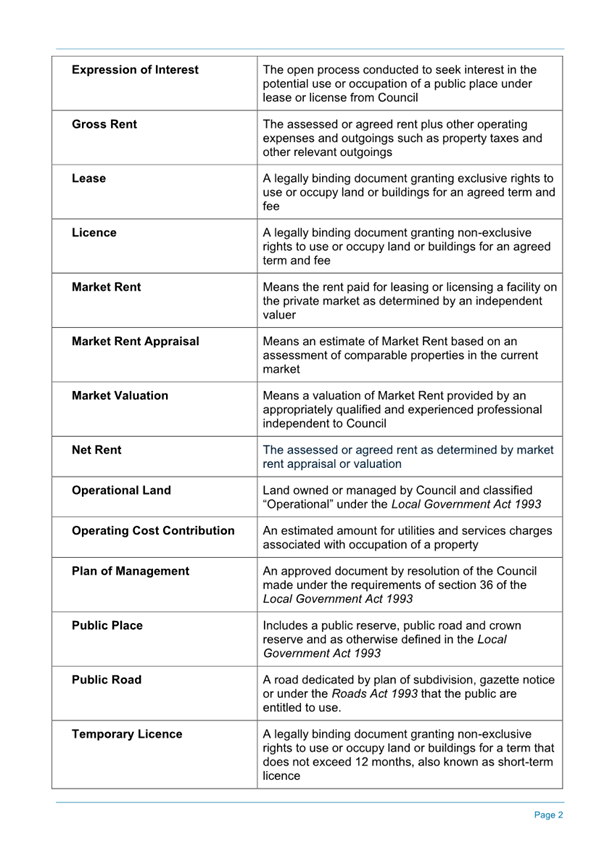
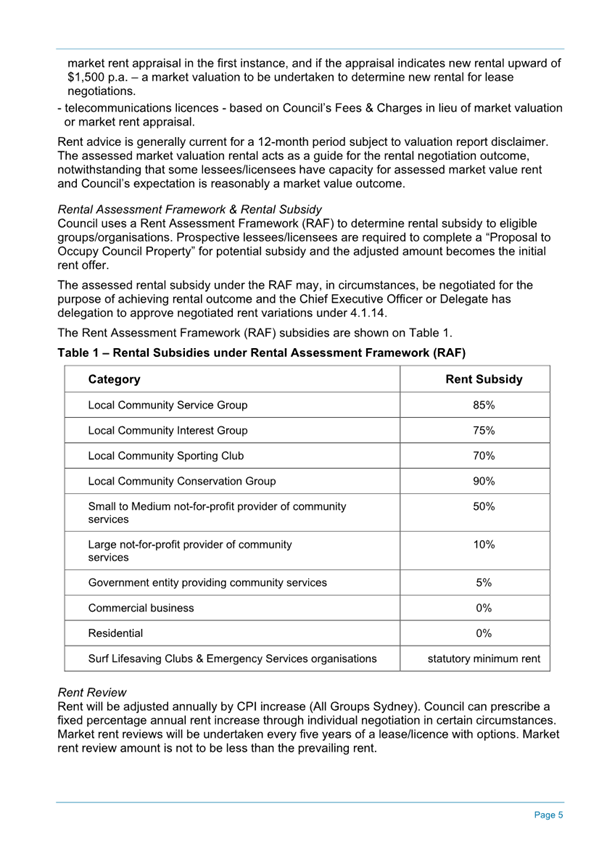
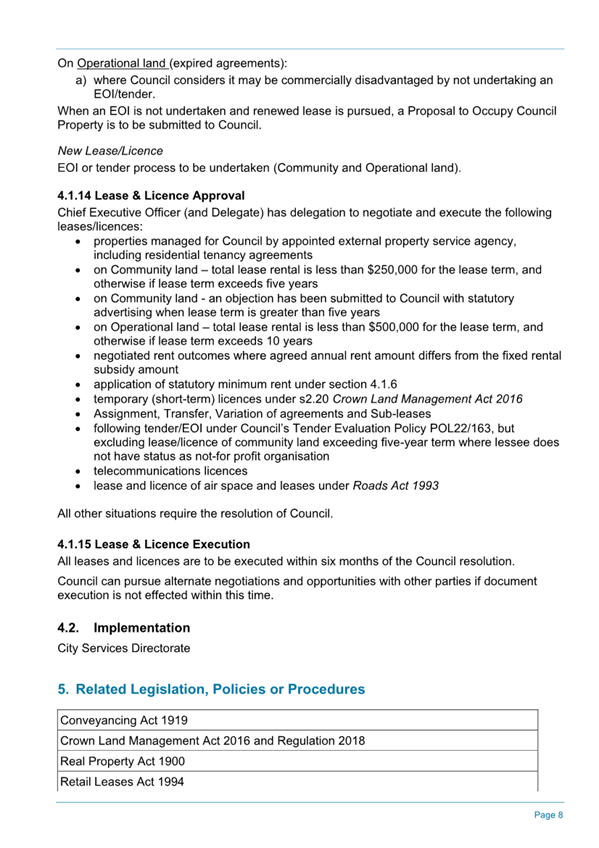
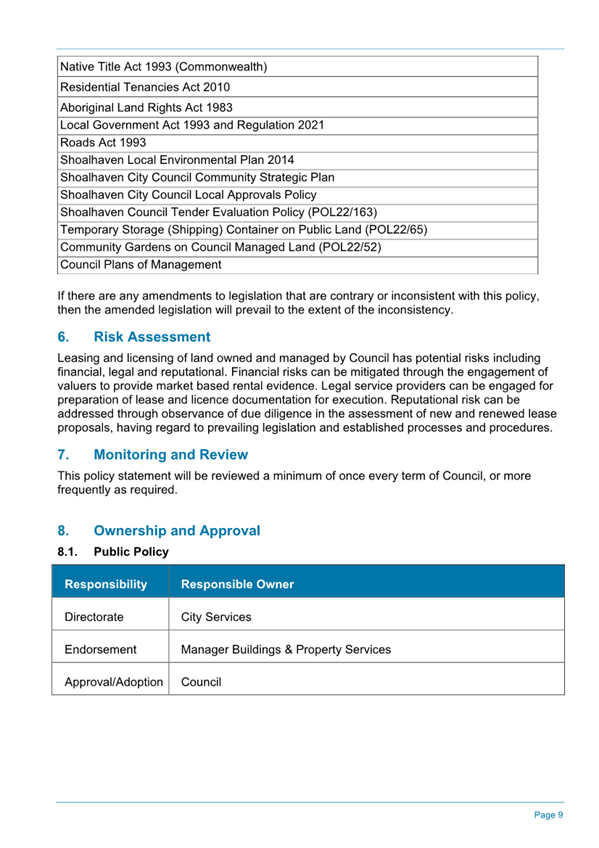
|
|
Ordinary Meeting – Tuesday
16 December 2025
Page
0
|
CL25.427 Shoalhaven
Coastal Management Programs Implementation and Resourcing
HPERM Ref: D25/526536
Department: Technical
Services
Approver: Kevin
Norwood, Acting Director - City Services
Purpose:
Council has recently adopted
three Coastal Management Programs (CMPs) that set the strategic intent for the
management of the Shoalhaven coastal zone within high-priority estuaries over a
ten-year period. Through the adoption of the various CMPs, Council requested a
report back on the resourcing requirements and the implementation of the CMPs
and the associated management actions (MIN25.298,
MIN25.300
and MIN25.562).
This report has been prepared for this purpose to provide information to
Council.
|
Recommendation
That Council note and receive
this report for information.
|
Background
Council has prepared four
Coastal Management Programs (CMPs) under the NSW Coastal Management Act 2016
(CM Act), in accordance with the NSW Coastal Management Manual and covering the
coastal zone defined by the CM Act and the State Environmental Planning Policy
(Resilience and Hazards) 2021 (RH SEPP). Over the course of 2025, Council has
adopted three CMPs that relate to the management of five high-priority
estuaries within the Shoalhaven coastal zone. The CMPs comprise a program of
integrated management actions that are intended to address key issues, and
harness new opportunities for the management of the Shoalhaven coastal zone.
The CMPs prepared and adopted by
Council are outlined below, alongside key details of each CMP:
· Shoalhaven
Open Coast and Jervis Bay CMP – adopted 6 May 2024 (MIN24.253).
The CMP includes 116 management actions for implementation at a total cost of
$45 million over 10 years.
· St Georges
Basin/Sussex Inlet, Swan Lake and Berrara Creek CMP – adopted 10 June
2025 (MIN25.298).
The CMP includes 66 management actions for implementation at a total cost of
$17.8 million over 10 years.
· Lake
Conjola CMP – adopted 10 June 2025 (MIN25.300).
The CMP includes 51 management actions for implementation at a total cost of
$12.2 million over 10 years.
· Lower
Shoalhaven River CMP – adopted 28 October 2025 (MIN25.562).
The CMP includes 56 management actions for implementation at a total cost of
$23.48 million over 10 years.
At the meeting of 10 June 2025
following the adoption of the St Georges Basin/Sussex Inlet, Swan Lake and
Berrara Creek CMP and Lake Conjola CMP, Council resolved to:
Receive a report back on the resourcing requirements and
the implementation of the plan and its actions (Stage 5 Implementation)
(MIN25.298 and MIN25.300).
MIN25.562 in relation to the
Lower Shoalhaven River CMP resolved that Council note the resourcing
requirements of the CMP and the financing of management actions as outlined in
the Business Plan.
This report has been prepared
for information in response to the above resolutions.
A Business Plan was developed
for each individual CMP which outlines the key components of the funding
strategy for the CMP to implement the management actions, including the cost of
proposed actions, proposed cost-sharing arrangements, and other potential
funding mechanisms. Funding for management actions will be established in
consultation with key stakeholders, with capital and operational allocations to
be determined via Council budget processes. Funding for management actions may
be gained from various sources, including competitive State and Federal
Government grant programs and Council’s internal funds.
Following the certification of
the CMPs (pending at the time of writing for the Lake Conjola and Lower
Shoalhaven River CMPs), Council is eligible to apply for grant funding for the
implementation of management actions through the Department of Climate Change,
Energy, the Environment and Water (DCCEEW) Coastal and Estuary Implementation
Stream Grants. This funding has been specifically created to provide a
two-to-one funding ratio for actions within a certified CMP. This grant funding
program is competitive and prioritises Councils with certified CMPs. However,
success in receiving grants is constrained by the available funding from the
NSW State Government and the number of applications received across the State
in a given year.
In preparing the CMPs, it has
been recognised that for Council to implement and deliver the identified
management actions, additional resourcing is required. Each CMP includes a
management action to respond to this and sets out for Council to “Establish
one new Full Time Equivalent (FTE) Coast & Estuary Officer role within
Council” (two roles proposed in the case of the Shoalhaven Open Coast and
Jervis Bay CMP). The Business Plan within the CMPs has assigned the relevant
management actions an expected cost of $1.3 million, equating to $3.9 million
across all three estuary CMPs (in addition to the $2.4 million expected cost
for the Shoalhaven Open Coast and Jervis Bay CMP) over the 10-year lifecycle of
the CMP to ensure that internal capability is maintained to oversee and carry
out strategic actions. This operational funding identified for internal Council
resources (and any capital project allocations) will be determined through
standard Council budget processes and long-term financial planning, accounting
for whole of organisational resourcing requirements and capability.
Staff resourcing and associated
Council budgets for the implementation of the CMPs is vital to ensure the
delivery of Stage 5 is achieved in line with the associated business plans.
This is paramount given the significant increase in workload requirements for
Council staff to implement management actions from each CMP in line with
legislation.
Risk Implications
The ongoing CMP implementation
faces resourcing and funding risks, with delivery of management actions
dependent on available financing (internal and external), and resourcing and
capacity of staff. The DCCEEW Coastal and Estuary Implementation Stream Grant
Program has been established to fund project works only and does not provide
financing for staff positions or project management through the delivery of
works. Therefore, resourcing of staff positions cannot easily be funded through
NSW State Government grant programs and will need to be prioritised by Council.
Internal Consultations
Throughout Stages 1-4 of the CMP
development, internal consultation was carried out within Council, including
consultation across and within Council Directorates to obtain feedback on the
existing risks and opportunities, and proposed management actions within each
CMP study area. Council has adopted each of the CMPs following reports provided
to Council at various Ordinary Meetings between 2024 and 2025. Internal
consultations will be ongoing throughout the implementation of the CMPs.
External Consultations
Throughout Stages 1-4 of the CMP
development, external consultation was carried with a range of representatives
from a range NSW State Government agencies and Non-Government Organisations.
The management actions within the CMPs identify where these external entities
have been identified as a ‘supporting partner’ in the
implementation of the actions. Letters of support have been provided by
relevant agencies listed against management actions as ‘supporting
partners’ for each CMP. Council will continue to engage with these
entities throughout the implementation of the CMP and to ensure that the
relevant legislation under each of their jurisdictional boundaries is
appropriately complied with.
Community Consultations
Stakeholder and community
engagement has been implemented progressively through each stage of the CMPs.
The various engagements were coordinated and developed
in line with CMP Engagement Guidelines developed by the NSW State Government
(DCCEEW), the Shoalhaven City Council Community Engagement Strategies 2022-2026
and 2025-2029, and the use of the International Association for Public
Participation (IAP2) guidelines. This included engagement with Traditional
Owner Groups, local communities, and public authorities through a range of
methods – including workshops, drop-in sessions, surveys, one-on-one
meetings and interactive online map-based platforms. The CMP documents
outline the community consultation process employed throughout the lifecycle of
each CMP development. The draft CMPs were publicly exhibited in line with the
requirements for consultation as outlined in the Coastal Management Act 2016
prior to being presented to Council for adoption. Ongoing consultation with the
community will occur throughout the implementation stage of the CMPs with this
activity reflected in the management actions of each CMP.
Policy and Statutory Implications
The CMPs have been prepared in
accordance with the NSW Coastal Management Framework that is governed by the CM
Act.
A CMP is considered a
‘living document’ that is to be reviewed and updated continually
throughout its lifecycle. A strategic review of the CMPs should occur at least
once every ten years to assess the effectiveness of the CMP in achieving its
objectives and to incorporate changes, considering new information, legislative
and policy changes, and improved understanding of the local coastal and
estuarine processes.
Financial Implications
Financial implications for the
resourcing and implementation of the various CMPs has been outlined above in
the background section. As part of the implementation of the CMPs sustainable
funding and financing arrangements for management actions will be established
in consultation with key stakeholders, with capital and operational allocations
to be determined via budget processes, and the reliance on grant funding for
delivery.
|
|
Ordinary Meeting – Tuesday
16 December 2025
Page
0
|
CL25.413 Development
Application DA2024/1589 - 737 Woollamia Road WOOLLAMIA - Lot 12 DP 9289
DA. No: DA24/1589/4
HPERM Ref: D25/441456
Department: Development
Services
Approver: Gordon
Clark, Manager - Strategic Planning
Attachments: 1. Architectural
Plan Set (under separate cover) ⇨
2. Draft
Notice of Determination - Refusal (under separate cover) ⇨
3. S4.15
Assessment Report (under separate cover) ⇨
4. Covering
Letter RFI Response (under separate cover) ⇨
5. Response
to SCC (under separate cover) ⇨
6. Suitability
of Material or Construction Methods Report (under separate cover) ⇨
7. Flood
Risk Management Peer Review (under separate cover) ⇨
8. Flood
Affectation Report (under separate cover) ⇨
9. Emergency
and Evacuation Plan (under separate cover) ⇨
10. Flood
Evacuation Map (under separate cover) ⇨
11. Hydraulic
Model Results (under separate cover) ⇨
12. Acid
Sulphate Soils Management Plan (under separate cover) ⇨
13. Adaptable
Housing Assessment Report (under separate cover) ⇨
14. Arborist
Impact Assessment (under separate cover) ⇨
15. Bushfire
Assessment Report (under separate cover) ⇨
16. Site
Plan Rev. D (under separate cover) ⇨
17. DA3.00
Section Plans (under separate cover) ⇨
18. Landscape
Plan (under separate cover) ⇨
19. First
Referral Response - Crown Lands (under separate cover) ⇨
20. Second
Referral Response - Crown Lands (under separate cover) ⇨
21. Draft
Notice of Determination - Approval including draft conditions of consent (Not
Recommended) (under separate cover) ⇨
22. Letter
from Northrop Engineers (under separate cover) ⇨
23. Covering Letter from
Applicant dated 4 December 2025 (under separate cover) ⇨
Note: This report was deferred from the
Council meeting on 9 December 2025.
|
Recommendation
That development Application DA2024/1589 for construction of 3
new multi-dwelling housing units in addition to the approved dwelling (under
DA23/1694 as modified by MA2024/1346) be refused subject to the
recommended reasons for refusal in Attachment 2.
|
Reason
for consideration by Council
On 23 September 2025 Council
resolved to call in development application DA2024/1589 for determination
citing public interest and any further additional information the applicant
provides to Council staff prior to the matter being reported back to Council be
taken into consideration (MIN25.372).
Description of Development: Construction of 3 new multi-dwelling housing units in
addition to the approved dwelling under DA23/1694 (as modified by MA2024/1346).
Owner: Liliana Zreik and Nader Zreik
Applicant: Liliana Zreik
Notification Dates: 22 August 2024 – 5 September 2024
No. of Submissions: Five (5)
Location Map:
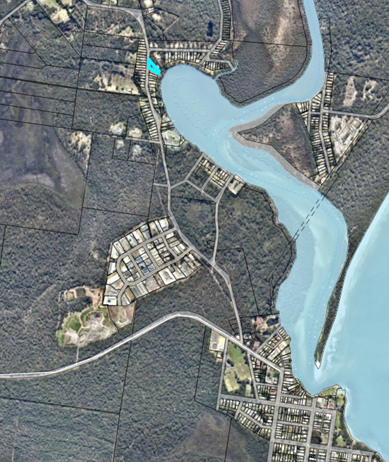
Figure 1: Location Map
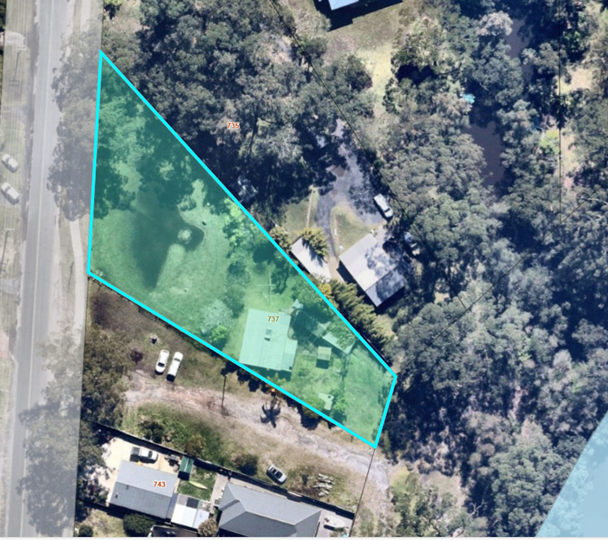
Figure 2: Location Map - Aerial imagery of subject site.
Note - existing dwelling to be demolished under DA23/1694
Background and Supplementary
Information
Proposed Development
The
proposal includes:
· Construction
of three one-storey attached multi-dwelling housing units with lofts.
· Construction
of associated driveways.
· Landscaping
of the site.
· Construction
of suitable infrastructure to service the proposed development, including
stormwater, sewerage connections, electricity supply and telecommunications.
· Modification
of Development Application No. DA23/1694 for the demolition of an existing
dwelling and construction of a single storey dwelling at 737 Woollamia Road,
Woollamia.
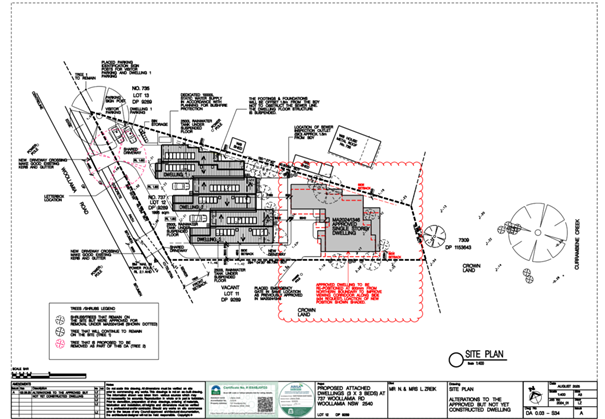
Figure 3: Site Plan – note red clouded dwelling
approved under DA23/1694
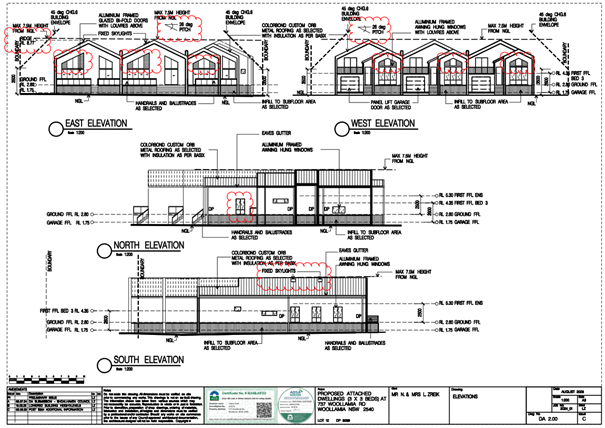
Figure 4: Elevation Plans
Subject Land
The
subject site is legally identified as Lot 12 DP 9289 and is described as 737
Woollamia Road Woollamia (refer to Figures 1 and 2).
Site & Context
The site is located on the eastern
side of Woollamia Rd and extends towards the banks of Currambene Creek.
The site occupies an area of 1991.81m2, is relatively flat with a
slight fall from south to north. A tributary of Currambene Creek flows through
1 Edendale Street, 2 lots north of the subject site.
A weatherboard cottage and metal
garage currently occupy the eastern portion of the site and are approved to be
replaced under DA24/1694 by a new dwelling with a greater building
footprint.
The site is zoned RU5 –
Village under the Shoalhaven Local Environmental Plan 2014 and is
located within bushfire prone and flood prone land.
The site falls within a High Hazard
Flood Storage hazard/hydraulic category for the 1%AEP event and High Hazard
Floodway hazard/hydraulic category for a PMF event under the Currambene and
Moona Moona Creeks Floodplain Risk Management Study and Plan (2016). The site
has a projected Flood Planning Level of 2.8m AHD.
The
subject site is adjoined by Crown land to the south and east and low-density
residential development.
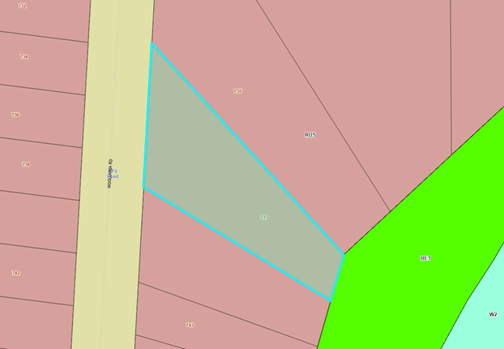
Figure 5: Zoning Map – RU5 - Village
History
On 5
September 2023, DA2023/1694 was lodged for a new single storey dwelling with
two lot Torrens title subdivision of the land. As part of the assessment
of the development application, Council’s Flood Engineer identified that
the dwelling house could be supported, on the basis of a better flood outcome
for single residence however the intensification of the land by way of
subdivision did not meet the relevant requirements outlined in Clause 5.21 of
Shoalhaven LEP 2014 and Chapter G9 of Development Control Plan 2014.
Following
a detailed assessment of amended plans and documentation provided by the
applicant (that deleted the two lot Torrens title subdivision from the proposed
development), this development application was approved on 6 December 2023 for
demolition of existing dwelling and construction of a single storey replacement
dwelling only.
On 8
May 2024 pre-lodgement advice was provided for concept plans showing the
construction of three (3) attached dwellings in addition to the approved
detached dwelling (issued under DA23/1694 as modified by MA2024/1346) to form a
multi-dwelling housing development. Refer to pages 18-19 in Attachment 3.
Despite
the provided pre-lodgement advice, the current development application,
DA2024/1589 for multi-dwelling development was lodged on 30 July 2024. The
development application was notified between 22 August and 5 September 2024.
Five submissions were received all objecting to the proposed development.
Council
issued three Requests for Information (RFIs):
· First
RFI (21 August 2024): Sought clarification on the proposed modification to
DA23/1694 and requested an amended landscape plan demonstrating compliance with
Chapter G13 of the DCP. The Applicant responded on 26 August 2024.
· Second
RFI (10 September 2024): Requested details on floodplain management, impacts on
adjoining Crown land (following review of the proposed development by the
Department of Planning, Housing and Infrastructure),
the proposed development’s interaction with a low-pressure sewer pipe
(following Shoalhaven Water review), and further clarification on the proposed
modification. The Applicant responded on 13 September 2024.
· Third RFI (29 October 2024): sought clarification of
floodplain management issues. The applicant responded on 22 November 2024.
In
addition to the abovementioned RFI requests, Council held an online meeting
with the landowner’s and their representatives on 29 October 2024 to
discuss the development application.
On 8
November the applicant requested an extension of time to respond to the third
RFI. The development assessment officer provided an extension to submit a
response to the RFI until 26 November 2024.
On 6
January 2025 the application requested a further meeting to discuss the
development application and flood concerns raised by Council’s flood
planning section.
On 21
January a meeting was held in person in Council chambers with Council staff and
the landowners, while the landowner’s representatives attended online.
On 12
March 2025, the Applicant lodged a Class 1 appeal against Council’s
deemed refusal.
On 29
August 2025 a Land & Environment Court section s34 conciliation conference
was held on the subject site. Council and the Applicant could not reach an
agreement due to flood planning contentions.
On 23
September 2025 Council resolved to call in development application DA2024/1589
for determination citing public interest and any further additional information
the applicant provides to Council staff prior to the matter being reported back
to Council be taken into consideration (MIN25.372).
On 7
October 2025 the Applicant provided further information in the NSW Planning
Portal.
On 12 November 2025Council
assessment staff held a meeting with the applicants to discuss the remaining
outstanding issues for the proposal.
On 13 November 2025 the
applicant responded to two (2) of the issues by providing updated landscape
plan and section plan.
On 4 December 2025 the applicant emailed the following four
(4) additional documents to council after the Business Paper for the Ordinary
meeting on Tuesday 9 December 2025 had been published on council’s
website:
· Covering
Letter dated 4 December 2025
· Letter
from Northrop Engineers dated 20 November 2025 addressing structural integrity
of the proposed development when flood inundated (Attachment 22)
· Acid Soil
Management Plan prepared by Terra Insight dated 28 November 2025 (Attachment
12)
· Adaptable
Housing Assessment Report dated 17 November 2025 prepared by the applicant
(Attachment 13)
Issues
Flooding
Development
assessment must consider clause 5.21 – Flood Planning of Shoalhaven LEP
2014 and Chapter G9 of Shoalhaven DCP 2014 with regard to the flooding
considerations relevant to this proposal.
Applicant’s Submission
The
Applicant has provided the following flood related material to support the
proposed development:
· RFI
Cover Letter (D24/509783, Attachment 4)
· Response
to SCC (Rienco Consulting) (D24/509764, Attachment 5)
· Flood
Risk Management Peer Review (Woolacotts) (D24/509766, Attachment 7)
· Suitability
of Material or Construction Method Report (D24/509768, Attachment 6)
· Flood
Affectation Report (D24/509770, Attachment 8)
· Emergency
and Evacuation Plan (D24/509773, Attachment 9)
· Flood
Evacuation Map (D24/509779, Attachment 10)
· Hydraulic
Model Results (D25/443416, Attachment 11)
· Northrop
Engineers Letter dated 20 November 2025 addressing structural integrity of
proposed development when flood inundated (Attachment 22)
Discussion
Flood Planning Assessment
– Shoalhaven LEP 2014 Clause 5.21
Clause 5.21 of Shoalhaven LEP 2014
sets out two key legal requirements. Firstly, under subclause (2), Council
cannot approve development on land identified as being in a flood-prone area
unless it is satisfied that the proposal meets specific flood related safety
and planning criteria. This means, Council cannot approve development
on land that is prone to flooding unless it is satisfied that the proposal
meets all of the following conditions:
1. Flood
Compatibility (Clause 5.21(2)(a)): The development must work with the
natural flood patterns of the land. It should not interfere or change how
floodwaters flow across the site.
2. No
Increased Flood Risk to Other Properties (Clause 5.21(2)(b)): The
development must not make flooding worse for nearby properties or increase the
risk of damage elsewhere. The letter from Northrop Engineers dated 20 November
2025 advises that the buildings will be designed and certified to resist flood
forces up to PMF events.
3. Safe
Occupation and Evacuation (Clause 5.21(2)(c)): The development must not adversely affect the safe occupation and efficient
evacuation of people or exceed the capacity of existing evacuation routes for
the surrounding area in the event of a flood.
4. Risk to life is managed (Clause
5.21(2)(d)): The development must include measures to protect
people’s lives during a flood, such as safe building design and emergency
plans.
5. No Harm to the Environment (Clause 5.21(2)(e)): The development must not cause unnecessary erosion,
damage to riverbanks or vegetation, or other environmental harm.
Secondly, when assessing a
development application on flood-prone land, in accordance with subclause (3),
Council must consider the following:
1. Climate
Change Impacts (Clause 5.21(3)(a): Whether the development could be
affected by future changes on flood behaviour due to climate change.
2. Design
and Size of Buildings (Clause 5.21(3)(b): Whether the buildings are
designed and scaled appropriately for a flood-prone area.
3. Safety
and Evacuation Measures (Clause 5.21(3)(c): Whether the development
includes features that reduce risk to life and allow people to evacuate safely
during a flood event.
4. Flexibility
for Future Changes (Clause 5.21(3)(d): Whether buildings can be moved,
modified, or removed if flooding or coastal erosion affects the area in the
future.
As identified in the Section 4.15
Assessment Report (Attachment 3), Council assessment staff have considered the
requirements of clause 5.21 of Shoalhaven LEP 2014 and Chapter G9 of Shoalhaven
DCP 2014.
It has been determined that the
proposed development does not meet the flood planning requirements under Clause
5.21 of the Shoalhaven LEP 2014 as outlined below:
1. Compatibility
with Flood Function and Behaviour (Clause 5.21(2)(a))
· The
Flood Impact Statement assumes the development is compatible with flooding
simply because the area is already a high hazard. However, it doesn’t
explain how the land behaves during floods or provide enough detail to confirm
the development is compatible with that behaviour.
· The
development increases the intensity of use in a high-risk flood zone, which
could change how floods behave both on the site and nearby. The Flood Impact
Statement acknowledges it “does not address flood behaviour for other
sites within the overall catchment,” which is essential consideration in
assessing flood compatibility.
2. Safe
Occupation and Evacuation (Clause 5.21(2)(c))
· The
proposal does not demonstrate that the development will not adversely affect
the safe occupation and efficient evacuation of people during the event of a
flood. In a major flood (PMF), the evacuation route could be cut off within two
hours, but the NSW SES Timeline Evacuation Model (best practice for evacuation
capabilities) identifies that the time required to evacuate would require a
minimum of 3.3 hours. This means that the time needed to evacuate exceeds the
available time on site.
· The
site lacks a formal flood warning system, and the SES has no additional
forecasting tools for the catchment. This means local SES units are also likely
to be cut off during a flood, limiting their ability to assist. This is because
the nearest SES units to the site are in Nowra and St Georges Basin. In a flood
event, both these units would likely be cut off from access to the site and its
locality due to local flooding of access roads. Therefore, there would be no
way for them to access the site or its locality to undertake door knocking and
to assist in evacuation. It is noted that door knocking is the only reliable
way of communicating an evacuation order.
· The
submitted evacuation plan relies on trespass over Crown land. Despite the
likelihood of such an evacuation occurring during an event, Council does not
have the judicial authority to approve access over third party land without the
consent of the Crown, which has not been given. (Attachment 9).
· These
factors indicate that safe evacuation cannot be readily achieved. In McCarthy v
Shoalhaven City Council [2025] NSWLEC 1643 (1 Wharf Road) the Court was
ultimately satisfied that evacuation was feasible as an appropriate risk
management response. The judgement held that development on flood affected land
was not precluded and that the decision maker must have reasoned satisfaction
that evacuation can be achieved, rather than eliminating all risk.
Council’s consultant legal team has provided advice which notes that the
subject proposal is distinguishable from Wharf Road for three reasons:
o Greater scale and
intensity – the proposal comprises three (3) new dwellings in addition to
the approved replacement dwelling, which will create a situation where multiple
households and vehicles would need to evacuate at the same time;
o High Hazard Flood Storage
– the location has a more severe hazard profile with a longer duration of
inundation and the likelihood of evacuation routes being cut significantly
earlier relative to the time needed for evacuation; and
o The proposal identifies a
timing deficit between the evacuation timeline (3.3 hours) and the closure of
the evacuation route (2 hours) – resulting in operational access for the
SES being potentially impeded.
Council’s preliminary legal
feedback is that these matters were not present, or not to the same degree, in
Wharf Road, where the Court emphasised modest scale and practicable evacuation
with conditions. The legal advice concludes that the Court’s findings in
Wharf Road support the staff recommendation.
3. Managing
Risk to Life (Clause 5.21(2)(d))
· The
applicant proposes a shelter in place strategy; however, this is unsuitable
given the site’s high hazard classification, prolonged inundation periods
(up to 7.5 hours in a 1% AEP flood event and 30+ hours in a PMF), and lack of access to essential
services during flood events.
· The
ground floor habitable floor level (bed 1 & 2 and general areas) meets the
1% Flood Planning Level for 2050 level while being 1.5m below the PMF level.
· The 1st
floor habitable floor level (bed 3) is at 4.35m AHD (50mm) above the PMF level.
This means occupants in a PMF level event would be stuck on the first floor for
up to 30 hours with limited access to sustenance and facilities (food, drink,
sanitary facilities).
· The
site would be inaccessible to essential services during flood events, posing
unacceptable safety risks to the occupants of multiple dwellings and emergency
personnel, thereby placing undue strain on emergency services.
· The
application lacks sufficient detail to assess the long-term acceptability of
site isolation under a shelter-in-place strategy.
· The
site and proposed development are inconsistent with the NSW Department of
Planning, Housing and Infrastructure’s 2024 shelter-in-place guidelines
for flash flooding (SIP) and lacks sufficient
information to demonstrate the acceptability of long-term isolation. The SIP guidelines also do not apply to sites affected by
High Hazard floodway, H5 or H6 areas or where inundation could exceed a maximum
12-hour period. Additionally, Council lacks an adopted policy to determine the
suitability of shelter-in-place as an emergency management strategy.
· Overall,
the intensification of development creates multiple households on a single site
and creates unnecessary risk to life and emergency response capability.
Flood Planning Assessment
– Shoalhaven DCP 2014 Chapter G9
The proposed development does not
comply with the following performance criteria in Chapter G9 of Shoalhaven
Development Control Plan (DCP) 2014:
i. The
development will not increase the risk to life or safety of persons during a
flood event on the development site and adjoining land.
ii. The
development will not unduly increase dependency on emergency services.
The proposed development is likely
to increase risk to life and safety during flood events, given that evacuation
is agreed by the applicant and Council flood engineers to be unfeasible.
The applicant’s reliance on
shelter in place for 7.5 hours during a 1% AEP event and up to 30+ hours in a
PMF event for four (4) dwellings is a much higher risk to life than the
decision for 1 Wharf Road where the Court required mandatory evacuation for a
single dwelling where shelter in place was not feasible.
Leaving 4 households stranded in a
PMF event for up to 30 hours will require emergency services to monitor these
residents for any emergency medical, food and or rescue needs as they will not
be able to leave the site. These factors collectively indicate that the
proposal does not meet the flood risk management objectives of the DCP and are
a threefold increase on the level of risk due to the number of additional
dwellings compared to the single dwelling (1 Wharf Road).
Acid Sulfate Soils
Development assessment must consider
clause 7.1 – Acid Sulfate Soils of Shoalhaven LEP 2014 and Chapter G26 of
Shoalhaven DCP 2014 with regard to the acid sulfate soils considerations
relevant to this proposal.
Applicant’s Submission
The applicant has provided a new
Acid Soil Management Plan prepared by Terra Insight dated 28 November 2025 (Attachment
12) to support the development application.
Discussion
The new Acid Soils Management Plan by Terra Insight
confirms staff concerns that the site is constrained by the presence of acid
soils. It has appropriately assessed the site and developed a plan for the
management of soils during demolition/construction.
The
Management Plan provides numerous management requirements within the body of
the report which include a required treatment application rate of lime (33kg
CaCo3 per tonne) to neutralise acid, restrictions on excavation period for
soils untreated and treated, liming of strip footings and dewatering protocols.
If
Council were of a mind to approve the application, then all the requirements of
the Acid Soil Management Plan (Part 6 of the Plan report) would need to be
complied with to minimise the potential for a pollution incident to Currambene
Creek. Thus a condition is included in the draft consent conditions requiring
that the erosion and sediment control plan must include the soil stockpile
areas and treatment pad in accordance with this plan and that all demolition
and construction activities carried out on the site for DA2024/1589 and
DA20223/1694 (as amended by MA2025/1346) must comply fully with the
Recommendations of Part 6 Of the Terra Insight Acid Soil Management Plan (Ref:
TERRA22-327.ASSMP Rev 0) dated 28 November 2025. (Attachment
21).
Compliance
with the National Construction Code (NCC formerly BCA) – Ceiling Heights
The development application must
consider compliance with the Building Code of Australia (BCA).
Applicant’s Submission
The
applicant has provided revised architectural drawings (in particular DA3.00
(Rev D) (D25/536348) Attachment 17) to support the development
application.
Discussion
The revised section plans DA3.00
(Rev D) received 13 November 2025 clarify that minimum floor to ceiling height
for bed 2 complies with NCC requirements.
Liveable
Housing Compliance
Development
assessment for multi dwelling housing must consider Silver Level requirements
in the Liveable Housing Design Guidelines (LHDG) in accordance with Section
5.4.3 of Chapter G13 of Shoalhaven DCP 2014.
Applicant’s Submission
The
applicant has now provided an Adaptable Housing Assessment Report, dated 17
November 2025 and prepared by the applicant (Attachment 13 - D25/570607)
to support the development application.
Discussion
The
following aspects are relevant as background in this regard
Accessibility – Is the greatest degree of features/elements in a
building to accommodate people with a disability. Full compliance with
AS1428.1-2021 is required by the Building Code of Australia (BCA)/National
Construction Code (NCC) for most Classes of buildings, but not Class 1a.
AS1428.1-2021
was adopted by an Amendment to BCA 2022 on 29 July 2025, superseding
AS1428.1-2009.
Adaptability – Housing that is designed in a way that it can be
easily adapted at a minimal cost to suit individual requirements/circumstances.
Compliance with the essential and desirable features of one of the three
Adaptable House Classes in AS4299-1995 Adaptable housing, depending upon the
site constraints.
AS4299
contains reference to compliance with AS1428.1 for some of the features. AS4299
requires a post-adaptation plan to be provided to demonstrate that the proposal
can comply with the objectives, performance requirements and minimum
requirements in AS4299.
Adaptable
housing is not required by the BCA/NCC. The need to provide adaptable housing
arises from planning instruments, such as SEPP’s, LEP’s and
DCP’s, and hence AS4299 is not referenced in the BCA/NCC. Compliance with
conditions of development consent regarding adaptability can form part of a
Construction Certificate (CC) assessment.
Liveability – This requires the least measures in the building
and is a building that is designed and constructed to meet the changing needs
of occupants in their lifetime. For many years, liveability for Class 1a was
required only by planning instruments. The planning instruments often
referenced the Liveable Housing Design Guidelines (LHDG). The LHDG contains
three performance levels, with the Silver Level (the minimum requirement) only
requiring 7 elements to be addressed.
In
BCA/ NCC 2022, the Australian Buildings Code Board (ABCB) introduced liveable
housing design (Part H8 of the BCA Vol 2). However, there was a variation that
excludes NSW from those requirements. Currently, any liveability requirements
for dwellings in NSW remain requirements of planning instruments. Compliance
with conditions of development consent regarding liability can form part of a
CC assessment.
At
least one dwelling is required to meet Silver Level standards. The
applicant claims all three new dwellings can comply with LHDG and also
indicates that the dwelling approved under DA23/1694 will be liveable and
adaptable under AS4299.
Comments - Council Certifier
It does not appear that liability to
the proposed three dwellings on the property has been fully addressed in this
latest submission. The current plans do not address concerns that were raised
in earlier referral comments.
With respect to the existing
approved dwelling, the revised Adaptability Report and post-adaptation plan
have not demonstrated that compliance with AS4299 can be achieved with the
submitted design. Refer to the s4.15 assessment report (Attachment 3)
for full detail of the deficiencies identified.
Revision to the adaptability report
and floor plans will be required to address AS4299. It is strongly recommended
that a suitably qualified person be engaged to assist in the design and
preparation of these plans and documentation should the matter proceed.
If Council is of a mind to approve the application a draft condition is
proposed requiring amended plans (Attachment 21).
Biodiversity
Development
assessment must consider the Biodiversity Conservation Act 2016, Chapter G3:
Landscaping Desing Guidelines and Chapter G5: Biodiversity Impact Assessment of
Shoalhaven DCP 2014 with regard to the biodiversity considerations relevant to
this proposal.
Applicant’s Submission
The Applicant has provided the
following biodiversity related material to support the proposed development:
· Arborist Impact Assessment (D25/443439, Attachment 14)
· Bushfire Assessment Report (D25/443438, Attachment 15)
· Site Plan – Rev. D (D25/443434, Attachment 16)
· Landscape Plan (D25/536335, Attachment 18)
Discussion
The two Swamp Mahogony trees
on site provide suitable breeding and foraging habitat for some mobile native
species, as such they represent valuable habitat. The current plans include the
removal of one of the large Swamp Mahogany tree (tree 2) along the western
boundary of the site. The presence and required removal of this large tree was
not shown in previous iteration of the site plans, although the location of the
impacting driveway has not changed.
In
accordance with the Biodiversity Conservation Act 2016, Section 1.3(k),
as amended by the Biodiversity Conservation Amendment (Biodiversity Offsets
Scheme) Act 2024 No 96, developments must apply the avoid, minimise and
offset hierarchy in their plans to ensure a proposed development avoids,
minimises and/or offsets any proposed impacts on biodiversity regardless of
entry into the Biodiversity Offset Scheme (BOS). Therefore, the applicant
must demonstrate how the impacts have been avoided, minimised and offset.
Avoidance is best achieved by first my investigating other design concepts that
avoid impacts to native vegetation and/or native species. Where complete
avoidance cannot be achieved, minimisation of impacts must be demonstrated
before offset/compensatory measures are applied.
An updated landscape plan
DA6.00 Rev B provides mitigation/offset of impacts required by providing
supplementary and complimentary planting on the site. A suitable
replacement tree for the Swamp Mahogany should be selected in accordance with
the Shoalhaven Tree Species list – Woollamia and native flora species
consistent with vegetation in the locality. Exotic species must not be
used. This matter could be dealt with by condition if Council is minded
to grant consent.
External Consultations
Crown
Land – Objection
Crown
Lands advised on 3 October 2023, that the developer cannot use adjacent Crown
Land (Reserve R755928) for access in relation to DA23/1694 (for the existing
approved dwelling house). On 29 August 2024, the Department of Planning,
Housing and Infrastructure (DPHI) issued a referral response objecting to the
current proposal, with reasons detailed in that correspondence.
DPHI
policies require new developments to be designed with setbacks and fire breaks
to avoid impacting Crown land. This includes avoiding use of Crown land for
asset protection zones, emergency access, or perimeter trails,
unless explicitly permitted.
In this
case the relevant Crown Land reserve is currently under Aboriginal Land Claim
and as such Crown Lands do not provide any private development with the
opportunity to make any application impacting the reserve until such time as
all land claims have been resolved.
DPHI has
not given permission for the developer to lodge applications that involve the
use of Crown Land. The Department continues to oppose the proposed development,
consistent with its previous communications.
Both the
approved development (DA23/1694) and the current application (DA2024/1589)
should be amended to remove any impact on Crown Land including deletion of the
proposed access gate.
Further
details are available in the Department’s referral responses (see Attachments
19 and 20).
Community Consultations
Five
(5) public submissions were received in relation to Council’s
notification of the development. All five (5) submissions were objections
to the development. The notification was made in accordance with
Council’s Community Consultation Policy with letters being sent within a
25m buffer of the site. The notification was for a two week period.
Key
issues raised as a result of the notification are provided below.
Flooding
and Emergency Risk
· The
site is located in a high hazard flood storage zone, with frequent flooding
observed over recent years.
· Increasing
the number of dwellings from one to four could result in up to 24 residents,
placing strain on emergency services during flood or fires.
· The
flood impact statement is inadequate and outdated, failing to reflect recent
flood events and climate change impacts.
Infrastructure
Limitations
· The
development would intensify pressure on already limited services and increase
traffic and parking demands.
Inappropriate
Scale and Density
· Overdevelopment
of the site.
· The
development represents medium/high density housing, which is incompatible with
Woollamia’s character of single, low-rise cottages.
Zoning and Planning Concerns
· Woollamia is zoned RU5 – Village,
intended to preserve its rural and low-density character.
· The proposal does not align with the
intent of the zoning or with the surrounding RU2 – Rural Landscape areas.
· Approval would set a precedent for
future multi-dwelling developments, risking permanent change to the
village’s identity.
Financial Implications
Financial
Implications Arising from Refusal Decision
The applicant lodged an appeal on
12 March 2025 with the NSW Land and Environment Court (LEC) on the grounds of
deemed refusal. There are significant costs associated with defending a
refusal.
Potential
Financial Implications Arising from Approval Decision
There
are potential cost implications for Council in the event of an approval of the
application. If the Council were to grant consent to the DA and either
inadvertently or intentionally fail to take into account, the jurisdictional
requirements at clause 5.21 of the SLEP2014:
a) Council
may incur personal liability and not benefit from protections and indemnity
afforded by section 733 of the Local Government Act 1993 if an aggrieved party
was also able to establish some form of harm and causation; and
b) it
would be open for a third party to challenge the validity of the consent in the
Land and Environment Court by way of proceedings pursuant to section 9.45 of
the Environmental Planning and Assessment Act 1979. Council may incur costs
associated with defending third party appeal in the Land and Environment Court
of NSW.
Legal Implications
Section
733 Local Government Act 1993
Section
733 of the Local Government Act 1993 provides that a Council does not incur any
liability with anything done, including the granting or refusal of consent to a
development application with respect to flood liable land, so long as it has
been done in good faith by the Council in so far as it relates to the
likelihood of land being flooded or the nature or extent of any such flooding.
Section 733 of the Local Government
Act 1993 provides local councils and statutory bodies representing the Crown,
including a councillor or an employee, with a limited legal indemnity for
certain advice given that relates to the likelihood of flooding or the extent
of flooding.
Clause 5.21 Flood Planning of
Shoalhaven LEP 2014 is a jurisdictional requirement and must be appropriately
considered by Council prior to determination being made.
If Council were to grant consent to
the DA and either inadvertently or intentionally fail to consider the
jurisdictional requirements at clause 5.21, Council may incur liability, as set
out above, if an aggrieved party was also able to establish some form of harm
and causation.
It would also be open for a third
party to challenge the validity of the consent in the Land and Environment
Court by way of proceedings pursuant to section 9.45 of the Environmental
Planning and Assessment Act 1979.
The
Act also provides that a council that acts in accordance with the Manual
relating to the management of flood liable land is taken to have acted in good
faith in relation to advice given, or things done or not done, relating to the
likelihood of flooding or the extent of flooding.
Summary and Conclusion
There
have been significant changes to planning for development in flood prone areas
in recent years following catastrophic flood events across NSW in 2022.
For
example, in February 2022, flooding in Lismore far exceeded the 1% AEP (1 in
100 year) event by 2 metres. Even the 0.2% AEP (1-in-500 year) event was
exceeded by 1.4 metres.
As a
result of the 2022 floods, the NSW Government Flood Inquiry made
Recommendations 18 and 21 which establish a risk-based approach when making
decisions on developing flood prone land.
Planning
Circular PS 24/001 (1 March 2024) provides guidance to decision makers on
determining development proposals under clauses 5.21 and 5.22 of the LEP,
recommending the application of a risk-based approach.
The
applicants have consistently acknowledged safe and efficient evacuation by the
NSW State Emergency Service (SES) cannot be relied upon and therefore the
proposal must, by default, rely on sheltering in place.
The
NSW Shelter in Place guidance acknowledges that this is not a design or safety
solution without risk. It recommends that the duration of shelter-in-place due
to isolation by floodwaters is less than 12 hours and not subject to
high hazard flooding in scenarios which include the Probable Maximum Flood
(PMF). The current proposal is in a high hazard flood storage area and relies
on shelter-in-place for up to 30 hours during a PMF event which is
contrary to the guidance.
The
proposal will further exacerbate these issues by increasing the number of
people on site who will potentially be vulnerable to flooding events in the future. Despite
the applicant’s position that this does not constitute intensification,
the NSW Land & Environment Court has accepted in Giacometti v Inner West
Council [2021] NSWLEC 1438 that “the proposed development for the
conversion of an existing dwelling house into three (3) separate residential
units results in an intensification of use on a flood control lot in an area of
high hazard category flood risk.”.
This
development proposal increases the risk by introducing three (3) additional
households (above the existing single approved household) in an area with an
unacceptable risk profile. Conservatively, that is potentially 7 additional
people (based on the census average of 2.3 persons per household) but
potentially far more who could be at risk in a future flood event and who will
then have to deal with the associated human impacts. If similar intensification
were replicated across other flood-affected properties, the cumulative impact
on evacuation capacity for the emergency services would most likely be severe
and unsustainable.
Recently
a range of broader research has also been released about the risks of housing
developments expanding into areas with high natural hazard risk and associated
impacts (e.g. insurance costs) on affected or impacted households.
Locations
where evacuation out of the floodplain is not possible before inundation, such
as 737 Woollamia Road, may require flood rescue operations by NSW SES
volunteers during flood events. When the duration of isolation is extensive,
i.e., longer than 12 hours, users of the site may change their mind regarding
sheltering in place whilst surrounded by flood water. This scenario and
potentially others would compel SES volunteers to divert limited resources (if
available) to undertake rescue operations in high flood hazard areas putting
the users of the site and the volunteers undertaking such rescue operations at
an unacceptable and avoidable risk.
Furthermore,
Council has never adopted or accepted shelter-in-place as an emergency response
strategy previously and a decision in favour of this may set an undesirable
precedence. The use of shelter-in-place should be investigated in a
catchment-wide assessment through a Flood Risk Management Study and Plan to
fully understand the inherent risk, liability, cumulative impact and its
suitability as a strategy, before adopting shelter in place in lieu of
evacuation as an accepted response.
Based
upon the recommendations of the s4.15 Assessment Report (Attachment 3),
Development Application No. DA2024/1589 is recommended for refusal for
the following reasons:
|
Reasons for Refusal
|
|
1)
|
Pursuant to Section 4.15(1)(a)(i) of the Environmental
Planning and Assessment Act 1979, the proposal is non-compliant with the
jurisdictional requirements set out in clause 5.21 of the Shoalhaven LEP 2014
and inconsistent with the clause objectives.
|
|
2)
|
Pursuant to Section 4.15(1)(a)(i) of the Environmental
Planning and Assessment Act 1979, the proposal is non-compliant with the
jurisdictional requirements set out in clause 5.22 of the Shoalhaven LEP 2014
and inconsistent with the clause objectives.
|
|
3)
|
Pursuant to Section 4.15(1)(a)(i) of the Environmental
Planning and Assessment Act 1979, the proposal is non-compliant with the
development controls set out in Chapter G5: Biodiversity Impact Assessment
and Chapter G9: Development on Flood Prone Land of Shoalhaven DCP 2014 and is
inconsistent with the acceptable solutions.
|
|
4)
|
Pursuant to Section 4.15(1)(c) of the Environmental
Planning and Assessment Act 1979, the proposed development may have an
adverse likely social and economic impact as a result of flooding impacts.
|
|
5)
|
Pursuant to Section 4.15(1)(c) of the Environmental
Planning and Assessment Act 1979, the information submitted with the
development application does not satisfactorily demonstrate that the site is
suitable for the proposed use.
|
|
6)
|
Pursuant to Section 4.15(1)(e) of the Environmental
Planning and Assessment Act 1979, having regard to the above matters to
address the relevant provisions of Environmental Planning and Assessment Act,
1979, the granting of development consent is not considered to be in the
public interest.
|
|
|
Ordinary Meeting – Tuesday
16 December 2025
Page
0
|
CL25.428 Tenders
- Culburra STP Upgrades
HPERM Ref: D25/466774
Department: Water
Asset Planning & Development
Approver: Andrew
McVey, Director - Shoalhaven Water
Purpose:
To inform Council of the tender
process for Culburra STP Upgrades.
In accordance with Section
10A(2)(d)(i) of the Local Government Act 1993, some information should remain
confidential as it would, if disclosed, prejudice the commercial position of
the person who supplied it. It is not in the public interest to disclose this
information as it may reveal commercial-in-confidence provisions of a contract,
diminish the competitive commercial value of any information to any person
and/or prejudice any person’s legitimate business, commercial,
professional or financial interests. This information will be considered under
a separate confidential report.
|
Recommendation
That Council consider a separate
confidential report in accordance with Section 10A(2)(d)(i) of the Local
Government Act 1993.
|
Background
Project
Descriptions
Shoalhaven Water has identified
Sewage Treatment Plants (STP) through the Shoalhaven Local Government Area
which require asset renewal/upgrades to meet current and future planned
inflows. The upgrade of the Culburra STP has been identified as an immediate
improvement need to facilitate the expected capacity growth within the Culburra
catchment.
Identified upgrade Works for the
Culburra Sewage Treatment Plant entails:
Inlet Works
· Remove
existing grit chamber internals and grit washing equipment.
· Install
new grit removal mechanical equipment.
· Remove
the existing step screen and washing system.
· Install
the new flow through band screen and associated screenings washing system.
· Modification
to the existing channel structure to suit the new Screen.
· New
Electrical switchboard (or modification) and all new wiring to suit.
Aeration Works
· Modify
existing blower set such that all four feed a common header (all blowers can
feed a single reactor) before splitting to each reactor.
· Install
actuated valves on the header to control airflow between reactors, this
requires modification to the control system such that reactor cycles are
180° out of phase.
· Install
additional instrumentation (aeration header flow meter, temp and pressure
protection and reactor dissolved oxygen probes) for system control.
· Install
new diffused aeration grids within each reactor to transfer the peak aeration
requirements.
Sludge Lagoon Works
· Reshape
the sludge lagoons to repair damage.
· Install
wave protection.
· Install
of concrete apron surrounding each lagoon.
· Install
overflow pipework from supernatant pump station to storm storage.
· Install
concrete base suitable for retrofitting aeration bridges columns in the future.
· Install
HDPE liner anchored to the concrete base.
· Install
new inlet / outlet points and access bridges.
· Install
of handrails to the perimeter of the lagoons
· Install
emergency egress matting.
· Install
of liner Vent.
· Install
of protective apron.
Tendering
Council called tenders for Culburra
STP Upgrades on 16 October 2025 which closed at
10:00 am on 17 November 2025. 1 tender were received at the time of
closing. Tenders were received from the following:
|
Tenderer
|
Location
|
|
AJM United Steels Pty Ltd
|
Auburn NSW 2144
|
Details relating the evaluation
of the tenders are contained in the confidential report.
Risk Implications
Procurement-related risks have
been addressed in accordance with Council's established procurement procedures.
Risks arising during the construction phase will be managed through Shoalhaven
Water’s project management practices.
Internal Consultations
Council’s Procurement Team
was consulted during the procurement process to provide oversight and guidance
regarding financial limitations, delegations, and statutory provisions for the
procurement of the works.
Consultation with Shoalhaven
Water’s Wastewater Operations team was also undertaken to coordinate
planned works.
The Review of Environmental
Factors (REF) for the planned upgrade was prepared by Council’s internal
Environmental Officers to clarify constraints associated with the proposed
works.
External Consultations
External design by Hunter H2O
Holding Pty Ltd (BECA) was utilsed as design documentation; as part of their
overall engagement by Council.
Community Consultations
The primary stakeholder during
the design development phase has been the adjacent landholding developer,
Sealark Pty Ltd.
Community and stakeholder
engagement during the construction phase is planned, with a dedicated project
webpage to be established under Council’s Major Projects & Works
portal.
Policy Implications
Nil. The tender process has
followed the requirements under the provisions of the Local Government Act
1993. The tenders were assessed in accordance with Council’s Local
Preference Policy.
Financial Implications:
Sufficient funds have been
allocated in the Sewer Fund in the 2025-2026 Financial Year. Funding is
available to cover both the tender amount and all other anticipated project
costs.
The project is supported by a
substantial grant by the NSW State Government under the Department of Planning,
Housing and Infrastructure’s Accelerated Infrastructure Fund –
Round 3.
|
|
Ordinary Meeting – Tuesday
16 December 2025
Page
0
|
CL25.429 Connection
to Town Sewerage System - 99B Garrads Lane Milton
HPERM Ref: D25/492383
Department: Water
Asset Planning & Development
Approver: Andrew
McVey, Director - Shoalhaven Water
Purpose:
Shoalhaven Water is in receipt
of an application under the Non-Urban Wastewater Connection Policy to connect
Proposed Lot 102 in approved subdivision SF10165, being 99B Garrads Lane Milton
to Council’s Sewerage System. Such an application requires Council
resolution under its Non-Urban Wastewater Connection Policy for approval to
proceed.
|
Recommendation
That
Council approve the connection of Proposed lot 102 in SF10165, 99B Garrads
lane Milton to the Milton-Ulladulla Sewerage Scheme by a pressure sewer
system, subject
1. The
landowner applying for a Certificate of Compliance under Section 305 of the
Water Management Act.
2. The
applicant complying with all conditions as specified in the Shoalhaven Water,
Water Development Notice issued under Section 306 of the Water Management Act.
|
Background
The property at 99B Garrads Lane
Milton contains and existing dwelling with onsite wastewater disposal, and an
application for a 2-lot rural subdivision, Council file SF10165, was approved
in 2010 with conditions for onsite wastewater disposal for the additional
vacant lot. Since then, the environmental standards have changed substantially
following the introduction of Chapter G8 of the Shoalhaven Development Control
Plan 2014 (DCP 2014) and the site would no longer be considered as suitable for
onsite disposal. The main inhibiting factors have been identified as:
· no
reserve area included in the original wastewater assessment.,
· rocky
clay soils on the site require a large amount of land for effluent disposal.,
· The
natural contours of the land are at slopes of greater than 20%.
As part of construction of a
residential subdivision in Eyrie Bowrie Drive (immediately to the west of the
subject lot), a pressure sewer main was installed to connect the subdivision to
town sewer. It is now feasible to connect Proposed Lot 102 in SF10165 to the
Eyrie Bowrie Drive pressure sewer main with a connection through No. 33 Eyrie
Bowrie Drive (refer to Figure 1 & 2 below).
Figure
1
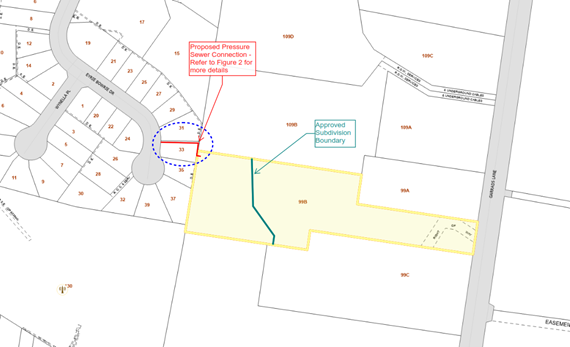
Figure 2
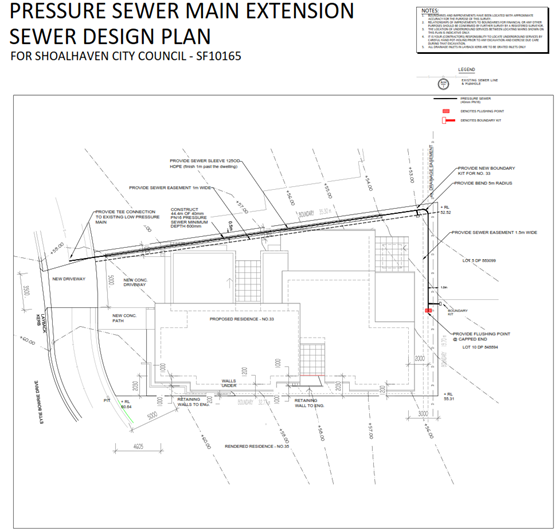
All pressure sewer designs, and
construction works are at the applicant’s expense, along with the payment
of a once off separate system connection fee to entitle Proposed Lot 102 to
connect to Town Sewer.
Risk Implications
The environmental risk
implications will be reduced following a successful connection to Council sewer
system with a pressure sewer option. Pressure sewer systems are fully sealed
and therefore significantly reduce risk of overflows. Shoalhaven Water has
installed more than 1000 similar systems in other low lying and flood
susceptible areas such as Lake Conjola, Woollamia, Lake Tabourie and Currarong.
Internal Consultations
Council Environmental Services
Unit is supportive of the connection to the Town sewerage system as the
applicant has demonstrated that sustainable onsite wastewater disposal is
impractical due to the site constraints (refer to email dated 17/11/2025
D25/543074).
Shoalhaven Water has reviewed
the wastewater hydraulic model and there is capacity within the existing system
for the additional loading.
External Consultations
The applicant has successfully
negotiated with the adjoining landowner at no. 33 Eyrie Bowrie Drive regarding
the creation of an easement for sewerage and construction works within the lot
(noting that construction of a dwelling at 33 Eyrie Bowrie Drive has recently
commenced) and has provided Council with a copy of a deed of agreement between
the two parties.
As part of the application to
connect to Town Sewer, the applicant has submitted a report by their nominated
consultant that it is not possible to manage wastewater by onsite treatment.
Community Consultations
No Community consultations have
been carried out as the matter relates to a private development and is dealt
with under Council’s Policy
Policy and Statutory Implications
Assessment
under the Non-Urban Wastewater Connection Policy:
Council’s
policy provides for non-urban zoned properties to connect to the town sewerage
system subject to compliance with Section 3.3 Criteria For Determination of
an Application for a Property to Connect to Council’s Sewerage System,
which states:
“Connection
to Council’s sewerage system will only be made available to non-urban
properties upon written application in the following circumstances:
· Where capacity
exists in the existing system, and
· Where the
current levels of service can be provided, and
· Where the
property is paying the wastewater availability charge.
Properties
not paying the wastewater availability charge will only be considered for
connection to Council’s sewerage system if it is not possible to manage
wastewater by on-site treatment. Approval in this situation is subject to
Council resolution.”
Assessment
in accordance with each of these criteria is outlined below:
· Where
capacity exists in the existing system
The calculated loading is 1.0
Equivalent Tenement (ET). The town sewerage system does have capacity to
support the proposed connection.
· Where
the current levels of service can be provided
Current levels of service via pressure
sewer can be provided.
· Where
the property is paying the wastewater availability charge
The property is not paying the
wastewater availability charge.
Properties not paying the
wastewater availability charge will only be considered for connection to
Council’s sewerage system if it is not possible to manage wastewater by
on site treatment. Approval in this situation is subject to Council resolution.
The current requirements in
Chapter G8 of the DCP 2014 no longer permit onsite sewer management due to the
site constraints and environmental risks.
Council’s Environmental
Services Unit is supportive of a connection to the town sewerage system as it
provides improved environmental outcomes and reduces the risk of wastewater
entering the sensitive land and waterways during a flood event or system
failure
Financial Implications
There are no negative financial
impacts to Council as all works are at the applicant’s full expense,
including payment of the once off Separate System Connection Fee of $8,964.40
(2025/26) and the levying of the wastewater availability charges once it is
connected. Shoalhaven Water will retain ownership of the pressure sewer unit
and therefore be responsible for its maintenance
|
|
Ordinary Meeting – Tuesday
16 December 2025
Page
0
|
CL25.430 Review
of Waste Services Policies
HPERM Ref: D25/421090
Department: Waste
Services
Approver: Andrew
McVey, Director - Shoalhaven Water
Attachments: 1. Waste
Services Fee Waivers and Subsidies Policy (under separate cover) ⇨
2. Waste
Management - Disaster Recovery Policy (under separate cover) ⇨
3. Waste
Disposal - No Charge Tipping Vouchers (under separate cover) ⇨
4. Garden Waste Mulch -
Community Assistance Policy (under separate cover) ⇨
Purpose:
All Public Policies are to be reviewed during the
Council term. The Waste Services Fees and Subsidies Policy is proposed to
replace three existing policies.
The Waste Services Fees and Subsidies Policy (Attachment
1) is presented to Council for consideration. The policy provides a framework and
guidelines for staff when administering requests in respect to these matters. The policy revises and replaces the provisions of:
· Waste Management - Disaster Recovery Policy (POL16/128) (Attachment 2)
· Waste Disposal - No Charge Tipping Vouchers Policy (POL16/169) (Attachment 3)
· Garden Waste Mulch - Community Assistance Policy
– (POL16/170) (Attachment 4)
|
Recommendation
That Council:
1. Adopt the Waste Services Fees and
Subsidies Policy as attached to the report.
2. Rescind the policies listed below,
as the provisions of those policies have been incorporated into the Waste
Services Fees and Subsidies Policy.
a. Waste Management - Disaster Recovery
Policy (POL16/128)
b. Waste Disposal - No Charge Tipping
Vouchers (POL16/169)
c. Garden Waste Mulch - Community Assistance
Policy (POL16/170)
|
Background
The proposal is to combine the three existing Waste
Services policies into one new Waste Services Fees and Subsidies Policy.
The Waste Management - Disaster Recovery Policy was introduced in 2016 to cover
waste produced as a result of significant flooding but incorporates waste
produced through other large scale natural disasters, including flood,
windstorm or tempest, earthquake, tsunami, heatwave, landslides, bushfire, plant
and animal disease or plague, and pandemic.
The policy provides a pre-determined
threshold that will empower Council staff to waiver the tip fees for disaster
generated waste at the Recycling and Waste Depots. This will reduce
delays in waiting for a decision and improve customer service.
Any costs incurred by Waste Services
need to be accounted for within the Waste Operations annual budget. Costs
include staff costs, sorting, transport, machinery, and any material processing
costs. The EPA levy may need to be paid to the State Government in
instances where they have not acknowledged the event to be a Natural
Disaster.
The Waste Disposal -
No Charge Tipping Vouchers policy provides for four no-charge tipping vouchers (two vouchers for
general domestic waste including green waste and two vouchers for green waste
only) to be issued annually for each assessment which is charged for a domestic
waste management service. The cost to
provide the voucher service for financial year 2024, was estimated to be $121 per
voucher using property (less than 60% of properties used their vouchers - 34,364
ratepayers).
The equivalent tipping fee value of
no-charge vouchers during the 2024/2025 financial year was over $4
million. The funding for these vouchers is sourced through the annual
domestic waste management charge (DWMC) and vouchers should therefore only be
distributed to residents who pay the annual DWMC.
The Garden Waste Mulch - Community Assistance Policy allows for Shoalhaven residents and
community to collect processed garden waste mulch from any Recycling and Waste
Depot, when available, for no charge. The requirement is for persons to
load themselves. However, loading equipment is available at the three
larger Depots (West Nowra, Huskisson and Ulladulla) if people would like the
mulch to be loaded for them a nominal loading fee placed on the
transaction.
The Waste Services Fees and
Subsidies Policy allows for non-profit organisations to access the mulch
and other materials at no charge following an approval process, to be approved
by delegated authority to the Waste Services Manager. This will provide clarity and confirmation of
provisions currently outlined in the adopted Fees and Charges.
Internal Consultations
Proposed changes to the policy
were not deemed to be significant and consultation has not been undertaken.
External Consultations
Proposed changes to the policy
were not deemed to be significant and consultation has not been undertaken.
Community Consultations
There is no statutory
requirement to publicly exhibit any of the policies contained in this
report. Council may choose to do so should they consider any changes of
significance.
Policy and Statutory Implications
The policy proposed largely
reflects the intent of the existing approved policy and the approved Fees and
Charges document.
Financial Implications
Changes proposed in the new
Policy will have minimal financial implications to current approved budgets.
The No Charge Tipping Vouchers have a significant impact on budgets
(over $4 million per year). Responding to disaster waste can also have a
significant impact on budgets and is currently not included in Waste Services
budgets. Other aspect of the new Waste Services Fees and Subsidies Policy have
a relatively small impact on budgets.
Risk Implications
There are potential Reputational
risks related to the provision of services that do not meet the expectations of
some members of the community. Conflict sometimes arises when the expectations
of individuals to provide fee waivers go beyond the provisions in the policy.
Financial constraints require
that limitations are made to the fee waivers and support the user pays
principle that helps support the reduction of waste generation.
The policy attempts to give
clarity to staff and the community about when fee waivers are available.
|
|
Ordinary Meeting – Tuesday
16 December 2025
Page
0
|
Local Government act 1993
Chapter
3, Section 8A Guiding principles for councils
(1)
Exercise of functions
generally
The
following general principles apply to the exercise of functions by councils:
(a) Councils should provide strong
and effective representation, leadership, planning and decision-making.
(b) Councils should carry out
functions in a way that provides the best possible value for residents and
ratepayers.
(c) Councils should plan
strategically, using the integrated planning and reporting framework, for the
provision of effective and efficient services and regulation to meet the
diverse needs of the local community.
(d) Councils should apply the
integrated planning and reporting framework in carrying out their functions so
as to achieve desired outcomes and continuous improvements.
(e) Councils should work
co-operatively with other councils and the State government to achieve desired
outcomes for the local community.
(f) Councils should manage
lands and other assets so that current and future local community needs can be
met in an affordable way.
(g) Councils should work with
others to secure appropriate services for local community needs.
(h) Councils should act fairly,
ethically and without bias in the interests of the local community.
(i) Councils should be
responsible employers and provide a consultative and supportive working
environment for staff.
(2) Decision-making
The
following principles apply to decision-making by councils (subject to any other
applicable law):
(a) Councils should recognise
diverse local community needs and interests.
(b) Councils should consider social
justice principles.
(c) Councils should consider the
long term and cumulative effects of actions on future generations.
(d) Councils should consider the
principles of ecologically sustainable development.
(e) Council decision-making should
be transparent and decision-makers are to be accountable for decisions and
omissions.
(3) Community participation
Councils
should actively engage with their local communities, through the use of the
integrated planning and reporting framework and other measures.
Chapter
3, Section 8B Principles of sound financial management
The
following principles of sound financial management apply to councils:
(a) Council spending should be responsible and
sustainable, aligning general revenue and expenses.
(b) Councils should invest in responsible and
sustainable infrastructure for the benefit of the local community.
(c) Councils should have effective financial
and asset management, including sound policies and processes for the following:
(i) performance management
and reporting,
(ii) asset maintenance and
enhancement,
(iii) funding decisions,
(iv) risk management practices.
(d) Councils should have regard to achieving
intergenerational equity, including ensuring the following:
(i) policy decisions are made
after considering their financial effects on future generations,
(ii) the
current generation funds the cost of its services
Chapter
3, 8C Integrated planning and reporting principles that apply to councils
The
following principles for strategic planning apply to the development of the
integrated planning and reporting framework by councils:
(a) Councils should identify and prioritise key
local community needs and aspirations and consider regional priorities.
(b) Councils should identify strategic goals to
meet those needs and aspirations.
(c) Councils should develop activities, and
prioritise actions, to work towards the strategic goals.
(d) Councils should ensure that the strategic
goals and activities to work towards them may be achieved within council
resources.
(e) Councils should regularly review and
evaluate progress towards achieving strategic goals.
(f) Councils should maintain an
integrated approach to planning, delivering, monitoring and reporting on
strategic goals.
(g) Councils should collaborate with others to
maximise achievement of strategic goals.
(h) Councils should manage risks to the local
community or area or to the council effectively and proactively.
(i) Councils should make appropriate
evidence-based adaptations to meet changing needs and circumstances.