Ordinary Meeting
Meeting Date: Tuesday,
25 January, 2022
Location: Council
Chambers, City Administrative Building, Bridge Road, Nowra
Time: 5.00pm
Membership (Quorum - 7)
All Councillors
Note:
An Official Ceremony will be held from 3.30pm prior to the
commencement of the Ordinary Meeting of the Council, which will include:
·
Welcolme to Country
·
Smoking ceremony and Yidaki performance
·
Presentation of Mayoral Chains
·
Mayoral oath and affirmation of office
·
Councillor oaths and affirmations
Please note: The proceedings of this meeting
(including presentations, deputations and debate) will be webcast and may be
recorded and broadcast under the provisions of the Code of Meeting
Practice. Your attendance at this meeting is taken as consent to the
possibility that your image and/or voice may be recorded and broadcast to the
public.
Agenda
1. Acknowledgement of Country
2. Opening Prayer
3. Australian National Anthem
4. Apologies / Leave of Absence
5. Confirmation of Minutes
· Ordinary
Meeting - 2 November 2021
· Extra
Ordinary Meeting - 23 November 2021
6. Declarations of Interest
7. Presentation of Petitions
8. Mayoral Minute
9. Deputations and Presentations
10. Notices of Motion / Questions on Notice
Nil
11. Committee Reports
Nil
12. Reports
CEO
CL22.1......... Declaration of Poll - Ordinary Election -
Saturday 4 December 2021........... 1
CL22.2......... Retirement - Director City Development Phil
Costello................................... 2
CL22.3......... Determination of Date and Time of Council
Meetings and Councillor Briefings 4
City Performance
CL22.4......... Election of Deputy Mayor and Assistant Deputy
Mayor.............................. 16
CL22.5......... Use of Countbacks to fill Casual Vacancies for
Councillors........................ 24
CL22.6......... Instruments of Delegation - Mayor and Chief
Executive Officer.................. 27
CL22.7......... Ordinary Meeting - Order of Business.......................................................... 40
CL22.8......... Community Consultation & Committee System........................................... 42
CL22.9......... LGNSW Special Conference 2022 - Voting
Delegates and Motions.......... 45
CL22.10....... LGNSW Water Management Conference 2022.......................................... 60
City Development
CL22.11....... Variations to Development Standards - December
Quarter 2021............... 62
13. Confidential
Reports
Reports
CCL22.1...... Proposed Strategic Property Purchase - Nowra
Riverfront Precinct
Local Government Act - Section 10A(2)(d)(ii) -
Information that would, if disclosed, confer a commercial advantage on a
competitor of the council.
There is a public interest
consideration against disclosure of information as disclosure of the
information could reasonably be expected to reveal commercial-in-confidence
provisions of a contract, diminish the competitive commercial value of any
information to any person and/or prejudice any person’s legitimate business,
commercial, professional or financial interests.
|
|
Ordinary
Meeting – Tuesday 25 January 2022
Page
0
|
CL22.1 Declaration
of Poll - Ordinary Election - Saturday 4 December 2021
HPERM Ref: D21/241751
Department: Business
Assurance & Risk
Approver: Stephen
Dunshea, Chief Executive Officer
Reason for Report
This
report is being submitted directly to the Ordinary Meeting to advise
Council of the result of the Election held on Saturday, 4 December 2021.
|
Recommendation
That
the report of the Chief Executive Officer regarding the Declaration of Poll,
Ordinary Election, Saturday 4 December 2021, be received for information.
|
Options
1. As recommended
2. That Council
receive the report of the Chief Executive Officer and add other recommendations
related to the election results.
Background
Notice is hereby given that as a
result of the election held on Saturday, 4 December 2021, the Returning
Officer, Mr Sam Tooley, has declared the following person duly elected as Mayor
of the City of Shoalhaven for the ensuing period, in accordance with the
provisions, Clause 356, of the Local Government (General) Regulation 2005.
Amanda Findley
Notice is also given that as a
result of the Election held on Saturday, 4 December 2021, the Returning
Officer, Mr Sam Tooley, has declared the following persons duly elected as
Councillors of the City of Shoalhaven for the Wards indicated hereunder, in
accordance with the provisions, Clause 356, of the Local Government (General)
Regulation 2005.
Ward One
John Wells
Tonia Gray
Matthew Norris
Serena Copley
Ward Two
Greg Watson
Evan Christen
John Kotlash
Paul Ell
Ward Three
Mark Kitchener
Muriel (Moo) D’Ath
Liza Butler
Patricia White
|
|
Ordinary
Meeting – Tuesday 25 January 2022
Page
0
|
CL22.2 Retirement
- Director City Development Phil Costello
HPERM Ref: D22/5110
Approver: Stephen
Dunshea, Chief Executive Officer
Reason for Report
This report is being submitted
directly to the Ordinary Meeting due to the retirement date of the Director
City Development being 28 January 2022.
|
Recommendation
That Council note the retirement of Phil Costello,
Director City Development and formally congratulate and thank Phil for his
contribution to Shoalhaven City Council and the community during his period
of employment with Shoalhaven City Council.
|
Background
After a long and distinguished
career spanning some 40 years, Director City Development, Phil Costello has
announced his much deserved retirement and will finish duties with Shoalhaven
City Council on 28 January 2022.
Phil commenced with Council in
August 2017 as Director Planning, Environment and Development with his diverse
portfolio including leadership of Council’s Building and Compliance,
Strategic Planning, Development and Environmental Services functions. The
2020 Organisational Review saw Phil transition to the position of Director,
City Development and he has most diligently undertaken that role through to his
retirement.
This is not the only time Phil
has worked at Shoalhaven City Council. In 1997 Phil successfully applied for
the position of Building Manager, bringing years of experience as Environmental
Health Officer with the NSW Health Commission to Shoalhaven City Council. Other
roles in Phil’s career have included Senior Health and Building Surveyor
with Wyong Shire Council, Manager Environmental Services at Lockhart Shire
Council, and a private business venture.
It has been a pleasure to work
with Phil since I joined Council in 2018, initially as a colleague Director and
more recently as his Chief Executive Officer. I have very much
appreciated Phil’s steady and confident advice and I have called upon him
many times to assist me in working my way through the many challenges that come
with the planning, development and environmental services functions that
Shoalhaven Council undertakes.
I’m sure that the Mayor
and Councillors will agree with me that Phil’s guidance and advice on
these matters, whilst full, frank and fearless, is always delivered in a most
calm, confident and reassuring manner.
I commend Phil on the
significant achievements he has made during his time with Council. Phil
has led his team through significant challenges in recent years including the
recovery efforts following the Currowan Fire of 2019/20 and the subsequent
significant flooding events.
These devasting events were
closely followed by the COVID-19 Pandemic which required urgent action to adapt
work practices to ensure it remained ‘business as usual’ as much as
possible with the majority of his team working remotely.
A good example of such
adaptability being facilitating community consultation meetings on sensitive
planning matters during the pandemic using digital technology. The active
use of digital media under Phil’s watch has proven to be most beneficial
- saving time and money for both staff and customers whilst at all times
remaining COVID safe.
Other significant environmental
achievements during Phil’s leadership include:
· Significant
development of Coastal Management Programs required under the Coastal
Management Act 2016.
· Worked
with DPIE – Lands (Crown Lands) and DPI Fisheries to achieve tangible and
pragmatic outcomes for intervention associated with the opening of
Intermittently Closed and Open Lakes and Lagoons (ICOLLs), including Shoalhaven
River, Lake Conjola and Tabourie Lake.
· Completed
flood management studies, including for the Shoalhaven River and St Georges
Basin, for the provision of technical information to NSW SES to protect
communities associated with the flood risk.
· Implementation
of Biodiversity Offset Schemes under the Biodiversity Conservation Act 2016 to
enable a balanced approach between development and environmental enhancement.
Phil’s retirement also
represents a loss to planning and environmental services more broadly in local
government given his standing in the industry and the high regard in which his
colleagues hold him.
We hope Phil takes with him fond
memories of his time at Shoalhaven City Council and we wish him and Jill all
the very best for the future
My thanks and appreciation are
extended to Phil.
|
|
Ordinary
Meeting – Tuesday 25 January 2022
Page
0
|
CL22.3 Determination
of Date and Time of Council Meetings and Councillor Briefings
HPERM Ref: D21/241820
Department: Business
Assurance & Risk
Approver: Stephen
Dunshea, Chief Executive Officer
Attachments: 1. Proposed
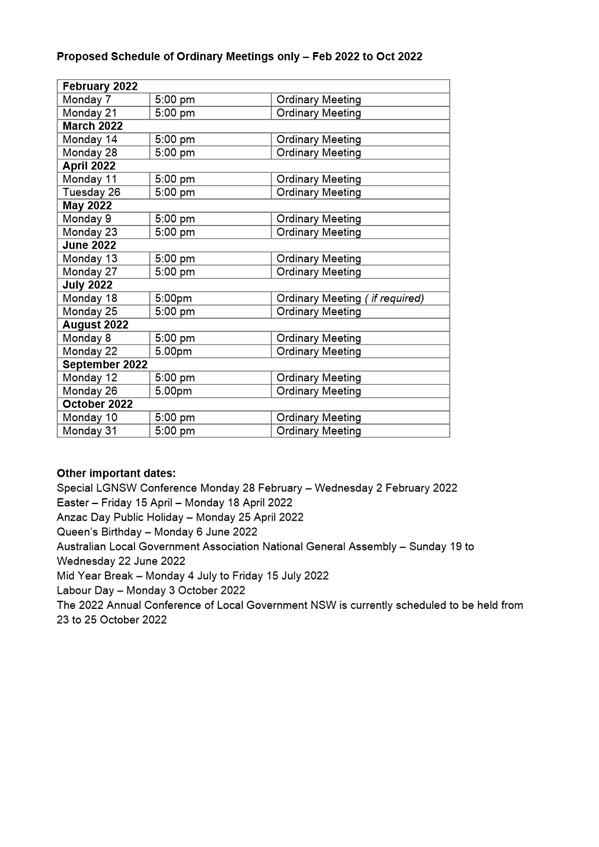
Meeting Schedule - Two Ordinary Meetings (Monday) ⇩
2. Proposed
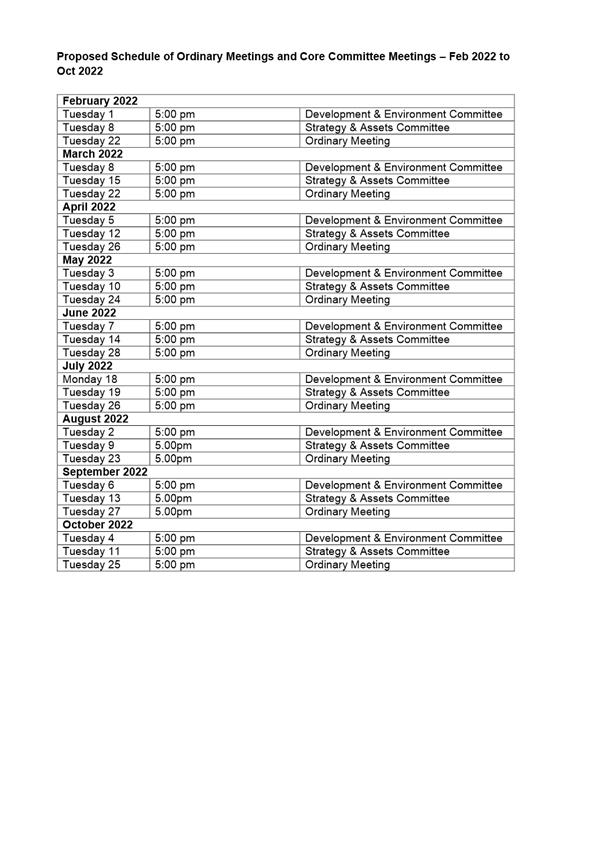
Meeting Schedule - Re- establishment of Core Committees of previous term of
Council ⇩
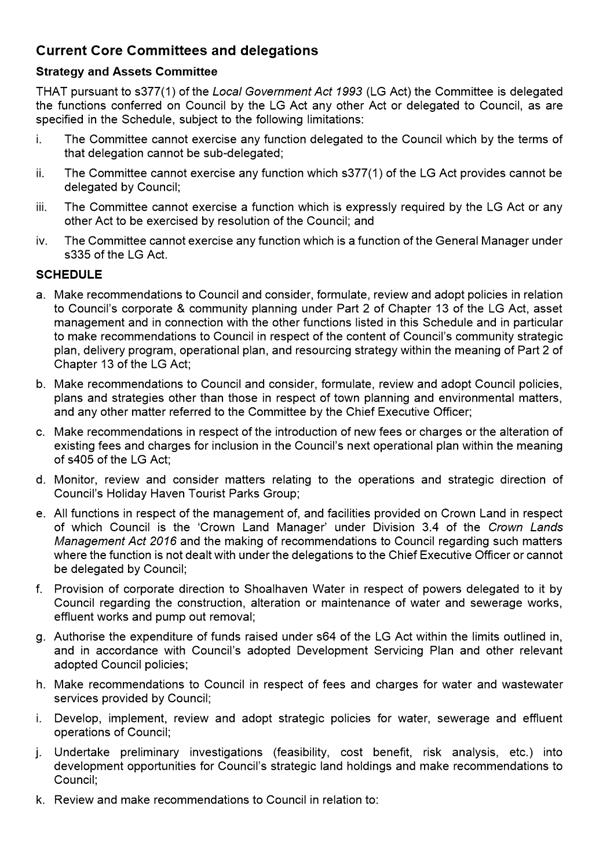
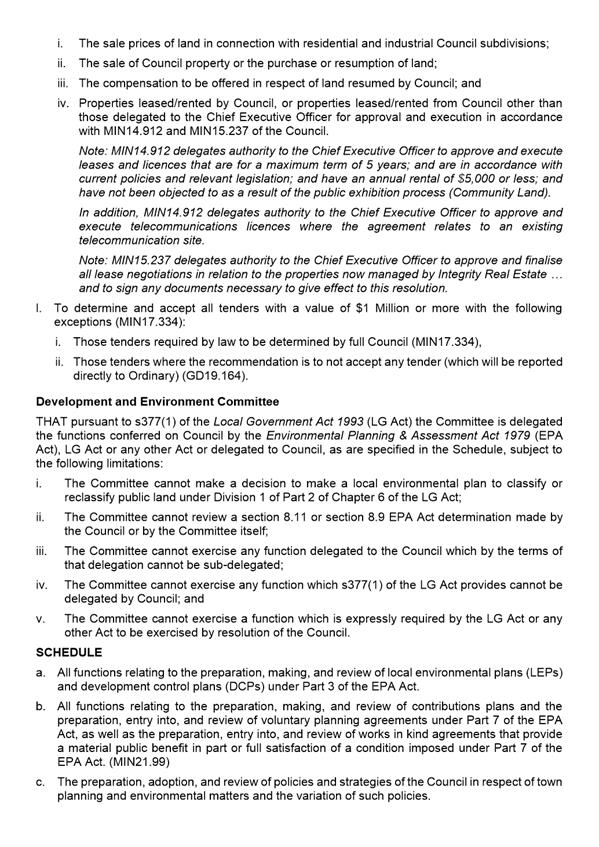
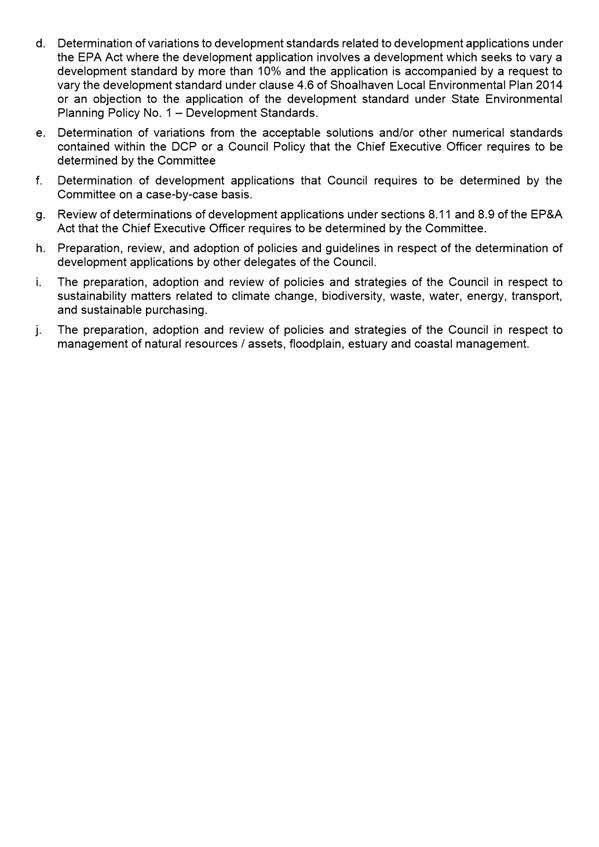
3. Instruments of Delegation -
Development & Environment Committee and Strategy & Assets
Committee ⇩
Reason for Report
To consider options in setting
the configuration of Core Committees and the time, date, and place for the
Council meetings for February – October 2022.
|
Recommendation
That Council:
1. Adopt a schedule of Ordinary Meeting
dates as per the attached schedule (Attachment 1 to this report)
providing for two (2) Ordinary Council Meetings per month held on a Monday
subject to the following:
a. Meetings and briefings not being
held on public holidays or during the following periods:
i. LGNSW
Special Conference – 28 February to 2 March 2022
ii. Easter
break – 15 to 18 April 2022
iii. NSW
Coastal Conference – 31 May to 2 June 2022
iv. Australian
Local Government Association National General Assembly –19 to 22 June
2022 – (dates not confirmed)
v. Mid-year
Council Recess - July 2022 NSW school holidays– 4 to 16 July 2022
vi. The
2022 Annual Conference of Local Government NSW - 23 to 25 October 2022
– (dates not confirmed)
2. Disestablish the “Core”
Committees being the Development & Environment Committee and the Strategy
& Assets Committee.
3. Reaffirm the authorisations to the
Chief Executive Officer as set out in the report.
4. Determine the start time for Council
meetings to be generally at 5.00pm.
5. Determine the start time for
Councillor Briefings to be generally at 4.00 pm.
|
Options
1. Re-establish
Core Committees of Development and Environment Committee and Strategy and
Assets Committee as per the previous term of the Council.
Implications: To facilitate the Council’s
consideration of this option, the following two documents have been attached to
this report:
Attachment 2 – Proposed list of meeting dates for Core
Committee and Ordinary Meetings (following the practice of the previous Council
Attachment 3 – Instrument of Delegations for the
Development and Environment and Strategy and Assets Committees.
The effective re-establishment of the Core Committees with
the same structure, function, delegation as the previous term of the Council
will require the Council to make a resolution which addresses several key
points. Wording for a suggested recommendation is outlined below should the
Council wish to adopt this option. Based on initial conversations with
councillors during induction sessions the CEO has been removed from membership
in the below recommendation. Should significantly reworking of the dates of
meetings be required or amendments be made to delegations of the Committee it
is recommended that these be addressed in detail at a further meeting of the
Council to ensure any changes are both practical and lawful.
The Council may consider it prudent at this time to
re-establish the Committees of the previous term of Council for the period of
February to September 2022 to retain continuity and allow new members of the
Council to experience this Model before determining to apply a different model
for the period of September 2022 to September 2023.
Option 1 Draft Recommendation – To establish
Core and Council Meeting arrangements as per the previous term of Council
That Council:
1. Pursuant
to Section 355(b) of the Local Government Act 1993, establish the following
‘Core’ Council Committees:
a. Strategy
and Assets Committee
b. Development
and Environment Committee
2. The
membership and quorums be set as follows:
a. Strategy
and Assets Committee
· Membership
Mayor
All
Councillors
· Chairperson has
casting vote
· Quorum: Five (5)
b. Development
and Environment Committee
· Membership
Mayor
All Councillors
· Chairperson has
casting vote
· Quorum: Five (5)
3. That
a Chairperson and Deputy Chairperson be appointed for each of the Core
Committees:
a. Strategy
and Assets Committee
i. Chairperson
– INSERT NAME
ii. Deputy
Chairperson – INSERT NAME
b. Development
and Environment Committee
i. Chairperson
– INSERT NAME
ii. Deputy
Chairperson – INSERT NAME
4. The
Delegations of the Strategy and Assets Committee and the Development and
Environment Committees be as outlined in Attachment 3 to this report.
5. Adopt
a schedule of Ordinary and Committee meeting dates as per the attached schedule
(Attachment 2 to this report) providing:
a. A
Three (3) week cycle of meeting dates per month, held on a Tuesday as follows:
i. Week 1
- Development and Environment Committee.
ii. Week 2
– Strategy and Assets Committee.
iii. Week 4
– Ordinary Meeting.
b. Meetings
and briefings not being held during the following periods:
i. LGNSW
Special Conference – 28 February to 2 March 2022
ii. Easter
break – 15 to 18 April 2022
iii. NSW Coastal
Conference – 31 May to 2 June 2022
iv. Australian Local
Government Association National General Assembly –19 to 22 June 2022
– (dates not confirmed)
v. Mid-year
Council Recess - July 2022 NSW school holidays– 4 to 16 July 2022
6. The
2022 Annual Conference of Local Government NSW - 23 to 25 October 2022 –
(dates not confirmed)
7. Reaffirm
the authorisations to the Chief Executive Officer as set out in the report
8. Determine
the start time for Council and Committee meetings to be generally at 5.00pm
9. Determine
the start time for Councillor Briefings to be generally at 4.00 pm
2. Not
re-establish the Core Committees of the Council and opt to have two Ordinary
Meetings of the Council per month as recommended and outlined in the report.
Implications:
A proposed meeting schedule for this arrangement is outlined
in Attachment 1 to the report. There are several efficiencies this model
may create outlined in the report.
3. Adopt
a different framework or arrangement of Core Committees for the period of February
to September 2022
Implications:
Should this option be pursued detail would need to be
provided in a further report to the Council for formal adoption of the Council
to ensure that a resolution with adequate detail and form is made by the
Council and that any delegations afforded to the Committee are lawful.
Recommended wording for a resolution is provided below for the Council:
Option 3 Draft Recommendation – To create a new
framework of Core and Council Meeting arrangements
That Council:
1. Pursuant to
Section 355(b) of the Local Government Act 1993, establish the following
‘Core’ Council Committees: (INSERT DETAIL)
2. A report be
provided to an Ordinary Meeting of the Council to be held on (INSERT DATE) to clarify the purpose,
function and delegation, and schedule of meetings including such Committees
prior to their first meeting.
3. That
Membership and Quorum of the Committee be as follows: (INSERT DETAIL))
4. That the
Chairperson and Deputy Chairperson of the Committees be as follows:
5. Set
the dates of the next Ordinary Meetings of the Council as follows (INSERT
DETAIL)
6. Reaffirm
the authorisations to the Chief Executive Officer as set out in the report
7. Determine
the start time for Council and Committee meetings to be generally at 5.00pm
8. Determine
the start time for Councillor Briefings to be generally at 4:00 pm
Background
Council’s Code of Meeting
Practice states that “The Council shall, by resolution, set the
frequency, time, date and place of its ordinary meetings” in
accordance with Section 365 of the Local Government Act (namely at least ten
times each year, each time in a different month).
How and when Council meetings
are held is up to each Council to decide, although the Local Government Act
1993 requires Council to meet at least 10 times a year, each time in a
different month.
Some Councils meet only once a
month. Many larger Councils meet more frequently because they have a higher
volume of business. Councillors should be given at least three days’
notice of meetings, except for extraordinary meetings called in an emergency.
All formal Council meetings must
be held in accordance with requirements in the Local Government Act 1993, the
Local Government (General) Regulation 2021 (Regulation) and the Council’s
Code of Meeting Practice to determine a schedule of meetings the Council needs
to determine the decision-making structure it wishes to put in place.
The decision-making
structure of the Council.
The Local Government Act
establishes the Council as the decision-making body with respect to the
functions of the Council. In practice, decisions can be made by the
Elected Council (at Ordinary and Extra Ordinary Meetings) or by an individual
or body under Delegated Authority.
The
Local Government Act at Section 377 sets that the Council may delegate
functions of the Council (other than some specific listed functions) to the CEO
or
any other person or body (not including another employee of the Council). A
separate report is provided on the Agenda of this Meeting to outline proposed
delegations to be provided to the CEO and Mayor of the Council in the form of
an Instrument of Delegation.
In addition to Council meetings,
Councils can establish Committees to oversee specific functions, projects or programs
and report back to the Council on those matters. A Council Committee is one
where members of the Committee are Councillors only. (As opposed to Advisory
Committees which have other members, such as community representatives.)
Council must
specify the function, purpose, and delegation of each of its Committees when
such a Committee is appointed but may amend those functions or purpose and
delegation from time to time.
Establishing
‘Council Committees’
A Council Committee is to consist of The Mayor, and such
other Councillors as are elected by the Councillors or appointed by Council
only.
The Chairperson of each Council
Committee (i.e., a Committee consisting of only Councillors) of Council must
be:
a) The
mayor; or
b) If
the Mayor does not wish to be the Chairperson of the Committee – a member
of the Committee elected by the Council; or
c) If
the Council does not elect such a member – a member of the Committee
elected by the Committee.
The Committee must be chaired by
the Mayor, or a Chair elected from its membership or by the Council. The Mayor
does not have to be the Chair of the Committee.
The meetings of Council
Committees are required to be conducted in accordance with the meeting rules
prescribed under the Act, the Regulation and Council’s Code of Meeting
Practice.
Each Councillor, whether a
member of a Committee or not, is entitled to attend and speak at a meeting of a
Council Committee. However, only Councillors who are members of the Committee
are entitled to put business on the Committee’s agenda, move or second a
motion at the Committee meeting, or vote at the meeting.
Core Committees, Advisory
Committees or Boards and Working Parties.
The previous term of the Council
continued the practice of establishing two (2) Committees which were referred
to as “Core” Committees which were given delegation to determine
many functions of the Council. Some other Councils use the term ‘Standing
Committees’ for these Committees. Each of the Core Committees
had membership of all Councillors and the CEO. The addition of the CEO meant
that these Councillors were not ‘Council Committees’ as outlined
above.
The ‘Core
Committees’ each were provided extensive delegations to deal with the
functions of the Council which are permissible to be delegated in their subject
areas. Those delegations are detailed in Attachment 3 to this report.
This meant that the Committees themselves have the power to determine (resolve)
a course of action rather than requiring resolution by the full Council.
The Core Committees established
by the previous Council were
· Development
and Environment Committee
This Committee was provided delegation to deal with functions
related to deal with Planning and Development and Environmental matters
including:
- Local
Environmental Plans (LEPs) and Development Control Plans (DCP’s)
- Contribution
Plans and Voluntary Planning agreements
- Policies
and strategies with respect to town planning and environmental matters
- Determination
and review of Development Applications referred to the Committee for
determination, including applications where there are variations to development
standards of more than 10% and variations from acceptable solutions
- policies
and strategies of the Council in respect to sustainability matters related to
climate change, biodiversity, waste, water, energy, transport, and sustainable
purchasing.
· Strategy
and Assets Committee
This Committee was provided delegation
to deal with functions relating to:
- Council’s
Corporate and Community Planning
- Polices
plans and strategies (other than Town Planning)
- Operations
of Holiday Haven Tourist Parks
- Crown
Land Management
- Shoalhaven
Water
- Strategic
Land Holding
- Council
Property Management
- Determination
of Tenders valued at over $1 million
This report recommends that the
practice of the previous Council with respect to the establishment of the
‘Core Committees’ be changed for this Council term to a schedule of
two Ordinary Meetings per month on a Monday. The reasons for this
recommended change are:
· Efficiencies
will result by having Council consider matters only once rather than repetitive
decision making with items becoming a recommendation from a Committee
· Our
decision-making processes will be clearer for the Community – all matters
are determined by one body.
· It will
allow quicker turn around for decisions required to be made by the elected
Council (i.e., on two occasions each month rather than one)
· Reduction in
the overall time Councillors are required to spend in formal meetings and
briefings each month, noting that the Council will have the opportunity to move
into ‘Committee of the Whole’ arrangements for informal discussion
when required
· The Code of
Meeting Practice of the Council and therefore meeting practice will be clearer
and more consistent for those participating in and watching decision making
meetings
· It will
reduce time taken by repeated deputations,
· The issues
of conflict of interest by the provision of a vote to the CEO in Committee
delegated decisions will be removed, with the decisions falling to elected
representatives, with support and guidance of the CEO.
Frequency/Date and Time of
Meetings
During the last term Shoalhaven
City Council has held ‘Core Committee’ and Council Meetings
commencing at 5pm on Tuesdays.
Briefing sessions are usually
held on Thursdays preceding those meetings from 4pm (concluding at 7pm or
before). These are confidential sessions.
The Council may set these times
and days to suit their requirements. When considering times and dates, Council
may consider:
- Availability
of all Councillors for the majority of meetings (where possible to achieve)
- Accessibility
of members of the public to attend meetings where required (in addition to
webcasting)
- Work,
Health and Safety of Councillors and Staff to attend and travel to and from the
meetings.
- Provisions
of the Code of Meeting Practice (e.g., The current Code sets that meeting must
conclude by 10pm)
- Achieving
an efficient and effective use of resources for the decision-making
requirements of the Council.
Meeting Business papers are
required to be provided to the Council 3 days prior to the meeting. The current
practice is for reports are published and provided to Councillors on the
Thursday afternoon prior to a meeting held on the following Tuesday. Adjustment
to the meeting days, may require a relative adjustment to business paper
delivery timeframes.
The proposal for Meetings to be
changed from a Tuesday to a Monday would permit time in the schedule to publish
the Business Paper each Wednesday, allowing consideration by the Councillors of
the reports prior to the briefing sessions held on Thursdays.
Authorities provided to
the Chief Executive Officer with respect to meeting arrangements.
As is the usual practice, it is
recommended that Council resolve to provide the following authorisation to the
Chief Executive Officer to enable the smooth scheduling and conduct of meetings
without Council resolution:
a) Calling of any
Briefing Sessions or Meetings of any established Committees: the Chief Executive
Officer be authorised to call Special Meetings or Briefing Sessions for any of
the Core or Advisory Committees and Boards.
b) Commencement Time
for any regular Council Committees: The Chief Executive Officer be authorised
to make changes to the commencing time for Council Committees where
appropriate.
c) Advisory
Committees – Frequency of Meetings: Advisory Committees to meet as
adopted by Council subject to Chief Executive Officer, in consultation with the
Chairperson, being authorised to call meetings on a more regular basis to
consider urgent and/or important business.
c) To allow the Chief
Executive Officer to consider alternate venues for the Ordinary Meeting of
Council in special circumstances (noting that Webcasting services will be
required)
Financial Implications
The frequency and time dedicated
to Committee meetings has a direct correlation with the administrative costs of
those meetings.
|
|
Ordinary
Meeting – Tuesday 25 January 2022
Page
0
|
|
|
Ordinary
Meeting – Tuesday 25 January 2022
Page
0
|
|
|
Ordinary
Meeting – Tuesday 25 January 2022
Page
0
|
|
|
Ordinary
Meeting – Tuesday 25 January 2022
Page
0
|
CL22.4 Election
of Deputy Mayor and Assistant Deputy Mayor
HPERM Ref: D21/340473
Department: Business
Assurance & Risk
Approver: Kevin
Voegt, Director - City Performance
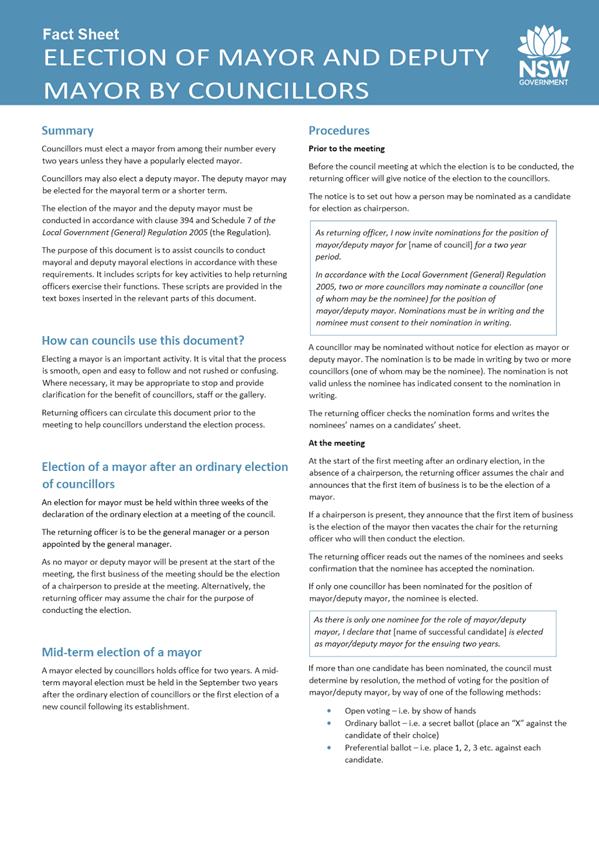
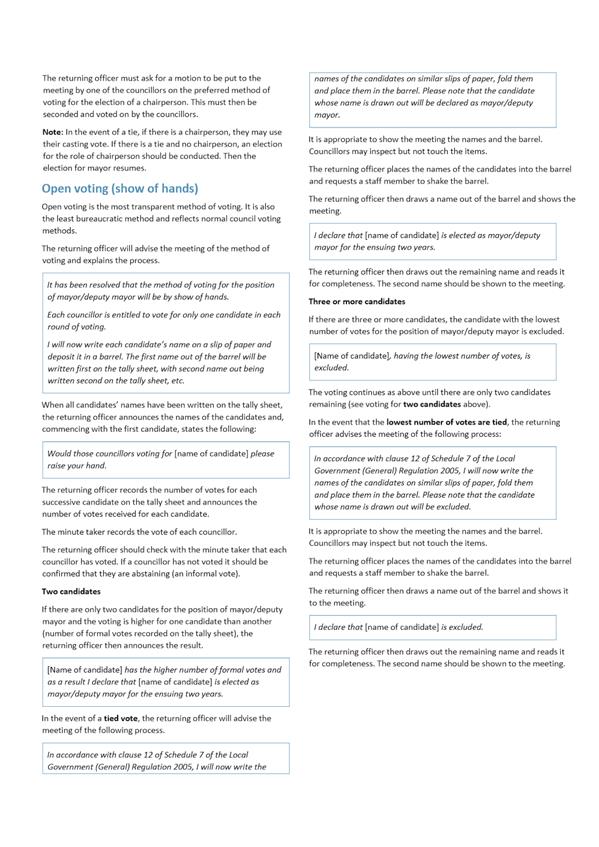
Attachments: 1. OLG
Fact Sheet ⇩
2. Nomination Form (councillors
information folder) ⇨
Reason for Report
To elect a Deputy Mayor and
consider the election of an Assistant Deputy Mayor.
|
Recommendation
That
Council
1. Resolve the period for which the
elected Deputy Mayor will hold office.
2. Conduct an election (by show of
hands) for Deputy Mayor for the resolved period.
3. Conduct an election (by show of
hands) for an Assistant Deputy Mayor for the resolved period should the
Council consider it necessary to retain this position.
|
Options
1. Elect and
appoint a Deputy Mayor and an Assistant Deputy Mayor.
2. Elect and
appoint a Deputy Mayor only.
Background
Under the provisions of Section
231 of the Local Government Act 1993 (LG Act) the Councillors may elect a
person from among their members to be the Deputy Mayor. A Deputy Mayor may be
elected for the Mayoral term or a shorter term.
The practice of the Council has
traditionally been an appointment for 12 months. The decision for a 12-month
appointment was made on the basis that at the time, there was only 12 months or
less remaining in the Council term.
The current options for Council
to determine with respect to the tenure of the election for these roles are:
· The period from
January 2022 until September 2022 (8 months)
· The period from
January 2022 until September 2023 (20 months)
· The period from
January 2022 until September 2024 (2 years 8 months)
Council has previously appointed
an Assistant Deputy Mayor who may exercise the function of Deputy Mayor if the
Deputy Mayor is prevented by illness, absence or otherwise from exercising the
function of the Deputy Mayor. Election to the position of Assistant Deputy
Mayor should follow the same procedure as for Deputy Mayor if Council considers
the position is required.
The
Deputy Mayor or the Assistant Deputy Mayor in his/her absence may exercise any
function of the Mayor at the request of the Mayor or if the Mayor is prevented
by illness, absence or otherwise from exercising the function or if there is a
casual vacancy in the office of the Mayor.
The Deputy Mayor also has a specific
function under Section 369:
“369
Who presides at meetings of the council?
(1) The Mayor or, at the request of or in the absence of
the Mayor, the Deputy Mayor (if any) presides at meetings of the Council.
(2) If the Mayor and the Deputy
Mayor (if any) are absent, a Councillor elected to chair the meeting by the
Councillors present presides at a meeting of the Council.”
The Returning Officer for the Election will be the Director
– City Performance (Kevin Voegt). Completed nomination forms are
requested to be submitted to the Returning Officer prior to Midday on Monday 24
January 2022.
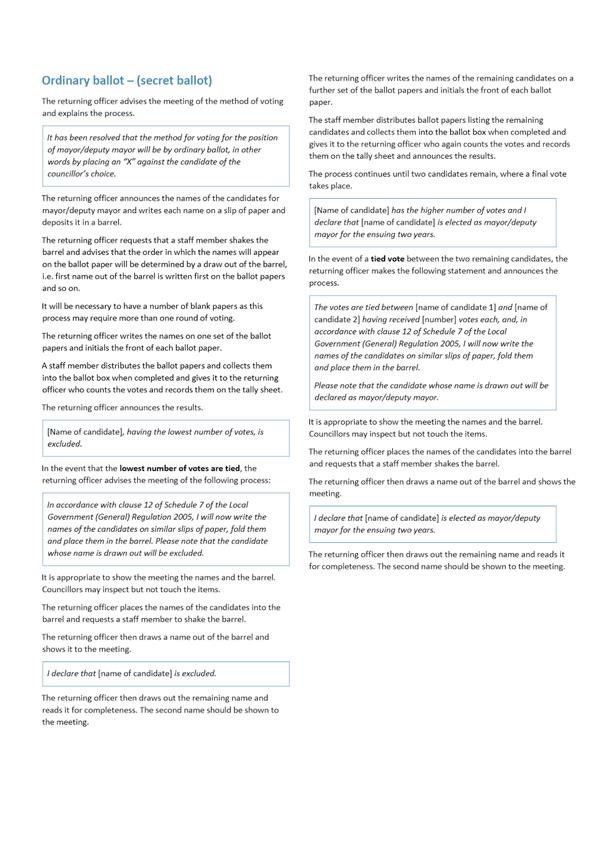
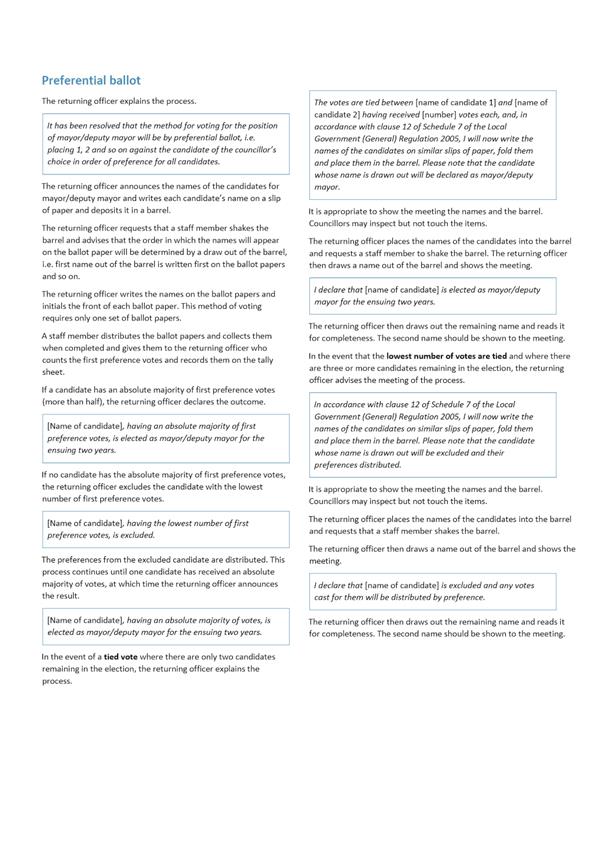
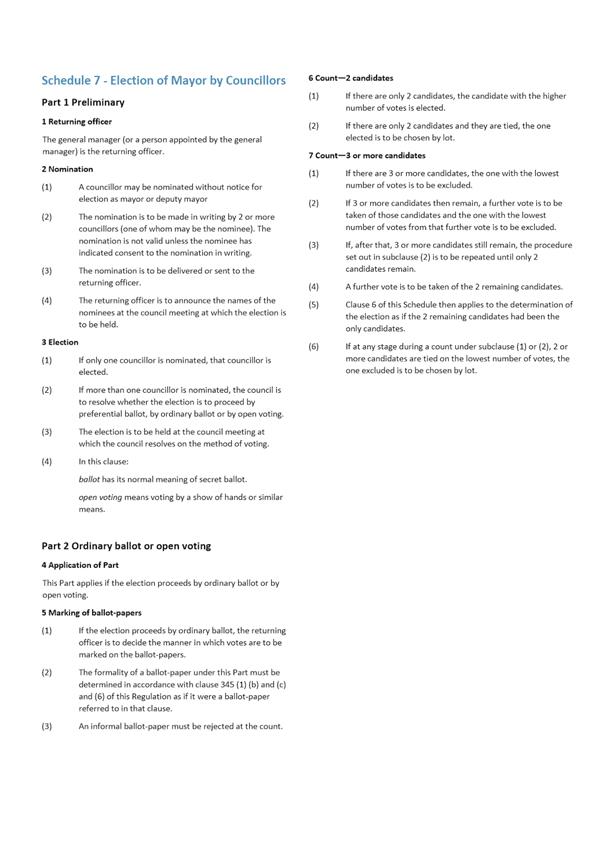
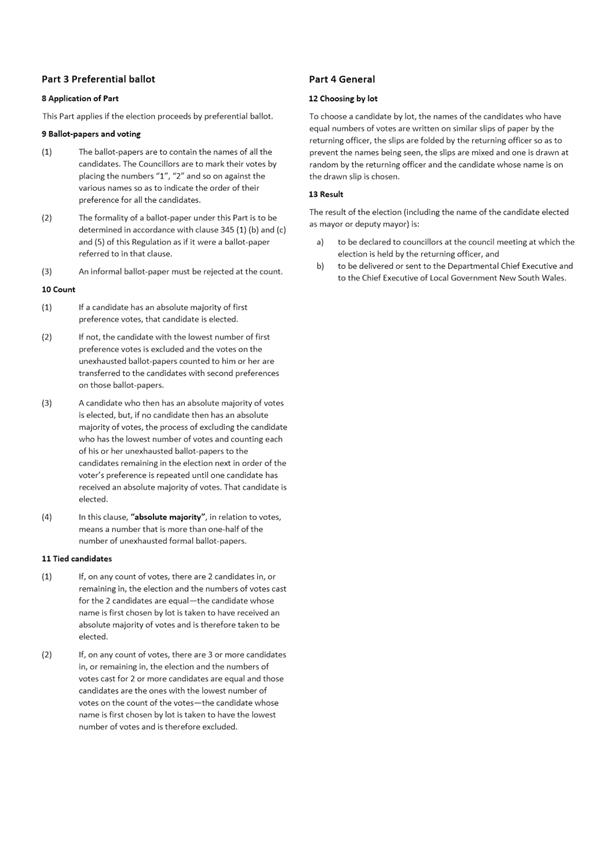
Schedule 7 of the Local
Government (General) Regulation 2021 prescribes three methods of election of
these positions:
· open ballot (e.g.
a show of hands)
· ordinary ballot,
or
· preferential ballot.
The method of election is as
outlined in the Attachment 1, being the Office of Local Government Factsheet
– Election of Mayor and Deputy Mayor released September 2018.
The Nomination forms are
provided under separate cover for use by Councillors. Additional forms
are available from the Director – City Performance.
Payment for the Deputy Mayor
Section 249(5) Local Government
Act allows Council to elect to pay the Deputy Mayor a fee when acting in the
office of the Mayor. The amount of the fee must be deducted from the
Mayor’s annual fee.
The option to determine if fees
will be paid to the Deputy Mayor will be included in a future report to
Council.
A request was sent to all NSW
Councils asking their position on paying the Deputy Mayor fees deducted from
the Mayoral fee. At the time of writing this report 38 responses have been
received.
· 22
Councils do not pay the Deputy Mayor fees.
· 7
Councils pay 100% of additional Mayoral fee during the time the Deputy is
acting (some with provisions relating to the length of time acting as Mayor)
· 7
Councils pay a percentage of the Mayoral Fee ranging from 10% to 50%
· 2
Councils pay a specific amount - $1,200 and $3,621
|
|
Ordinary
Meeting – Tuesday 25 January 2022
Page
0
|
|
|
Ordinary
Meeting – Tuesday 25 January 2022
Page
0
|
CL22.5 Use
of Countbacks to fill Casual Vacancies for Councillors
HPERM Ref: D21/528909
Department: Business
Assurance & Risk
Approver: Kevin
Voegt, Director - City Performance
Reason for Report
To allow Council to consider the
options available to use countbacks of the votes cast at the 4 December 2021
Local Government Election to fill casual vacancies of Councillors, which may
occur in the first 18 months after the election or to hold by-elections should
this situation occur.
|
Recommendation
That
Council determine if the option available to
use countbacks of the votes cast at the 4 December 2021 Local Government
Election to fill casual vacancies of Councillors, which may occur in the
first 18 months after the election or to hold by-elections should this
situation occur will be utilised.
|
Options
1. That the Council
pass a resolution at this meeting to declare that any vacancies in the office
of Councillor that occur within the 18 months following the 4 December 2021
Election will be filled by a countback.
Implications: Any casual vacancies occurring in the
office of a Councillor within 18 months after the election of Councillors on 4
December 2021 will be filled by countback rather than a by-election. The
wording of the recommendation to achieve this is specifically outlined by the
NSW Electoral Office to enact the provision as outlined below and MUST be
resolved at this first meeting of the Council if it is to occur.
Required Wording – Recommendation for Countback
to occur
“That
I. Pursuant
to section 291A(1)(b) of the Local Government Act 1993 (the Act) Shoalhaven
City Council declare that casual vacancies occurring in the office of a
Councillor within 18 months after the last Ordinary election of Councillors for
the Council on 4 December 2021 are to be filled by a countback of votes cast at
that election for the office in accordance with section 291A of the Act; and
II. The
Council directs the CEO to notify the NSW Electoral Commissioner of the
Council’s decision within 7 days of the decision.”
2. That Council
does not proceed with the option of a Countback method.
Required Wording – “That Council
receive the report for information.”
Implications:
Any vacancy that occurs within this term will be filled by
by-election unless Ministerial approval is given by the Minister under Section
294 of the Local Government Act to dispense with the need for a
by-election.( i.e. In the last 18 months of the Council term).
There is no further opportunity for Council to resolve to
use a Countback other than at this meeting of 25 January 2022. It is
estimated that the cost of a by-election would be in excess of $200,000 to be
funded by the Council.
Background
Following amendment to the Local
Government Act, Council has the option to determine the process for filling
casual Councillor vacancies which may occur within the first 18 months after an
election under Section 291A(1) of the Local Government Act (see below).
In the case of the 4 December 2021 Election, this 18-month period concludes on
4 June 2023.
The choices available to the
Council in this circumstance are to fill any such vacancy by either a countback
from the last election or a by-election.
If Council determines to fill
casual vacancies of Councillors using the countback method, a resolution (as
worded in Option 1 of this report) needs to be passed at the first meeting held
after the election and the NSW Electoral Commissioner must be notified within 7
days of the decision being made.
If Council does not pass the
resolution at Option 1, any vacancies must be filled via a by-election process,
and it is noted that if the vacancy occurs within the 18-month period prior to
the next election additional provisions apply where Council may make an
application under Section 294 of the Local Government Act for the
Minister to dispense with the need for a by-election.
Section 291A (1) of the Local
Government Act states that:
291A Countback to
be held instead of by-election in certain circumstances:
(1) This section
applies to a casual vacancy in the office of a Councillor if;
(a) the casual vacancy occurs
within 18 months after the date of the last Ordinary election of the
Councillors for the area, and
(b) the Council has at its
first meeting following that Ordinary election of Councillors, by resolution,
declared that any such casual vacancy is to be filled by a countback of votes
cast at the last election for that office.
Countbacks are not available to
fill casual vacancies in the office of a Councillor where:
· The Councillor who
vacated office was elected at an election using the optional preferential
voting system (i.e., elections where only one civic office is required to be
filled such as the election of a popularly elected Mayor) or;
· The Councillor was
elected at an uncontested election.
If a Casual vacancy occurs in
the office of the Mayor, the vacancy may be filled as outlined in Section 294
(3) & (4) of the Act.
Section 294 of the Local
Government Act states that:
‘294 Dispensing
with by-elections
(1) This section applies
if a casual vacancy occurs in the office of a councillor, including a mayor
elected by the electors of an area, within 18 months before the date specified
for the next ordinary election of the Councillors for the area.
(2) If such a casual
vacancy occurs in the office of a councillor (but not the office of a mayor
elected by the electors), the Minister may, on the application of the council
–
(a) order that the vacancy
not be filled, or
(b) order the holding
on a stated day of a by-election to fill the vacancy and revoke any earlier
order made under paragraph (a).
(3) If such a casual
vacancy occurs in the office of a mayor elected by the electors, the casual
vacancy is to be filled by the Governor appointing to the vacant office a
councillor nominated by the council.
(4) If the council does
not nominate a Councillor for the purposes of subsection (3), the Governor may
appoint one of the Councillors to the vacant office.’
The legislative arrangement for
countbacks has not been available at previous elections of the Council and as a
result, there is no commentary available on the benefits of the practice other
than the financial reason outlined below and the speed at which a vacancy may
be filled under this method (49 days from notification of vacancy) as opposed
to the calling and conduct of a by-election.
Financial Implications
It is noted that the financial
implications to Council of a by-election are estimated to be in excess of
$200,000 so there is a financial benefit to Council in resolving to use
countbacks of the votes cast at the 4 December 2021 Local Government Election to
fill casual vacancies of Councillors.
|
|
Ordinary
Meeting – Tuesday 25 January 2022
Page
0
|
CL22.6 Instruments
of Delegation - Mayor and Chief Executive Officer
HPERM Ref: D21/241784
Department: Business
Assurance & Risk
Approver: Kevin
Voegt, Director - City Performance
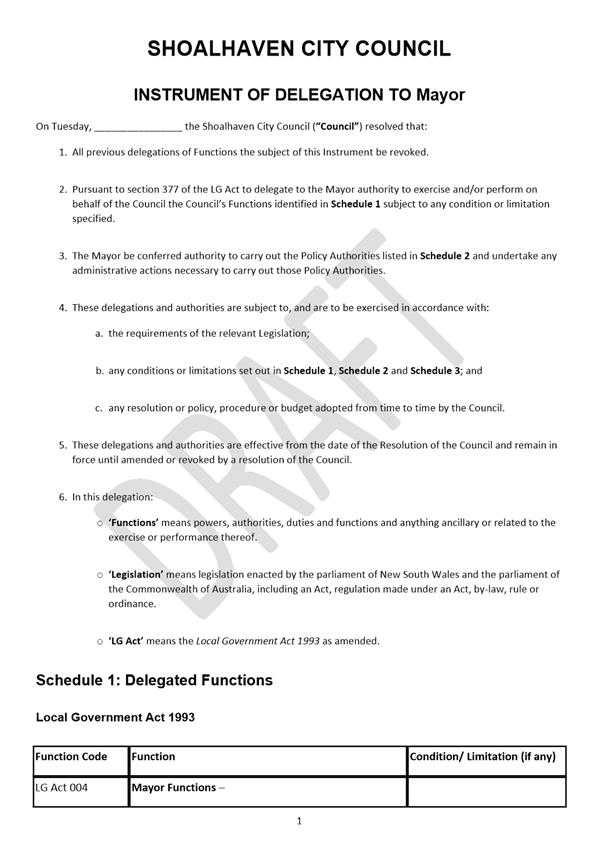
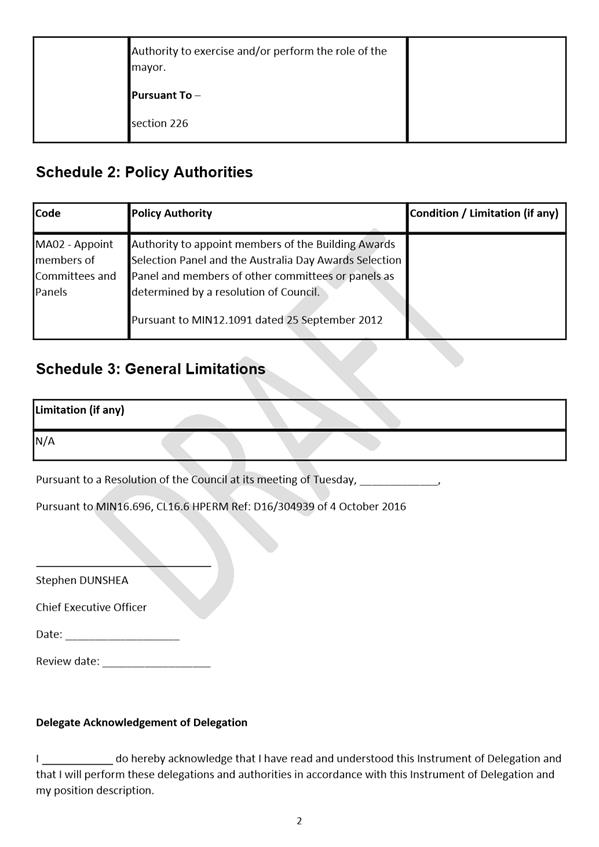
Attachments: 1. Draft
Instrument of Delegation - Mayor ⇩
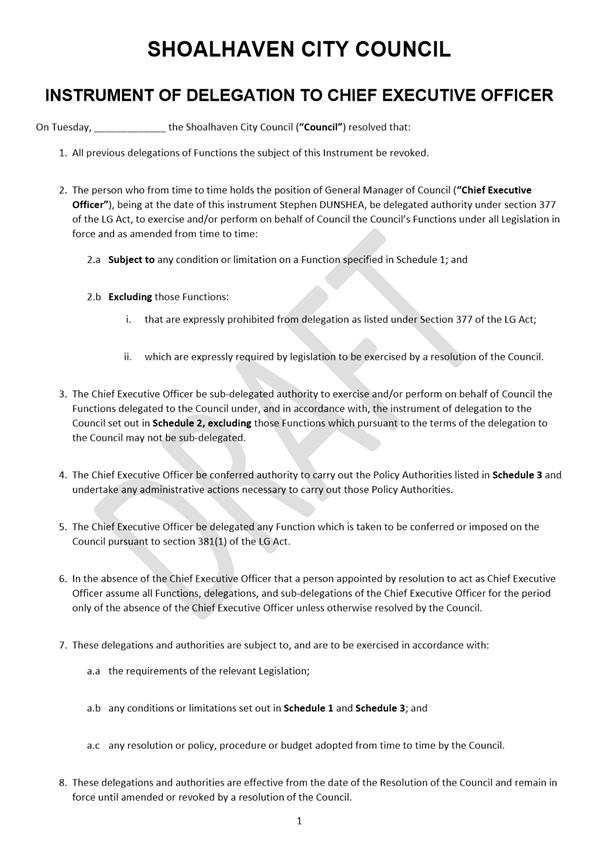
2. Draft Instrument of
Delegation - Chief Executive Officer ⇩
Reason for Report
To provide the Instruments of
Delegation for the Mayor, the Chief Executive Officer, and provisions to allow
for an Acting Chief Executive Officer when required.
|
Recommendation
That Council:
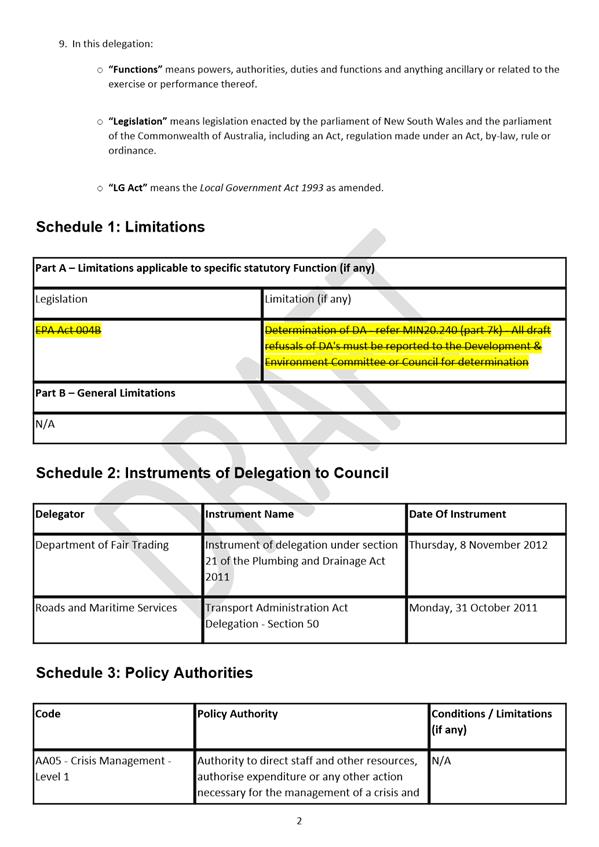
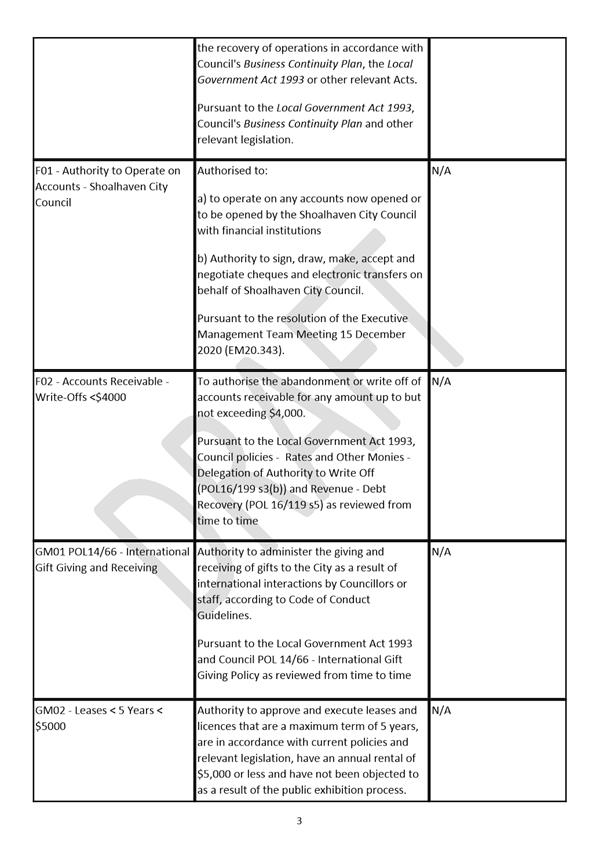
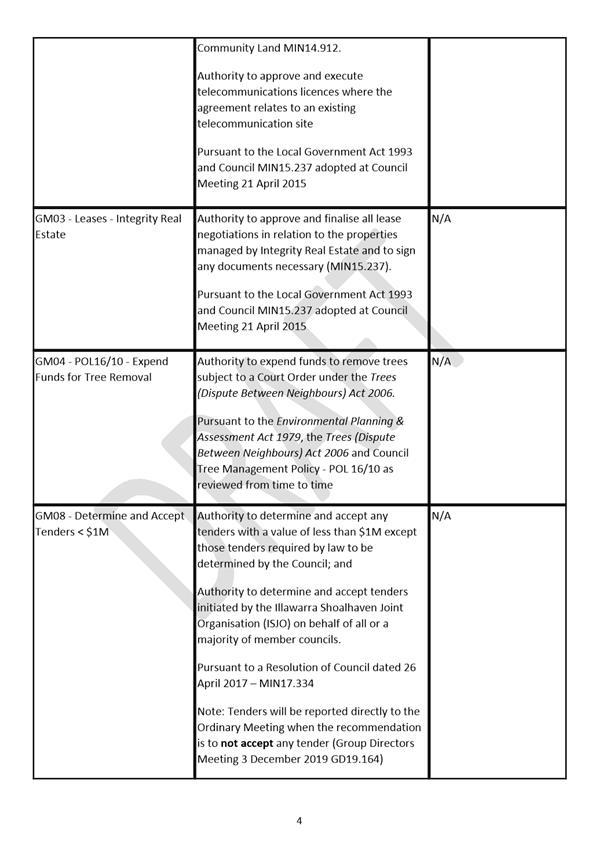
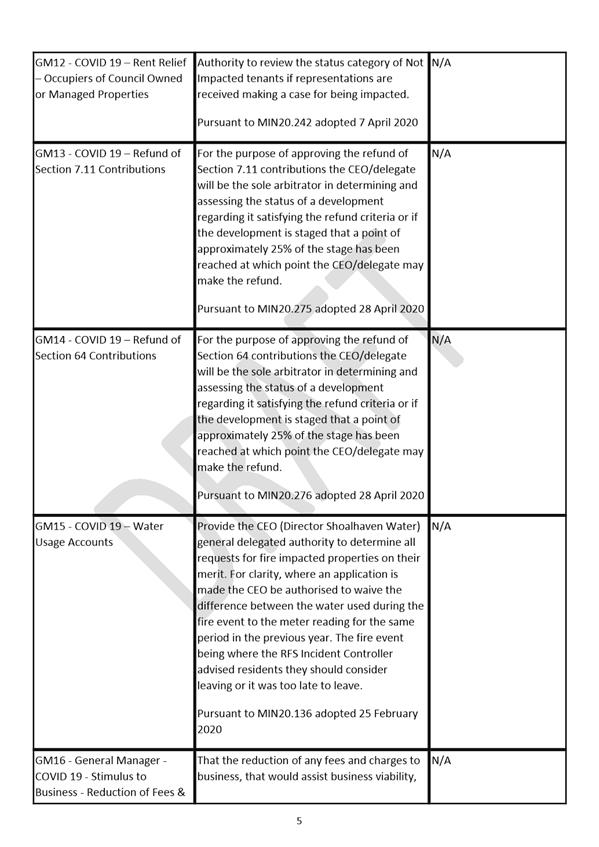
1. Restore the Delegations of authority
to the Chief Executive Officer as outlined in the Instrument of Delegation
provided as Attachment 1 and outlined in this report
2. Delegate to the Mayor the authority
as outlined in the Instrument of Delegation as provided as Attachment 2 and
outlined in this report.
3. That for the period 25 January 2022
to 30 September 2022, one of the persons (determined by the Mayor at the
relevant time) holding the position of:
a. Director, City Development;
b. Director, City Futures;
c. Director, City Lifestyles;
d. Director, City Performance;
e. Director, City Services
be appointed to act as
Chief Executive Officer if the Chief Executive Officer is sick or otherwise
absent from work on leave or for any other purpose. Such appointment is
to cease upon the return to work of the Chief Executive Officer or by other
resolution of the Council.
4. Authorise that any person acting as
Chief Executive Officer pursuant to this resolution has all the functions,
delegations, and sub-delegations given to the Chief Executive Officer by the
Council.
|
Options
1. To adopt the
instruments of delegation provided as attachments to the report and include in
the resolution the recommended provisions to allow for a Director to be
appointed as Acting Chief Executive Officer.
Implications: The Instruments of delegations and
recommendations proposed have been updated following review.
2. To adopt
differing Instruments of delegation and /or provisions for the appointment of
an Acting Chief Executive Officer
Implications: Amendments to the proposed
Instruments of Delegation and/or recommendations for appointment of an Acting Chief
Executive Officer may impact upon the ability of the Council to make lawful
decisions of the Council. It would be strongly recommended that should the
Council wish to amend those proposed, that legal advice be sought.
3. To defer the
adoption of the differing instruments to allow for further information or
advice.
Implications: The Mayor will not be able to apply
delegations until such time as they are approved by the Council.
Background
In accordance with Section 380
of the Local Government Act, 1993 each Council must review its
delegations within the first 12 months of each term of office.
In accordance with Section 377
(see below) of the Local Government Act 1993 Council may delegate to the
General Manager (CEO) the functions of Council with the exception of those
listed below.
377 General power of the council to delegate
(1) A council may, by resolution, delegate to the general
manager or any other person or body (not including another employee of the
council) any of the functions of the council under this or any other Act, other
than the following--
(a) the appointment of a general manager,
(b) the making of a rate,
(c) a determination under section 549 as to the levying
of a rate,
(d) the making of a charge,
(e) the fixing of a fee,
(f) the borrowing of money,
(g) the voting of money for expenditure on its works,
services or operations,
(h) the compulsory acquisition, purchase, sale, exchange
or surrender of any land or other property (but not including the sale of items
of plant or equipment),
(i) the acceptance of tenders to provide services
currently provided by members of staff of the council,
(j) the adoption of an operational plan under section
405,
(k) the adoption of a financial statement included in an
annual financial report,
(l) a decision to classify or reclassify public land
under Division 1 of Part 2 of Chapter 6,
(m) the fixing of an amount or rate for the carrying out
by the council of work on private land,
(n) the decision to carry out work on private land for an
amount that is less than the amount or rate fixed by the council for the
carrying out of any such work,
(o) the review of a determination made by the council,
and not by a delegate of the council, of an application for approval or an
application that may be reviewed under section 82A of the Environmental
Planning and Assessment Act 1979 ,
(p) the power of the council to authorise the use of
reasonable force for the purpose of gaining entry to premises under section
194,
(q) a decision under section 356 to contribute money or
otherwise grant financial assistance to persons,
(r) a decision under section 234 to grant leave of
absence to the holder of a civic office,
(s) the making of an application, or the giving of a
notice, to the Governor or Minister,
(t) this power of delegation,
(u) any function under this or any other Act that is
expressly required to be exercised by resolution of the council.
Delegations to the General
Manager (CEO) allow the normal functions of Council to be undertaken without
the requirement of resolutions from Council.
Council previously resolved on 7
April 2020, at an Extraordinary/Special Meeting of the Council (MIN20.240
– 7(k)) to temporarily adjust the delegation of the CEO with respect to
Development Application processing due to COVID-19.
As NSW has reached the required
vaccination levels to allow NSW Health to remove the majority of restrictions
regarding COVID-19 the attached delegation removes the adjustment under
MIN20.240.
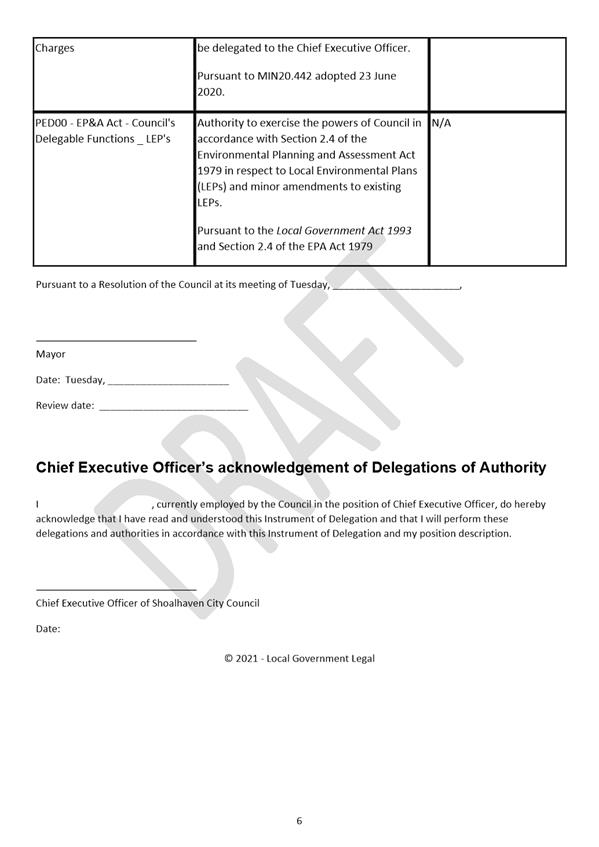
Attachment 1 provides the
proposed Instrument of Delegations for the Chief Executive Officer.
Attachment 2 provides the
proposed Instrument of Delegation for the Mayor.
In accordance with Section 226
of the Local Government Act, 1993 the role of the Mayor is as follows:
(a) to
be the leader of the council and a leader in the local community,
(b) to
advance community cohesion and promote civic awareness,
(c) to be
the principal member and spokesperson of the governing body, including
representing the views of the council as to its local priorities,
(d) to exercise,
in cases of necessity, the policy-making functions of the governing body of the
council between meetings of the council,
(e)
to preside at meetings of the council,
(f) to
ensure that meetings of the council are conducted efficiently, effectively and
in accordance with this Act,
(g) to
ensure the timely development and adoption of the strategic plans, programs and
policies of the council,
(h) to promote
the effective and consistent implementation of the strategic plans, programs
and policies of the council,
(i) to
promote partnerships between the council and key stakeholders,
(j)
to advise, consult with and provide strategic direction to the general manager
in relation to the implementation of the strategic plans and policies of the council,
(k) in
conjunction with the general manager, to ensure adequate opportunities and
mechanisms for engagement between the council and the local community,
(l) to
carry out the civic and ceremonial functions of the mayoral office,
(m) to
represent the council on regional organisations and at inter-governmental
forums at regional, State and Commonwealth level,
(n) In
consultation with the councillors, to lead performance appraisals of the
general manager [CEO],
(o)
to exercise any other functions of the council that the council determines.
It is anticipated that the Mayor
in carrying out the civic and ceremonial functions of the Mayoral office, will
facilitate attendance and participation in civic duties by other Councillors
when the Mayor is unable to attend. To ensure this is effectively managed
in a way which provides opportunities to members of the elected Council, the
Mayor is given authority to nominate relevant representatives of the Council,
with particular respect to relevant Ward Councillors to attend events in place
of the Mayor when the Mayor is an apology. This will effectively rescind
MIN19.791 (parts 1 to 4) and MIN20.777 (parts 1 & 2).
MIN19.791
That:
1. The
Mayor will attend and represent on behalf of Shoalhaven City Council.
2. If
the Mayor is unable to attend, The Deputy Mayor will attend and represent on
behalf of Shoalhaven City Council.
3. If
the Mayor and Deputy Mayor are unable to attend, The Assistant Deputy Mayor
will attend and represent on behalf of Shoalhaven City Council.
4. In
the event the Mayor, Deputy Mayor or Assistant Deputy Mayor are unable to
attend Ward Councillors will be asked to attend and represent on behalf of
Council.
5. A
wreath be supplied to a Councillor attending any commemoration service in their
own right or when representing the Mayor.
MIN20.777
That Council reindorse the
following and expanded policy regarding the Deputy Mayor, Assistant Deputy
Mayor and Ward Councillors in respect of when the Mayor is unable to act, or
attend any invited event, function, meeting or such like occasion:
1. An
apology from the Mayor without a delegate attending is not an option.
2. In
respect of Council or Mayoral Duties or invitations when the Mayor is unable to
act or attend the Deputy Mayor shall be requested to attend in the
Mayor’s place, if the Deputy Mayor is unable then the Assistant Deputy
Mayor is to be invited and should the Assistant Deputy Mayor be unable to
attend to the function it shall be offered to a Ward Councillor who lives in
the area where the event is to be held. The Councillors acting in this role
shall be selected in rotation.
3. When
a Minister of the Crown or senior Government Official is visiting the area and
the Mayor or CEO is aware of the visit, Ward Councillors are to be extended an
invitation to attend.
4. A
full register of functions, events and such like and those Councillors who are
called on to act for the Mayor shall be kept by the CEO and be published to
Councillors monthly.
In accordance with advice
received, specific recommendations are proposed to allow for the appointment of
an Acting Chief Executive Officer in circumstances where the Chief Executive
Officer is absent.
|
|
Ordinary
Meeting – Tuesday 25 January 2022
Page
0
|

|
|
Ordinary
Meeting – Tuesday 25 January 2022
Page
0
|
|
|
Ordinary
Meeting – Tuesday 25 January 2022
Page
0
|
CL22.7 Ordinary
Meeting - Order of Business
HPERM Ref: D21/241795
Department: Business
Assurance & Risk
Approver: Kevin
Voegt, Director - City Performance
Reason for Report
The Local Government (General)
Regulation 2021 states that at a meeting of the Council (other than an Extra
Ordinary meeting) the General Order of Business is as fixed by the
Council’s Code of Meeting Practice or as fixed by resolution of the
Council.
|
Recommendation
That
Council adopt the Order of Business, as follows, for the Ordinary Meetings of
Council:
1. Acknowledgement of Country
2. Opening Prayer
3. Australian National Anthem
4. Apologies/Leave of Absence
5. Confirmation of Minutes
6. Declarations of Interest
7. Presentation of Petitions
8. Mayoral Minutes
9. Deputations & Presentations
10. Call Over of the Business Paper
11. Report of Committees
12. Report of the Shoalhaven Traffic Committee (if
required)
13. Officers Reports
14. Notices of Motion and Questions on Notice
15. Addendum Reports
16. Confidential Reports
*If any
items of business require attendance of specialist staff (e.g., Legal,
Insurance, Property) then Council will generally consider those items
following the Deputations
|
Options
1. Council adopts
the order of business as shown in the recommendation.
2. Council changes
the order of business by removing or altering the order of items of business.
Background
Council’s Code of Meeting
Practice provides that “the Order of Business” on the Agenda for
Council and Committee Meetings be as fixed by the Code or by resolution of
Council. In accordance with Clause 8.1 of the Code of Meeting Practice the
Council should now adopt a general order of business which applies to its
meetings in this new term.
The Order of Business outlined
in the recommendation is the Order of Business which was in use at the
conclusion of the previous Council term with the exception of the placement of
the Notices of Motion and Questions of Notice on the Agenda. This change
reflects that which is proposed in the latest Model
Code of Meeting Practice released by the Office of Local Government on 29
October 2021 as their suggested order and is proposed as it focuses the
decision making on the business arising from the strategic priorities of the
Council.
Also included in the
recommendation is the reinstatement of the Call Over of the Business Paper.
This provides a prompt to the Council to utilise the provisions of the Code of
Meeting Practice with respect to calling out only those items of business that
require discussion.
For practical reasons, the
welcoming aspects of the meeting should occur at the beginning of the meeting
before the business of the meeting is dealt with.
The items of the Australian
National Anthem and the Opening Prayer are traditional opening items for
Ordinary Meetings of Shoalhaven City Council which all previous Councils have
opted to include in the Order of Business.
In the previous term, the
Council resolved that the Opening Prayer on the Order of Business was to be a
‘Christian Prayer’. The Council may wish to retain the previous
approach or may consider alternatives such as a 'Multi-faith Prayer' or
alternatively a 'Moment of Prayer or Reflection' for this term of the Council.
With respect to the business of
the Meeting, any Mayoral Minute will take precedence over all business on the
Council’s agenda for the meeting. There is no specified order for
business following the Mayor Minute required under the Local Government Act or
Regulations.
The Council may pass a
resolution at any meeting to change the order of business for that meeting
(Clause 8.2).
Council will need to reconsider
meeting practice when it considers the adoption of a new Code of Meeting
Practice prior to June 2022.
|
|
Ordinary
Meeting – Tuesday 25 January 2022
Page
0
|
CL22.8 Community
Consultation & Committee System
HPERM Ref: D21/335239
Department: Business
Assurance & Risk
Approver: Kevin
Voegt, Director - City Performance
Attachments: 1. Proposed
Committee List arising from Councillor Workshop on 18 January 2022. (under
separate cover) ⇨
Reason for Report
This report is being submitted
directly to the Ordinary Meeting due to the determination of Councillor
membership, confirm or disband the purpose/objective, delegated authority and
quorum of Council’s Committees.
|
Recommendation
That Council
1. Continue the operation of the
following Committees, Boards & Reference Groups pursuant to Section 355
– Local Government Act and pursuant to Section 377 with purpose,
delegation and sitting fee (if applicable), Councillor and staff membership
and quorum as outlined in the attachment to the report:
a. Audit, Risk and Improvement
Committee (39763E) and authorise the Committee to carry out the roles and
responsibilities in accordance with the Audit Committee guidelines published
by the Office of Local Government and Council’s Audit, Risk &
Improvement Committee charter.
b. Regional Development Committee
(39964E)
c. Senior Staff Contractual Matters
Committee (5001E).
d. North Floodplain Risk Management
Committee (59952E)
e. Central Floodplain Risk Management
Committee (59951E)
f. Southern Floodplain Risk
Management Committee (59950E)
g. North Coastal Management Program
Advisory Committee (64354E)
h. Central Coastal Management Program
Advisory Committee (64355E)
i. Southern Coastal
Management Program Advisory Committee (64356E)
j. Aboriginal Advisory
Committee (1209E)
k. Business and Employment Development
Committee (38821E)
l. Homelessness Taskforce
Shoalhaven (55584E)
m. Inclusion and Access Advisory Group (1228E)
n. Motor Sports Complex Working Party
(69319E)
o. Natural Area Volunteers Group
(42643E)
p. Nowra CBD Revitalisation Strategy
Committee (50242E)
q. Rural Fire Service Strategic
Planning Committee (1227E)
r. Shoalhaven Arts Board (2123E)
s. Shoalhaven City Mayor’s
Relief Fund (3926E)
t. Shoalhaven
Entertainment Centre Councillor Reference Group (61867E)
u. Shoalhaven Heads Estuary Taskforce
(45866E).
v. Shoalhaven Sports Board (12623E)
w. Shoalhaven Tourism Advisory Group
(1490E)
x. Strategic Planning Working Party
(65374E)
y. Youth Advisory Committee (1506E)
2. Disband the Infringement
Review Panel (59312E) and this be reflected in the Council’s
Compliance Policy.
3. Appoint Councillor and staff
membership of each Committee or Board as outlined in the Attachment to the
report.
4. Note that the Urgent Grant
Submissions Committee (65067E) has expired in accordance with MIN20.700.
|
Options
1. That Council
adopt the Committees with their purpose, terms of reference, delegations,
membership and meeting frequency, as outlined in the attachment, and note that
the Urgent Grant Submissions Committee has expired.
Implications: This will continue current resourcing
allocations and community membership.
2. That the
proposed list of Committees be altered, and/or those purpose, terms of
reference, delegations, membership and meeting frequency, be amended.
Implications: Dependent upon the extent of the amendments,
resources for the administration and support of Committees and other resource
allocations may be impacted.
Background
At the commencement of each
term, the Council establishes its process of community consultation in terms of
advisory and other Committees to inform the Council. These Committees are
reviewed each year, usually in September, and other amendments are proposed to
the Council throughout the term, when identified or required.
The attachment and this report
outlines the Councillor and staff representation for Council’s existing
Committees and boards at the end of the previous term of the Council. The
names populated in the attachment are those which were raised and discussed at
the Workshop of Councillors held on 18 January 2022 and submitted nominations.
Areas highlighted in the attachment will need further clarification in the
determination of this item .
The Council may wish to remove,
amend the purpose and objectives or reappoint the Committee or Board by
determining Councillor and staff representative members for the period of
February to September 2022.
The recommendation of this
report to disband the Infringement Review Panel arises from discussion of
Councillors at the workshop held on 18 January 2022 and the views of Councillors
that this Panel was no longer required. It is noted that the Panel is
established under the Compliance Policy and necessary adjustments will need to
be made with respect to that policy.
Once the Council has determined
the Committees and Boards, meetings of the Committees and Boards will be called
with initial discussions to consider the terms of reference and any adjustments
to be recommended to the Council with respect to membership. Any
adjustments to the Terms of Reference or Membership will be reported to the
Council for determination.
The Terms of Reference of
Committees and Boards are considered to be policies of the Council and may be
viewed on the Policies
and Procedures section of the Council website which is listed in
alphabetical order.
Please note that the Homelessness Taskforce Shoalhaven
(55584E) was reconvened on 14 October 2021 after Council endorsed the
re-establishment of the Taskforce at the Strategy & Assets Committee
meeting held on 14 September 2021 (MIN21.638).
|
|
Ordinary
Meeting – Tuesday 25 January 2022
Page
0
|
CL22.9 LGNSW
Special Conference 2022 - Voting Delegates and Motions
HPERM Ref: D21/338192
Department: Business
Assurance & Risk
Approver: Kevin
Voegt, Director - City Performance
Attachments: 1. Letter
of Invitation ⇩
Reason for Report
This report is being submitted
directly to the Ordinary Meeting due to the requirement for Council to resolve
the Conference motions to meet the submission deadline of 30 January 2022.
Also, to approve attendance and
nominate voting representatives at the 2021 LGNSW Special Conference to be held
at Hyatt Regency Sydney from Monday 28 February to Wednesday 2 March 2022.
|
Recommendation
That:
1. Council approve attendance by all
interested Councillors at the 2021 LGNSW Special Conference to be held at Hyatt Regency Sydney from Monday 28 February to Wednesday
2 March 2022, and such attendance be deemed
as Council business.
2. Registration fees be met in
accordance with Council’s adopted policy.
3. Council confirm one of the voting
delegates at the 2021 LGNSW Special Conference to be the Mayor.
4. Council determine the other four (4)
Councillors to attend the conference as Council’s voting delegates as
follows:
a.
b.
c.
d.
5. The motions outlined within the
report which have been submitted to the conference be retained as the
Council’s contribution to the Business Paper of the LGNSW Special
Conference.
|
Options
1. As
recommended.
Implications: The representation of the Council at
the Conference will be complete, and Council’s previously submitted
motions will be retained on in the Business Paper of the 2021 LGNSW Special
Conference.
2. That Council
does not accept the motions as outlined in the report and proposes
alternatives, and/or does not nominate voting representatives.
Implications: Motions will need to be worded and
endorsed
Background
The Local
Government NSW (LGNSW) Annual Conference is the
main policy making event for the NSW local government sector. The 2021
conference was separated into two components, due to the rescheduling of the
Local Government Elections:
· A one-hour Annual Conference to present the annual report
and financial reports, which was conducted online on Monday 29 November 2021;
and
· A Special Conference, including the debate and resolution
of motions setting the advocacy agenda for 2022, to be held in person at the
Hyatt Regency Sydney from Monday 28 February to Wednesday 2 March 2022.
At the Special Conference, Delegates will vote on motions
which help determine the policies and priorities for LGNSW and the sector. It
is a key event for Local Government where Councillors from across the state
come together to share ideas and debate issues that shape the way the sector
functions and is governed.
For Council to participate fully in the conference, it is
recommended the Council register attendees, nominate voting delegates, and
submit motions for debate within the timeframes specified in this paper.
Registration to attend the Conference
The program
and registration information for the three-day Special Conference from
28 February to 2 March 2022 are at https://lgnswconference.org.au. Costs
associated with the conference are:
Member
Standard Registration $1,094.50
Conference
Dinner Ticket (optional) $176.00
Registration
closes on 14 February 2022.
The 2021/22 Council budget contains provision for all
Councillors to attend the conference should they wish to do so.
Attached
to this report is a copy of the Letter of Invitation for the Conference
(Attachment 1).
Councillors
who wish to be registered to attend and have accommodation booked for this
conference should notify the Executive Office so that arrangements can be made
in advance of the 14 February registration deadline.
Voting delegates
Voting delegates must be registered to attend the
Conference and be registered as a voting delegate.
Confirmation has been received from LGNSW that Council will
have five (5) voting entitlements at the Conference to vote on motions.
Council is required to advise LGNSW of the names of its
nominated voting delegates for the Special Conference by 5pm (AEDT) on Thursday
17 February 2022.
Voting delegates may not appoint a proxy to attend or vote
at formal business sessions on their behalf.
It is proposed that Council nominates the Mayor plus four
(4) Councillors to attend as voting delegates.
Motions
LGNSW has
called for the submission of motions. Councils are encouraged to formulate
motions submitted in terms of the current policy statements.
LGSNW
recognised that Councils would not know who their Councillors would be until
late December but encouraged submission of motions to the conference as early
as possible. Accordingly, the following six (6) motions that were endorsed by
Councillors at the Ordinary meeting on 28 September 2021 have been submitted
for the business paper of the Conference.
Motion 1 - Extending Bushfire Grant Funding
That Local Government NSW advocates to the NSW Government to
amend the criteria for Bushfire Grant Funding to enable Councils to continue to
repair damaged infrastructure in severely affected areas.
Background
The 2019-2020 Black Summer bushfires continue to have a
significant impact in many Local Government areas, with infrastructure still in
need of replacement or repair. Councils are highly appreciative of the
assistance already provided, in particular from the Bushfire Local Economic
Recovery Fund. However, not all grant opportunities are aimed at longer-term
rehabilitation of damaged areas that needs to continue after the disaster. It
is requested that the NSW Government broaden the criteria for Bushfire Recovery
Grants to allow for damaged infrastructure to be replaced.
Motion 2 - Impact of Holiday Homes
That Local Government NSW asks the NSW Government to
consider legislative tools to assist Councils with the impact of short-term
rental platforms on local communities with respect to long-term rental
availability.
Background
Local rental markets are being challenged by the growth of
short-term accommodation platforms such as Airbnb and HomeAway, with long-term
housing stock for residents being repurposed as holiday homes.
A 2018 research project commissioned by the Australian
Coastal Councils Association, Planning responses to online
short-term holiday rental platforms, found that coastal localities
require support to respond to the proliferation of short term holiday rentals,
which account for a median of 4% of all housing stock, with rates in popular
localities as high as 17%.
The NSW Government has been working on state-wide provisions
to help manage short term rental accommodation. These cover some of the
regulatory approaches identified in this research project, including:
· Consistent short
term rental accommodation definition and associated clarification
· Standards for
short term accommodation – fire safety standards
· Enable local
planning responses – ability to reduce number of days (360 to 180) in
Council areas or parts of them.
The NSW Government’s current proposed response to
short term rental accommodation will at this stage be fully operational by the
end of 2021.
The Government is requested to help provide more tools that
councils can apply to address these issues, as recommended by the Australian
Coastal Councils Association study. The Government could also consider
undertaking a study into how short-term rentals impact on the economic recovery
of local commercial centres. Councils also recognise the importance of being
“open for business” and proportionate regulation.
Motion 3 - Code of Conduct
Procedures
That Local Government NSW request the State Government to
amend the Model Code of Conduct Procedures to remove the current role of the
elected Council in determination of sanctions arising from conduct
investigations.
Background
The current Model Code of Conduct Procedures includes at
Part 7, provision for a report being presented to the Council when an
independent investigator determines that the conduct of a Councillor
investigated constitutes a breach of the Code of Conduct. The role of the
Council in this regard under the procedures is to consider the investigation
report and determine a sanction which should be applied to the
Councillor.
It is proposed that the determination of sanctions is best
made by an independent authority, rather the elected Council. Given the
political and/or factional nature of some Councils, the current procedure may
permit situations where the determination of a sanction against a Councillor is
based on other factors and not reflect community and procedural expectations.
Motion 4 - Infrastructure Contributions Reforms
That Local Government NSW call upon the NSW Government to
withdraw the Environment, Planning and Assessment Amendment (Infrastructure
Contributions) Bill 2021 and undertake further consultation with the Local
Government Sector on the proposed reforms.
Background
NSW Councils have called on the NSW Government to withdraw
proposed infrastructure contribution rule changes from Parliament which could
see the nature of these important contributions change.
These contributions by developers help fund critical local
infrastructure works associated with new developments where possible.
Shoalhaven City Council has concerns about the NSW
Infrastructure Contributions Reforms following the NSW Government’s
introduction of the Environment, Planning and Assessment Amendment
(Infrastructure Contributions) Bill 2021 into the NSW Parliament in June 2021.
Local Government NSW is urged to continue advocating to
protect Local Government from any amendments to infrastructure contributions
which leave Councils and communities exposed to expending ratepayer funds on
new infrastructure made necessary by new development, currently the
responsibility of developers.
Motion 5
- Funding for Social and Affordable Housing
That Local Government NSW requests the NSW Government to
provide increased assistance to Councils for additional funding for social and
affordable housing.
Background
The Shoalhaven Local Government Area is currently
experiencing a crisis situation with respect to housing availability, social
housing availability and general housing affordability in our community. This
crisis is shared with many other Councils across the state.
A whole-of-government approach is advocated to address the
housing affordability crisis in New South Wales. It is proposed that the
Association request urgent funding for increased provision of social and
affordable housing to meet the needs of a growing number of residents in
housing stress, particularly those marginalised by the current private housing
market.
Motion 6 - Social and
Affordable Housing Models
That Local Government NSW requests that the State Government
investigate different models for social and affordable housing, such as equity
share and covenant housing.
Background
The NSW Government is called upon to act, including
regulatory reforms, to facilitate innovative housing types that demonstrably
improve affordability. These housing types include but are not necessarily
limited to shared equity homebuyer schemes (appropriately targeted/means tested
for low-moderate income groups); covenant housing (below-market rate homes with
land title restrictions making housing affordable in perpetuity – e.g.
through restricting capital gain profits/mandating below-market rents etc);
subsidised key worker housing; tiny house developments; meanwhile uses;
build-to-rent with mandated affordability; rent-to-buy schemes; net-zero carbon
and passive design homes (to reduce ongoing costs of housing); housing co-operatives
and capped profit development models. Innovative housing models such as
those described above could be tested in the form of pilot projects, design
competitions and demonstration projects to evaluate affordability outcomes and
facilitate appropriate supporting regulation.
Previous Council support: Shoalhaven City Council Submission
to NSW Government Discussion Paper: A Housing Strategy for NSW (June 2020)
adopted by Council 25/8/2020 (MIN20.596).
At this meeting the Council may resolve to remove one or more
of the resolutions above or to submit further urgent motions for inclusion in the Conference Business Paper by 12 midnight
AEST, Sunday, 30 January 2022.
All motions must be adopted by Council before submission. Given the timing of
this deadline, any additional motions proposed will need to be articulated in
full and endorsed in the Council resolution of this item to allow inclusion in
the Business Paper of the Conference.
|
|
Ordinary
Meeting – Tuesday 25 January 2022
Page
0
|
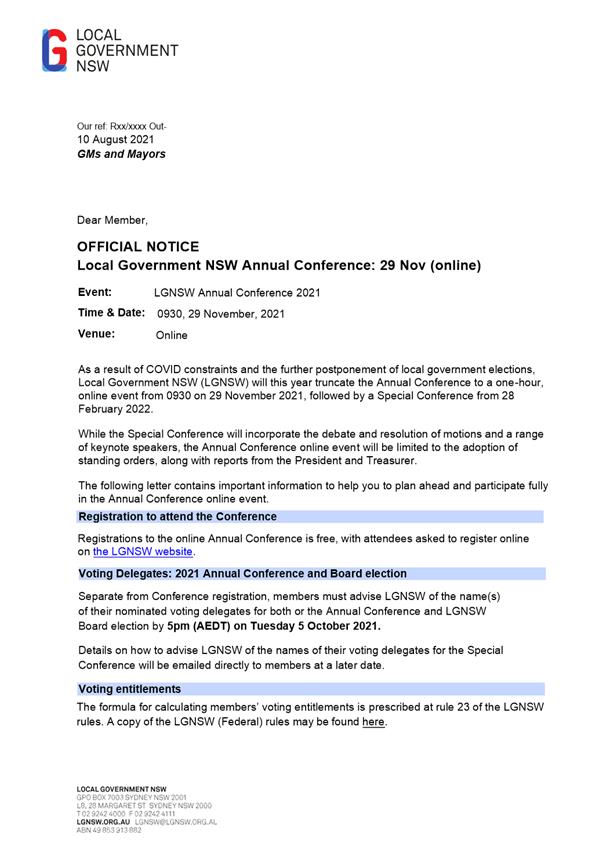
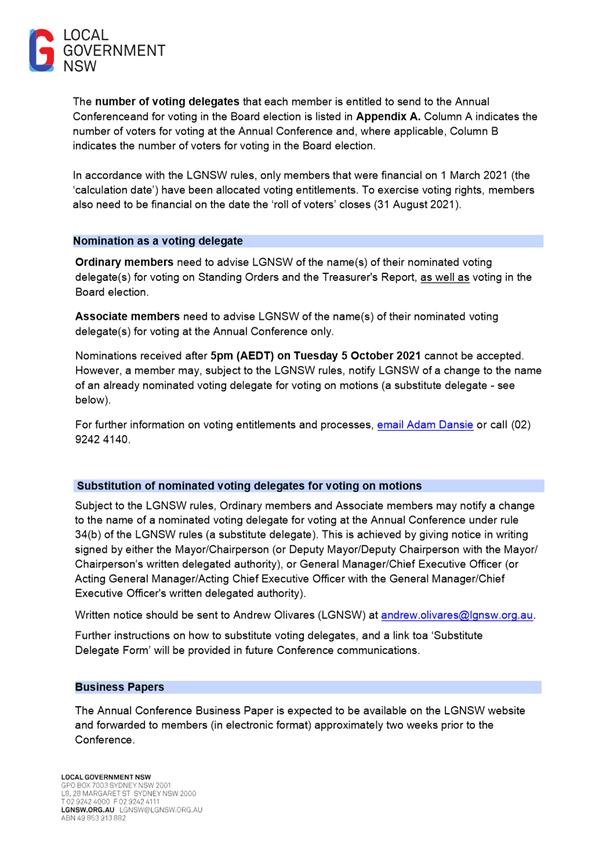
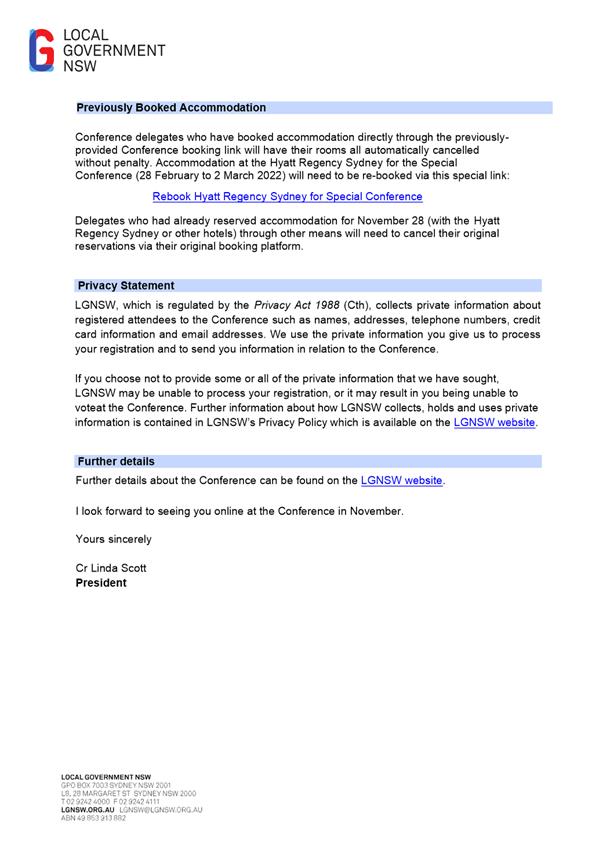
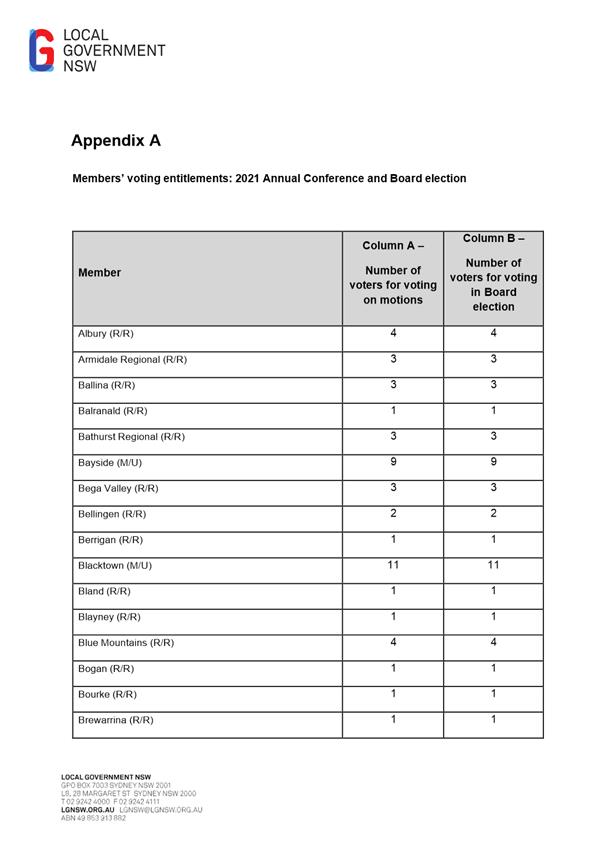
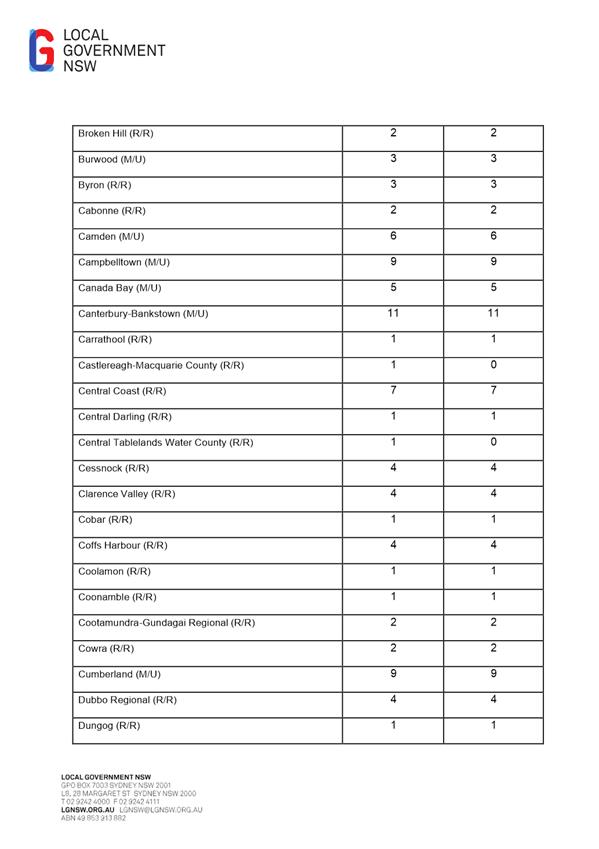
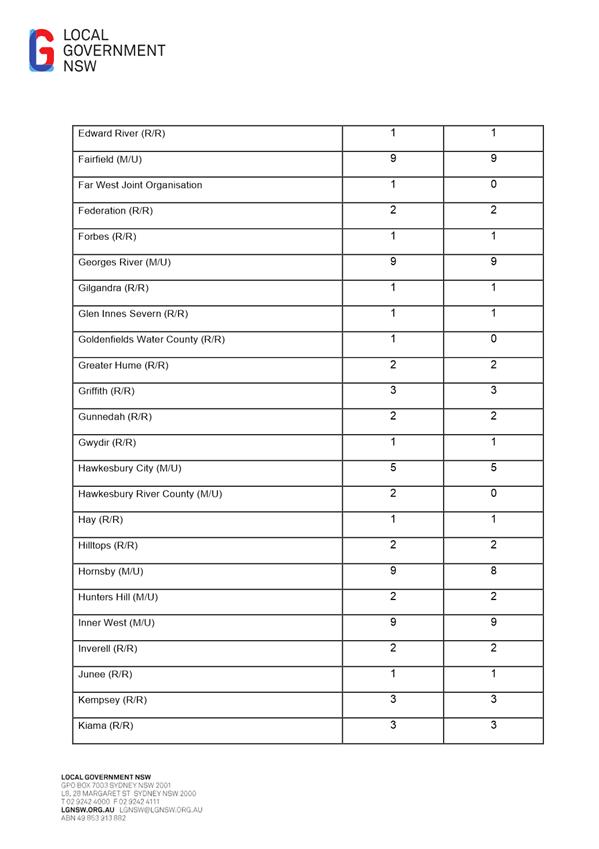
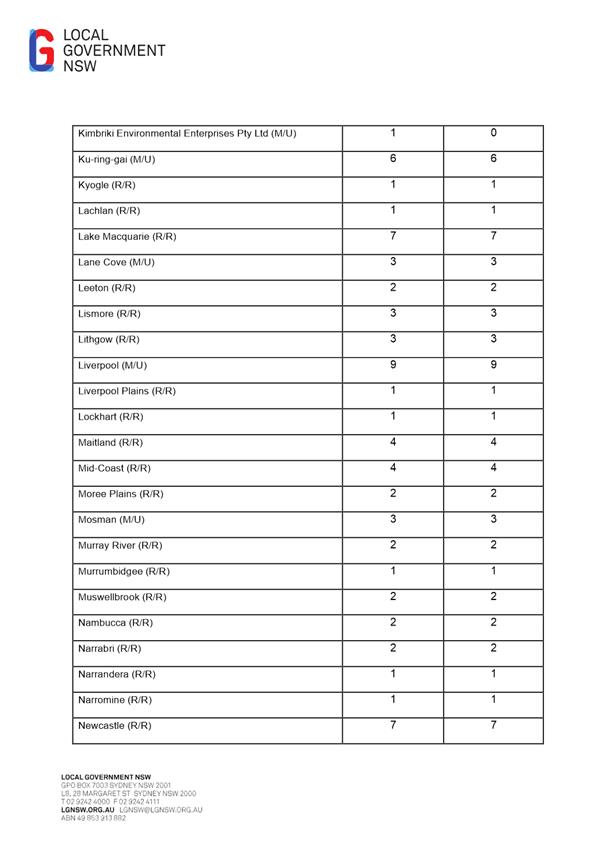
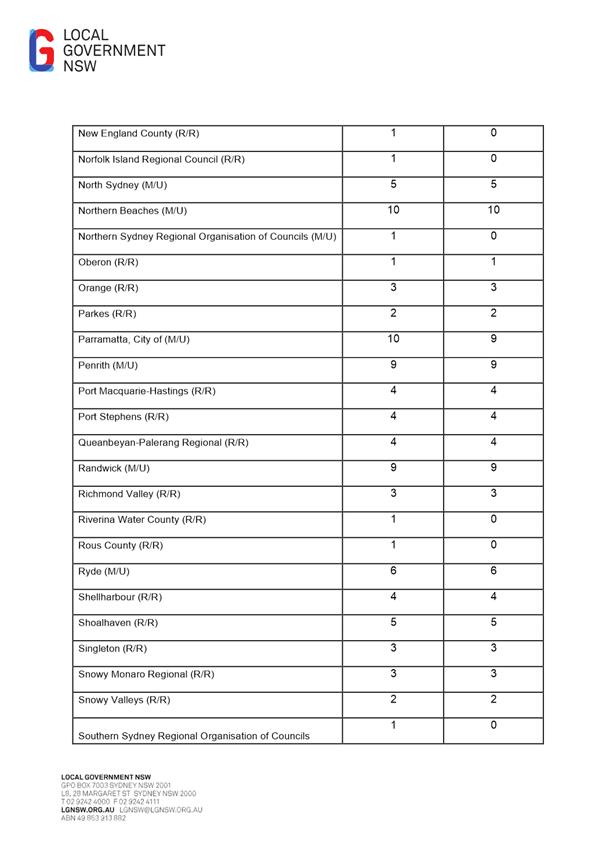
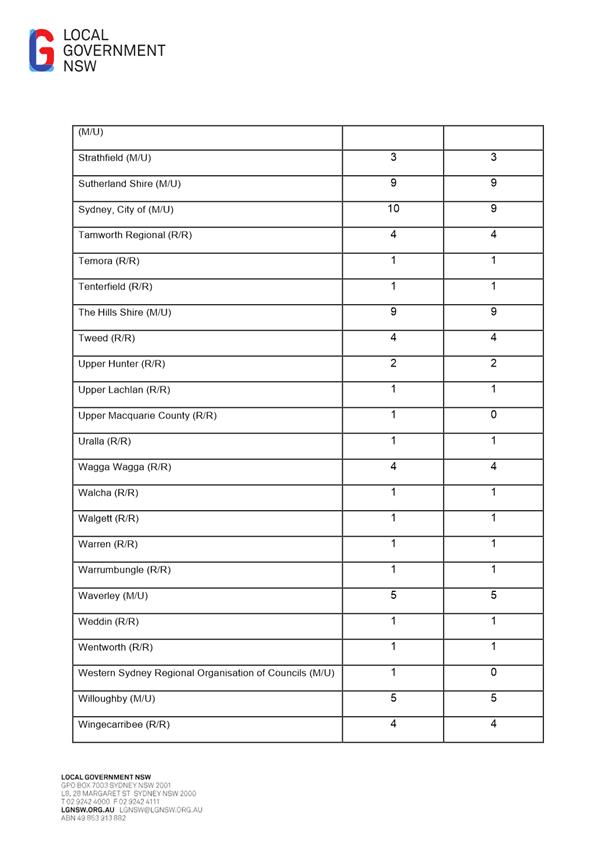
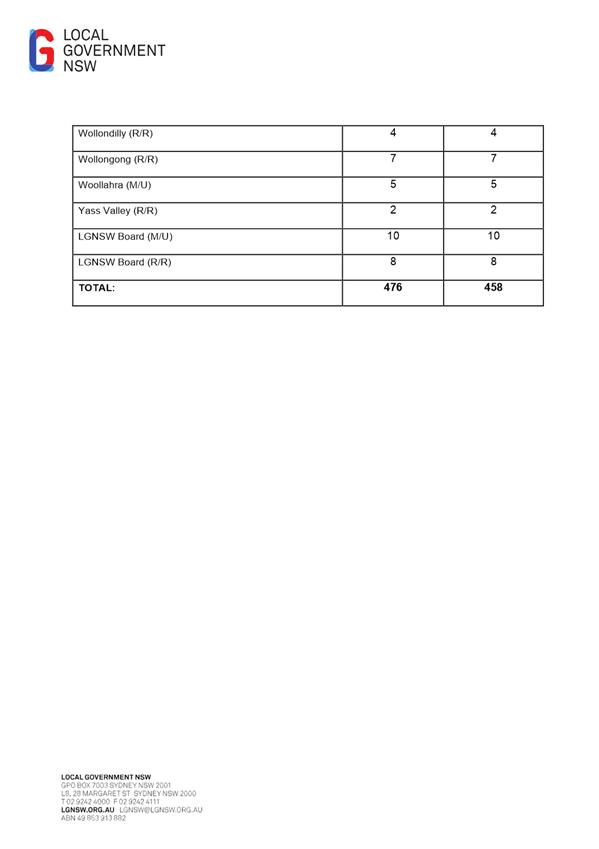
|
|
Ordinary
Meeting – Tuesday 25 January 2022
Page
0
|
CL22.10 LGNSW
Water Management Conference 2022
HPERM Ref: D22/12850
Department: Business
Assurance & Risk
Approver: Kevin
Voegt, Director - City Performance
Reason for Report
To consider Councillor
attendance at the LGNSW Water Management Conference scheduled for Wednesday, 9
February 2022 to Friday, 11 February 2022 in Narrabri, NSW.
|
Recommendation
That Council
1. Notes the details of the LGNSW Water
Management Conference 2022 scheduled for 9 to 11 February 2022 in Narrabri,
NSW.
2. Authorises available Councillors to
attend the conference and such attendance be deemed Council Business.
3. Travel, registration fees,
accommodation and all reasonable out-of-pocket expenses be met in accordance
with its adopted policy.
4. Request Councillors attending the
conference to provide a written report within 30 days of returning from the
conference.
|
Options
1. As per the
recommendation.
2. That Council
limit the number of Councillors attending the Conference to a number the
Council considers suitable and such attendance be deemed Council Business.
3. That Council not
approve Councillor attendance at the Conference as Council Business.
Background
The LGNSW Water Management
Conference 2022 is considered relevant to Local Government and information in
relation to the conference can be found on the LGNSW
website.
Costs associated with the
conference are estimated as follows:
· Registration: $720.00
· Travel,
accommodation and out of pocket expenses: not yet determined.
An option available to Council
is to define the number of Councillors attending the conference and for Council
to determine the appropriate Councillors authorised to attend.
The
Conference commences at 3.00pm Wednesday, 9 February 2022 and concludes at 3.30pm
Friday, 11 February 2022.
Council meetings during this
time have not yet been determined and will be set in accordance with what is
resolved at the Ordinary Meeting on Tuesday 25 January 2022.
Policy Implications
The Council Members – Payment of Expenses and
Provision of Facilities Policy limits attendance at conferences to three per
annum per Councillor, exclusive of any conference arranged by either the State
or National Local Government Associations. This conference is organised by
Local Government NSW.
Financial Implications:
Funds are available for
Councillors to attend this conference.
|
|
Ordinary
Meeting – Tuesday 25 January 2022
Page
0
|
CL22.11 Variations
to Development Standards - December Quarter 2021
HPERM Ref: D21/540189
Department: Development
Services
Approver: Phil
Costello, Director - City Development
Reason for Report
This report is being submitted
directly to the Ordinary Meeting due to therequirement that the information
contained in the report is to be reported to the full elected Council and to
the Department of Planning, Industry and Environment.
Council is required to consider
variations to development standards (contained in an environmental planning
instrument such as the Shoalhaven Local Environmental Plan) which exceed 10%,
with lesser variations able to be dealt with by staff, under delegation.
Council is also required to publish the variations in
addition to reporting the variations to the full Council and the Department of
Planning, Industry and Environment.
|
Recommendation
That
Council receive the Variations to Development Standards – June Quarter
Report 2021 for information.
|
Options
1. Receive the
report for information.
Implications: Council will be complying with the
reporting provisions as detailed in Circular PS20-002 Variations to
development standards.
2. Resolve an
alternative and provide details to staff.
Implications: Depending on what is resolved, the
Council would need to ensure compliance observing that the Department
undertakes periodic audits.
Background
SEPP 1 and clause 4.6 have allowed flexibility in the
application of development standards by allowing the consideration of
development proposals that meet the objective of a development standard but not
its stated value.
On 5 May 2020, the Department of Planning, Industry and
Environment issued a new circular (PS20-002) which replaced PS18-003 and issued
assumed concurrence, governance, and reporting requirements for consent
authorities. It also advised that Council reports are to come through the
Planning Portal and the repeal of SEPP 1. The concurrence is conditional
(for example, variations exceeding 10% which must be reported to Council, staff
cannot exercise delegations).
A link to the circular can be found here.
Procedural and reporting requirements
To ensure transparency and integrity in the planning
framework, the Department requires monitoring and reporting measures.
· A written application must be made to support a variation.
· An online register of all variations to be maintained.
· A report must be submitted through the Portal.
· A report of all variations from a Council must be provided
to a meeting of the Council at least once a quarter.
Audit
The Department will continue to
carry out random audits to ensure the above monitoring and reporting measures
are complied with. The Department and the NSW Independent Commission Against
Corruption will continue to review and refine the audit strategy.
It is noted that the application
has been the subject of ICAC investigations (amongst other things) referred to
as Operation Dasha. More information is available here. The Department is currently reviewing the
application of clause 4.6.
Should ongoing non-compliance
be identified with one or more consent authorities, the Secretary is able to
consider revoking the notice allowing concurrence to be assumed, either
generally for a consent authority or for a specific type of development.
Conclusion
The repeal of SEPP 1 came into
effect from 1 February 2020 as part of the SEPP Review Program to update and
simplify the NSW Planning system.
The variations are provided to
the Department in the form of a spreadsheet and are published as soon as
possible after the quarter has ended.
The table below is based on the
spreadsheet but is simplified for easier reading. The spreadsheets are viewable
on Council’s webpage and are published quarterly as soon as possible
after the last day of the month.
1. Table – Variations December
Quarter 2021
|
DA
|
Lot
|
DP
|
Street Name
|
Suburb
|
Post Code
|
Description
|
Standard Varied
|
Extent of Variation
|
Decision
|
Date
|
|
DA21/1673
|
1
|
21597
|
St Vincent
Street
|
Ulladulla
|
2538
|
“Residential
Other” (Mixed use – commercial and residential flats (24)
& car parking
|
Height
|
6.4%
|
Approval
|
01/11/2021
|
|
DA21/1962
|
11
|
22226
|
Haiser Rd
|
Greenwell
Point
|
2540
|
Alterations and additions to a
dwelling
|
Height
|
9.61%
|
Approval
|
23/12/2021
|
|
|
Ordinary
Meeting – Tuesday 25 January 2022
Page
0
|
Local Government Amendment (governance &
planning) act 2016
Chapter
3, Section 8A Guiding principles for councils
(1)
Exercise of functions
generally
The
following general principles apply to the exercise of functions by councils:
(a) Councils should provide strong
and effective representation, leadership, planning and decision-making.
(b) Councils should carry out
functions in a way that provides the best possible value for residents and
ratepayers.
(c) Councils should plan
strategically, using the integrated planning and reporting framework, for the
provision of effective and efficient services and regulation to meet the
diverse needs of the local community.
(d) Councils should apply the
integrated planning and reporting framework in carrying out their functions so
as to achieve desired outcomes and continuous improvements.
(e) Councils should work
co-operatively with other councils and the State government to achieve desired
outcomes for the local community.
(f) Councils should manage
lands and other assets so that current and future local community needs can be
met in an affordable way.
(g) Councils should work with
others to secure appropriate services for local community needs.
(h) Councils should act fairly,
ethically and without bias in the interests of the local community.
(i) Councils should be
responsible employers and provide a consultative and supportive working
environment for staff.
(2) Decision-making
The
following principles apply to decision-making by councils (subject to any other
applicable law):
(a) Councils should recognise
diverse local community needs and interests.
(b) Councils should consider social
justice principles.
(c) Councils should consider the
long term and cumulative effects of actions on future generations.
(d) Councils should consider the
principles of ecologically sustainable development.
(e) Council decision-making should
be transparent and decision-makers are to be accountable for decisions and
omissions.
(3) Community participation
Councils
should actively engage with their local communities, through the use of the
integrated planning and reporting framework and other measures.
Chapter
3, Section 8B Principles of sound financial management
The
following principles of sound financial management apply to councils:
(a) Council spending should be responsible and sustainable,
aligning general revenue and expenses.
(b) Councils should invest in responsible and
sustainable infrastructure for the benefit of the local community.
(c) Councils should have effective financial
and asset management, including sound policies and processes for the following:
(i) performance management
and reporting,
(ii) asset maintenance and
enhancement,
(iii) funding decisions,
(iv) risk management practices.
(d) Councils should have regard to achieving
intergenerational equity, including ensuring the following:
(i) policy decisions are made
after considering their financial effects on future generations,
(ii) the
current generation funds the cost of its services
Chapter
3, 8C Integrated planning and reporting principles that apply to councils
The
following principles for strategic planning apply to the development of the
integrated planning and reporting framework by councils:
(a) Councils should identify and prioritise key
local community needs and aspirations and consider regional priorities.
(b) Councils should identify strategic goals to
meet those needs and aspirations.
(c) Councils should develop activities, and
prioritise actions, to work towards the strategic goals.
(d) Councils should ensure that the strategic
goals and activities to work towards them may be achieved within council
resources.
(e) Councils should regularly review and
evaluate progress towards achieving strategic goals.
(f) Councils should maintain an
integrated approach to planning, delivering, monitoring and reporting on
strategic goals.
(g) Councils should collaborate with others to
maximise achievement of strategic goals.
(h) Councils should manage risks to the local
community or area or to the council effectively and proactively.
(i) Councils should make appropriate
evidence-based adaptations to meet changing needs and circumstances.